Poly Netting vs Wire Poultry Netting: Which One Should You Buy?
Lightweight poly netting and wire poultry netting compared for chicken runs: flexibility, strength, mesh size and predator defense, with figures from the listings.

On this page
Top picks at a glance
As an Amazon Associate I earn from qualifying purchases.
- 1
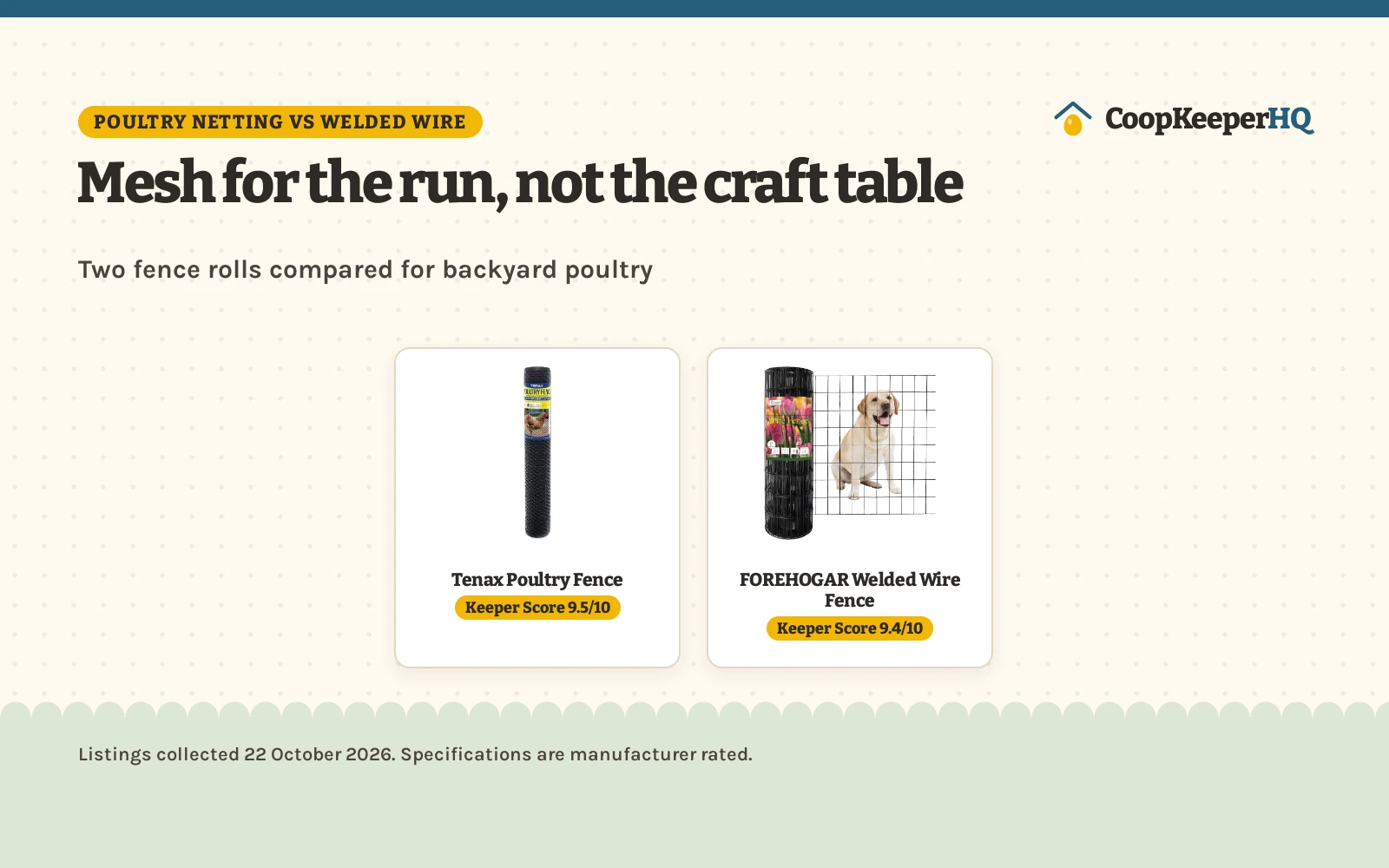
 Tenax Poultry Fence9.5/10View on Amazon
- 2
 BSTPCOO Bird Netting for Chicken CoopView on Amazon
- 3
 Poultry Netting Electric FenceView on Amazon
- 4
 PVC Hexagonal Poultry Netting Chicken Wire 12" x25' x 1" MeshView on Amazon
- 5
 HOSTIC 4FTx150FT Chicken Wire NettingView on Amazon
- 6
 Black Plastic Chicken Wire 16in x 10ftView on Amazon
- 7
 DQS Bird Netting 100’ x 100’with 1" MeshView on Amazon
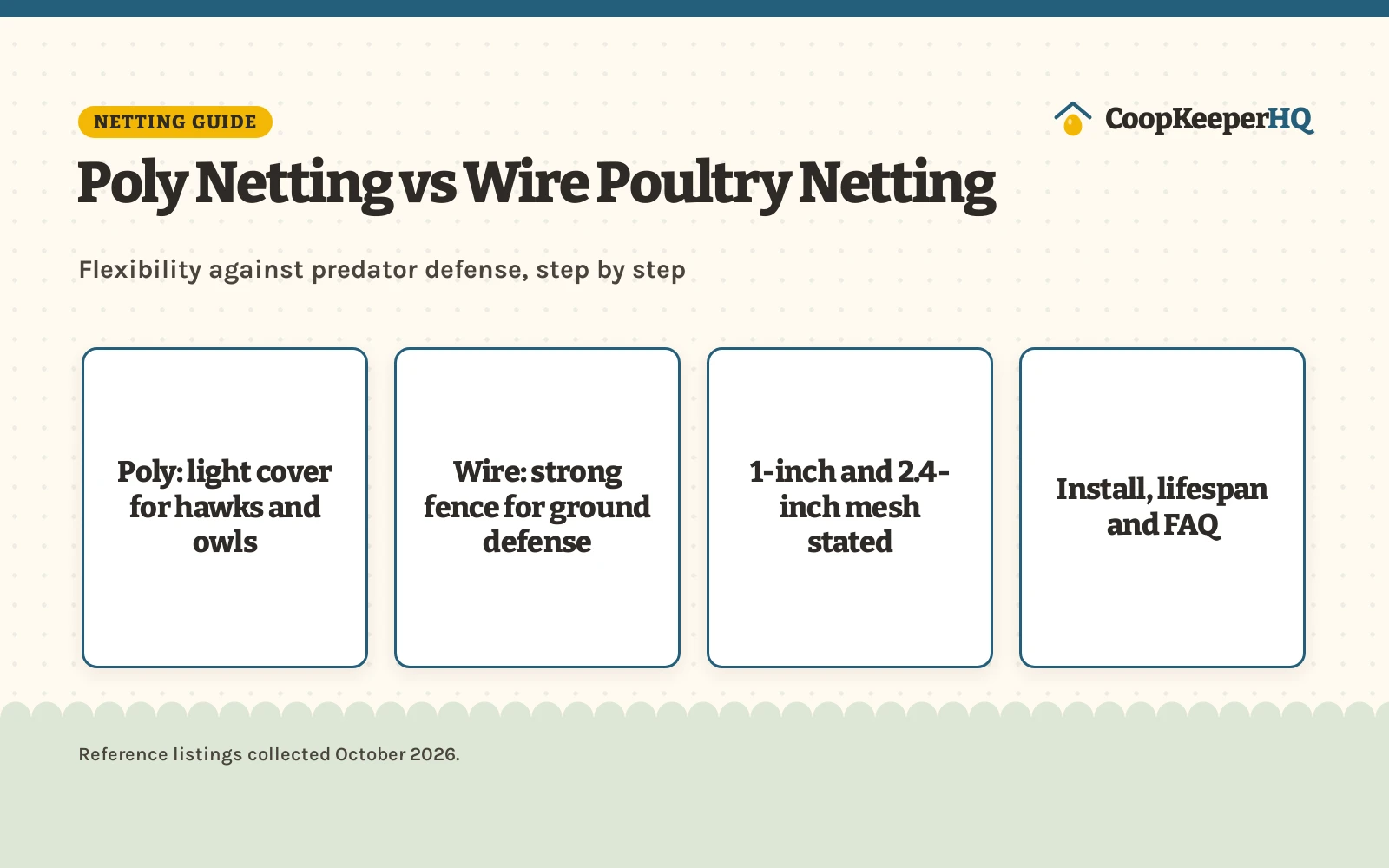
A hawk circling the yard settles the question fast: the run needs a cover, and the choice comes down to poly netting vs wire poultry netting. The direct answer is that poly netting is the light, flexible cover for keeping birds of prey out of the run, while wire poultry netting is the stronger, longer-lasting fence for walls and ground-level defense. This guide compares the two step by step, with figures from the netting listings.
Other options for the coop
 BSTPCOO Bird Netting for Chicken CoopCheck price on Amazon
 Poultry Netting Electric FenceCheck price on Amazon
 PVC Hexagonal Poultry Netting Chicken Wire 12" x25' x 1" MeshCheck price on Amazon
 HOSTIC 4FTx150FT Chicken Wire NettingCheck price on Amazon
 Black Plastic Chicken Wire 16in x 10ftCheck price on Amazon
 DQS Bird Netting 100’ x 100’with 1" MeshCheck price on Amazon
CoopKeeperHQ earns a commission if you buy through our links, at no added cost to you. Affiliate disclosure.
Poly netting vs wire poultry netting: the short version
Poly netting is plastic mesh, sold in big lightweight rolls for covering runs, garden beds and fruit trees. Wire poultry netting is metal mesh, heavier and stiffer, used for run walls and fences. Both keep chickens in; they differ in what they keep out and how long they last.
| Topic | Poly netting | Wire poultry netting |
|---|---|---|
| Material | Nylon or HDPE plastic (listings state both) | Metal wire (no wire listings in the reference set) |
| Mesh sizes stated | 1 inch and 2.4 inch | Not stated |
| Roll sizes stated | 25 by 50 ft, 25 by 100 ft, 50 by 50 ft | Not stated |
| Weight and handling | Light; cut with scissors, fasten with cable ties | Heavier; needs posts and fasteners |
| Best job | Run covers against hawks and owls | Walls and ground-level defense against chewing predators |
| Weakness | Chewing predators can get through it | Heavier to install, harder to reposition |
What poly netting is
The listings describe two plastics. The BSTPCOO netting is nylon multifilament, 25 by 50 feet with 2.4-inch square mesh, UV-proof per the listing, and it ships with 50 cable ties and 8 stakes. The listing says it cuts to size with scissors without fraying. One data wrinkle: the BSTPCOO title and bullets state 2.4-inch mesh while its spec table says 3/4-inch; the title and bullets win under the site’s rules, so treat it as 2.4-inch mesh.
The POYEE and Vocray nettings are HDPE with 1-inch mesh. The POYEE listing states a 25 by 100 foot roll at 30g per square meter, which it compares with typical market netting at 6 to 9g per square meter, and describes it as UV-resistant and rot-resistant. The Vocray listing states a 50 by 50 foot roll, woven HDPE weighing 0.6 oz per meter that can support over 100 pounds, resistant to cold and heat changes. Both makers describe their netting as reusable across seasons.
What wire poultry netting is
Wire poultry netting is metal mesh sold in rolls for fences and run walls. No wire listings sit in the reference set, so no figures are given here. In general terms, wire is stiffer and heavier than poly, holds its shape on a fence line, and resists chewing far better than plastic. It takes more work to install: posts or a frame, and staples or clips to fix it. Where poly is a cover you drape and tie, wire is a fence you build.
Predator defense: where each one holds
Match the material to the predator. Hawks and owls hunt from above, and a poly cover over the run stops them; the POYEE and Vocray listings name hawks, owls, foxes and raccoons as the targets of their 1-inch mesh, while the BSTPCOO listing names birds, hawks and squirrels for its 2.4-inch mesh. Those raccoon and fox claims are the makers’: read the chewing-predator caveat below before trusting them. Smaller mesh keeps out smaller animals: the Vocray listing notes that 1-inch mesh helps against rabbits and mice where 2.4-inch mesh does not.
At ground level the calculus changes. Raccoons, foxes, dogs and rats chew, claw and push, and plastic mesh is not the tool for stopping them. For run walls, aprons and anything a predator can reach with teeth, wire mesh or hardware cloth is the answer. Many keepers use both: poly over the top against hawks, wire around the sides against everything else. Our how to predator proof a chicken coop guide walks through the full setup, and the poultry netting for roof picks compare cover options.
Installation and handling
Poly netting wins on ease. It is light enough to drape over a run frame, cut with scissors and fasten with the included cable ties or zip ties; the BSTPCOO listing includes 50 cable ties and 8 stakes, and the Vocray listing suggests zip ties to trees or fences. Stretch it evenly: both the BSTPCOO and Vocray listings warn that overstretching one side distorts the mesh and changes the dimensions, which is normal for diamond and square mesh, not a defect. The Vocray listing gives a useful rule: choose a net 1.5 times larger than your estimate if you are unsure of the size.
Wire netting takes more planning. It needs a frame or posts, it is cut with wire cutters rather than scissors, and it holds its shape once fixed, which is a strength on walls and a hassle overhead. For a permanent run, that stiffness is exactly what you want; for a temporary cover or a seasonal garden bed, poly is the easier pick. See the hardware cloth vs chicken wire comparison for the wire side of the family.
How long each lasts
The poly listings lean on UV resistance and reusability: nylon and HDPE that the makers describe as UV-proof or UV-resistant, rot-resistant and reusable season after season. Those are the makers’ claims, and sun exposure is still what wears plastic out quickest, so take a net down for winter if the run does not need it. Wire outlasts plastic in the open, at the cost of rust where coatings fail; it is the fit-and-forget choice for permanent fencing. Either way, walk the run each season and check for holes, sagging and loose fasteners.
Birds, breed size, run time and climate in; coop floor, run space, roost length and nesting boxes out.
Use a charger rated for the length of netting you run, ground it as the manual describes and post warning signs where neighbors or children can reach the fence. Keep grass and weeds off the bottom strands, and never leave netting unpowered, because birds and wildlife can tangle in it. Read our Safety Disclaimer.
FAQ for the flock
Will poly netting keep raccoons out?
Not reliably. The POYEE and Vocray listings name raccoons as targets, but that is the makers’ claim: raccoons chew through plastic, so treat poly as a cover against birds of prey only. Use wire mesh or hardware cloth for walls and ground-level defense, and keep poly for the roof.
What mesh size should a run cover be?
The listings state 1-inch and 2.4-inch mesh. The 1-inch mesh on the POYEE and Vocray nettings keeps out smaller animals like rabbits and mice; the 2.4-inch BSTPCOO mesh targets birds and hawks. Smaller mesh means broader protection.
Can I cut poly netting to size?
Yes. The BSTPCOO listing states it cuts with scissors without fraying, and the Vocray listing says it cuts to any size needed. Measure the run, then follow the Vocray tip and buy 1.5 times your estimate if unsure.
How do I keep the net from sagging?
Stretch it evenly across the frame and fasten at many points with cable ties or zip ties. The Vocray listing states its netting can support over 100 pounds, but even stretching matters more than strength: overstretching one side distorts the mesh.
Does poly netting survive winter?
The HDPE listings describe resistance to cold and heat changes, UV rays and rain, and reuse across seasons. Those are the makers’ claims. In harsh winters, taking the net down when the run is empty extends its life.
More coop guides
- Poultry Netting for Roof: 5 Aerial Predator Run Covers Compared (2026)
- Best Hardware Cloth (2026): Welded Wire Rolls for Predator Protection
- How to Predator Proof a Chicken Coop and Run
- Hardware Cloth vs Chicken Wire: Which Keeps Predators Out?
See the chicken runs and fencing guides and the predator protection section for the rest of the setup.