Quail Coop Size: Space Requirements and Setup Guide
Floor space guidelines, height recommendations, cage dimensions and shelter setups for housing a healthy backyard quail flock.

On this page
Top picks at a glance
As an Amazon Associate I earn from qualifying purchases.
- 1
 GOJOOASIS Wooden Chicken Coop Rabbit Hutch for 2 Hens9.3/10View on Amazon
- 2
 AMZOSS 2-Story Solid Wood Rabbit Hutch with Ventilation Door9.3/10View on Amazon
Quail coop size depends on flock count and bird variety, with manufacturer specifications from Hatching Time allotting 11.8 x 17.3 in of floor space for 5 standard quail or 3 larger birds. In their 2-section setup, Hatching Time expands floor area to 23.8 x 17.3 in for up to 10 standard quail, while outdoor runs from PawHut provide nearly 43 ft² for coveys to forage on the ground. Giving birds sufficient room to feed, drink and rest prevents behavioral issues and keeps the covey healthy.
Other options for the coop
 Aivituvin Chicken Coop for 2 ChickensCheck price on Amazon
 Trixie Natura Duck CoopCheck price on Amazon
 GDLF Wooden Quail Cage IndoorCheck price on Amazon
 Hatching Time Quail and Pigeon Transport CoopCheck price on Amazon
 PVC Pipe Chicken Feeder No Waste for Coop Hanging PoultryCheck price on Amazon
 AIVITUVIN Chicken Coop for 2 Chickens Home Ues Outdoor SmallCheck price on Amazon
CoopKeeperHQ earns a commission if you buy through our links, at no added cost to you. Affiliate disclosure.
Quail coop size: floor space per bird
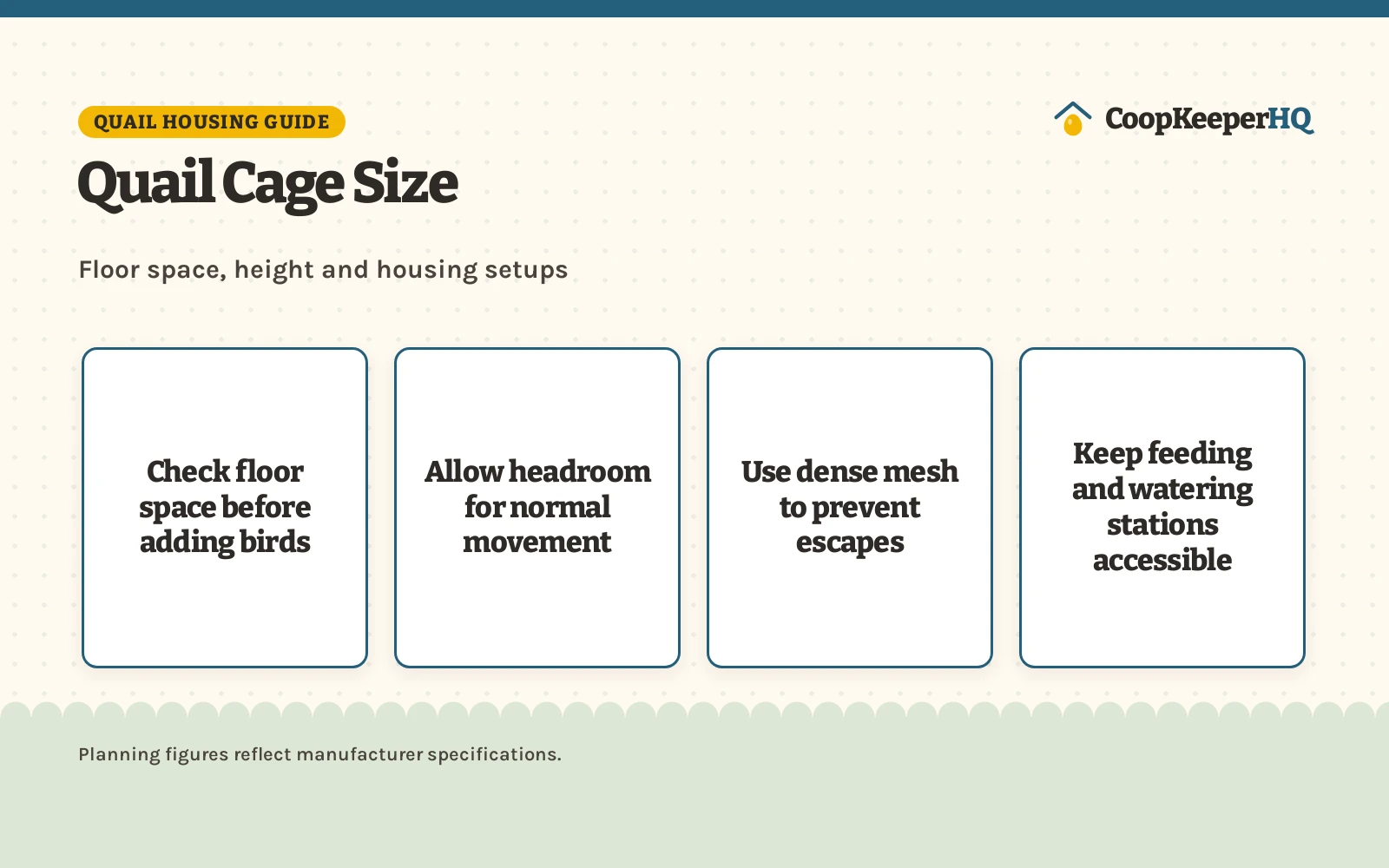
Adequate floor space prevents feather pecking, stress and reduced egg laying. Coturnix quail need dedicated room to walk, forage and rest without jostling cage mates, with heavier jumbo strains needing extra floor allowance. Calculate space based strictly on usable floor area rather than total exterior footprint.
Indoor breeding cages use compact layouts. For example, Hatching Time lists 11.8 x 17.3 in of floor space for 5 standard quail (or 3 larger birds) in an individual section, expanding to 23.8 x 17.3 in across 2 sections for up to 10 standard quail. While compact wire cages suit controlled breeding with roll-out egg trays, floor pens on bedding require significantly more open area per bird to prevent soiled litter.
Maintain fresh airflow and ventilation
Quail droppings release ammonia quickly, making continuous airflow essential. Proper coop sizing requires open ventilation to draw moisture and stale air away from floor level without creating direct drafts on resting birds.
Position vents high on walls above bird height. Wire mesh panels provide generous airflow in outdoor pens, while solid partitions block prevailing winter winds. If bedding feels damp or odors linger, expand venting immediately.
Choose suitable flooring and bedding
Flooring affects cleaning frequency and usable space. Enclosed wire cages, like Hatching Time models, use sloped wire floors that roll eggs forward while dropping manure into removable pans below. Wire must support small feet comfortably without causing injuries.
Solid-floor coops require absorbent bedding like dry pine shavings or hemp to absorb moisture and insulate birds. In wooden shelters like the GOJOOASIS A-frame coop (on Amazon) (measuring 47 x 18 x 19.5 inches with 2 doors), maintain deep, dry shavings across the floor and spot clean damp patches regularly.
Plan ceiling height and overhead safety
Startled quail flush straight upward with explosive force. In pens with intermediate ceiling heights, birds strike hard roofs with enough velocity to cause severe head injuries.
Plan for restricted low ceilings or tall walk-in heights. Compact setups, like Hatching Time cages with an assembled exterior height of 18.1 in H (overall 11.8 x 24 x 18.1 in or 23.8 in L x 24 in W x 18.1 in H), restrict headspace so flushing birds cannot build dangerous speed. Conversely, walk-in runs like the PawHut enclosure standing 73″H let birds flutter upward and decelerate safely. Pens of intermediate height require soft ceiling netting to cushion impacts.
Position feeders and drinkers efficiently
Interior dishes clutter walking space and invite feed contamination. Exterior hanging dispensers keep feed clean and leave open floor area for the flock.
Mounting external hardware saves space. CluckRoots offers an outside-hanging metal feeder holding 4 pounds of feed with 3 x 1.5” ports to prevent scratching. For hydration, the HAEZU gravity waterer (on Amazon) holds 16.6 fl oz (500ml), rated for 10-15 button quails for up to 3 days with an anti-drowning shallow tray. Compact options like the Orelaventino 2-in-1 feeder (on Amazon) and waterer (5.3 x 4.7 x 6.2 inches with 250ml water and 300g feed capacity) minimize footprint inside smaller pens.
Indoor breeding cages versus outdoor pens
Housing choices dictate sizing and protection. Indoor cages inside sheds or garages protect birds from severe weather and wild predators. Stacked systems like Hatching Time units or PawHut hutches (53.75″ L x 19.75″ W x 36.5″ H across 2 levels with 4 doors) maximize flock density in small footprints, provided any general hutch wire is lined with fine mesh.
Outdoor runs give birds fresh air and foraging room. PawHut walk-in runs provide nearly 43 ft² of space with an access door measuring 21.3″ W x 60.2″ H. Because quail do not use raised chicken perches or high nest boxes, adapt walk-in runs with ground-level shelter, shade and rain panels. Compare setups in our best quail coop guide.
Predator protection and wire mesh sizing
Quail attract raccoons, snakes, rats and cats. Standard hexagonal chicken wire is unsafe because predators reach through wide openings and quail can get heads caught.
Use sturdy galvanized hardware cloth with 1/2 in spacing for all perimeter fencing. While cage accessories like the CluckRoots feeder fit wire mesh of 1/2″ x 1/2″ or 1/2″ x 1″ for port mounting, open pen walls need tight 1/2 in wire cloth. Extend wire aprons outward on the ground to block digging predators, as detailed in our hardware cloth guide.
Plan for easy cleaning and tray access
Accessible doors make routine cleaning manageable. Pull-out waste trays allow keepers to slide manure pans out without reaching inside the cage or disturbing birds.
Designs like the AMZOSS 2-story hutch (on Amazon) (36 x 17.7 x 33.5 inches with 3 doors) and Hatching Time cages include pull-out droppings trays beneath wire floors. For ground coops lacking trays, wide side doors or hinged roof lids allow keepers to shovel soiled bedding quickly.
Daily covey management routine
A steady daily routine prevents covey problems. Check water levels daily, keeping gravity cups clean. Replenish game bird crumble in feeders and confirm ports remain unblocked.
Collect eggs daily from collection trays or floor corners. Quail lay on floor bedding or roll-out trays rather than raised chicken boxes; store your harvest using our guide to egg cartons for small eggs. Watch for bullying or feather loss. If illness appears, consult a poultry veterinarian or state agricultural extension office.
A simple quail coop checklist
- Floor space matches covey size without crowding feeding and resting areas
- Air vents provide continuous cross-ventilation above bird height
- Ceiling is low enough to prevent flight injuries or tall enough for a walk-in setup
- Feeders and drinkers mount securely without cluttering walking space
- Perimeter wire mesh features narrow openings like 1/2 in spacing to bar predators
- Access doors and pull-out droppings trays allow rapid daily cleaning
For more shelter options and housing setups, see our best quail coop guide and browse budget quail coops for economical alternatives.
Birds, breed size, run time and climate in; coop floor, run space, roost length and nesting boxes out.
Wash your hands after handling birds, eggs or equipment, supervise children around the flock, and check local rules on flock size and roosters before you buy. For sick birds, call a poultry veterinarian or your state extension office. See CDC backyard poultry guidance. Read our Safety Disclaimer.
FAQ for the flock
How much space does a quail need in a coop?
Space depends on housing style. For compact indoor breeding cages, Hatching Time allots 11.8 x 17.3 in of floor space for 5 standard quail (or 3 larger birds) in an individual section, and 23.8 x 17.3 in across 2 sections for up to 10 standard quail. Outdoor ground pens on bedding require significantly more open floor space, with walk-in runs like PawHut offering nearly 43 ft² for coveys.
How tall should a quail coop be?
Keep ceilings low or full walk-in height to prevent flush injuries. Compact indoor cages like Hatching Time units (18.1 in H exterior) restrict interior headspace so birds cannot build dangerous flight momentum, whereas walk-in pens standing 73″H allow birds to flutter upward and decelerate safely.
Can you keep quail in a standard chicken coop?
Standard chicken coops require modifications for quail. Chicken wire gaps are large enough for quail to escape, and high perches go unused. Line open mesh with 1/2″ x 1/2″ wire cloth and add ground shelter partitions.
What size wire mesh is safe for a quail coop?
Galvanized 1/2″ x 1/2″ hardware cloth is the safest choice to block predators like raccoons, snakes and rats. While CluckRoots feeder fittings mount to cage wire with 1/2″ x 1/2″ or 1/2″ x 1″ spacing, pen exteriors need tight 1/2 in wire cloth. Wide 4-inch gaps on general livestock pens let quail escape entirely.
Do quail need roosts or nesting boxes in their coop?
Quail do not use elevated roosts or raised nest boxes. They rest on dry floor bedding or cage wire and lay eggs on the floor or into collection trays. Provide quiet, sheltered ground corners with dry shavings.
More coop guides
- Best Quail Coop: 5 Backyard Picks Compared (2026)
- Quail Coop Cheap: 5 Budget Picks for Backyard Flocks (2026)
- Best Hardware Cloth for Chicken Coop Runs and Aprons
See our quail and poultry section and the chicken coop guides.