Solar vs Electric Chicken Coop Door: Which One Should You Buy?
A practical guide comparing solar and electric chicken coop doors on wiring chores, winter reliability, predator protection and power options for backyard flocks.

On this page
Top picks at a glance
As an Amazon Associate I earn from qualifying purchases.
- 1
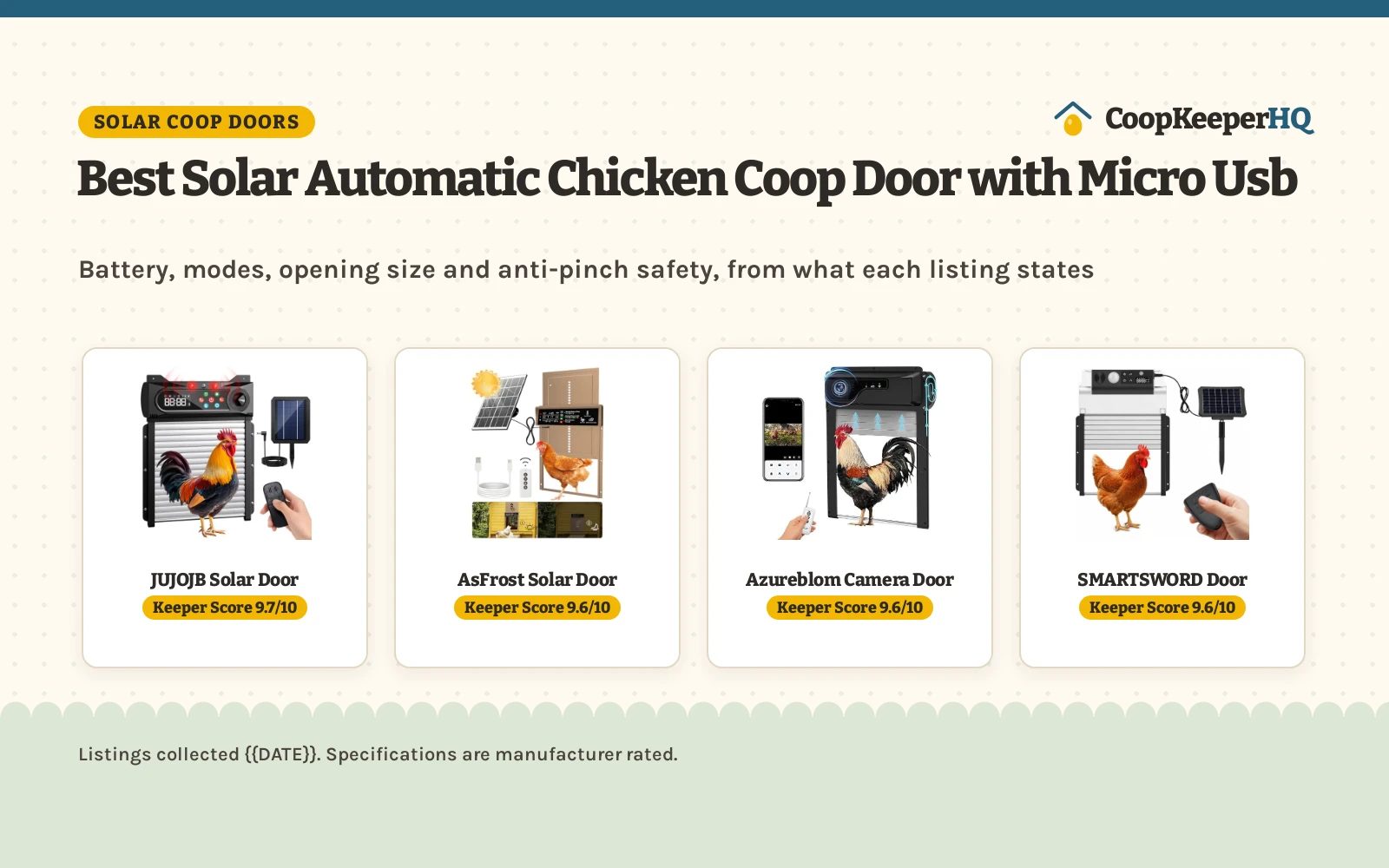
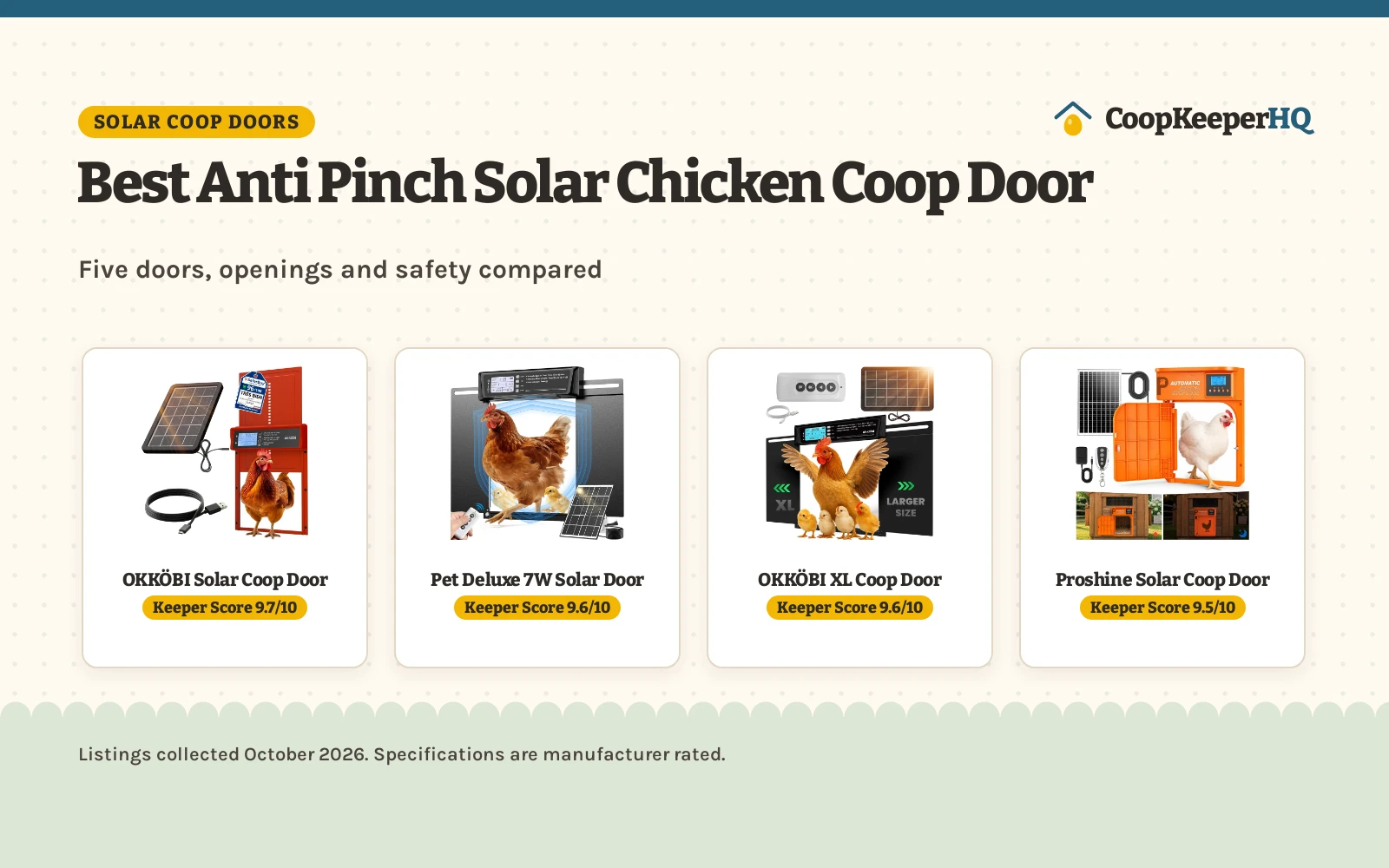
 Large Automatic Chicken Coop Door Solar Powered 4000mAh High9.7/10View on Amazon
- 2
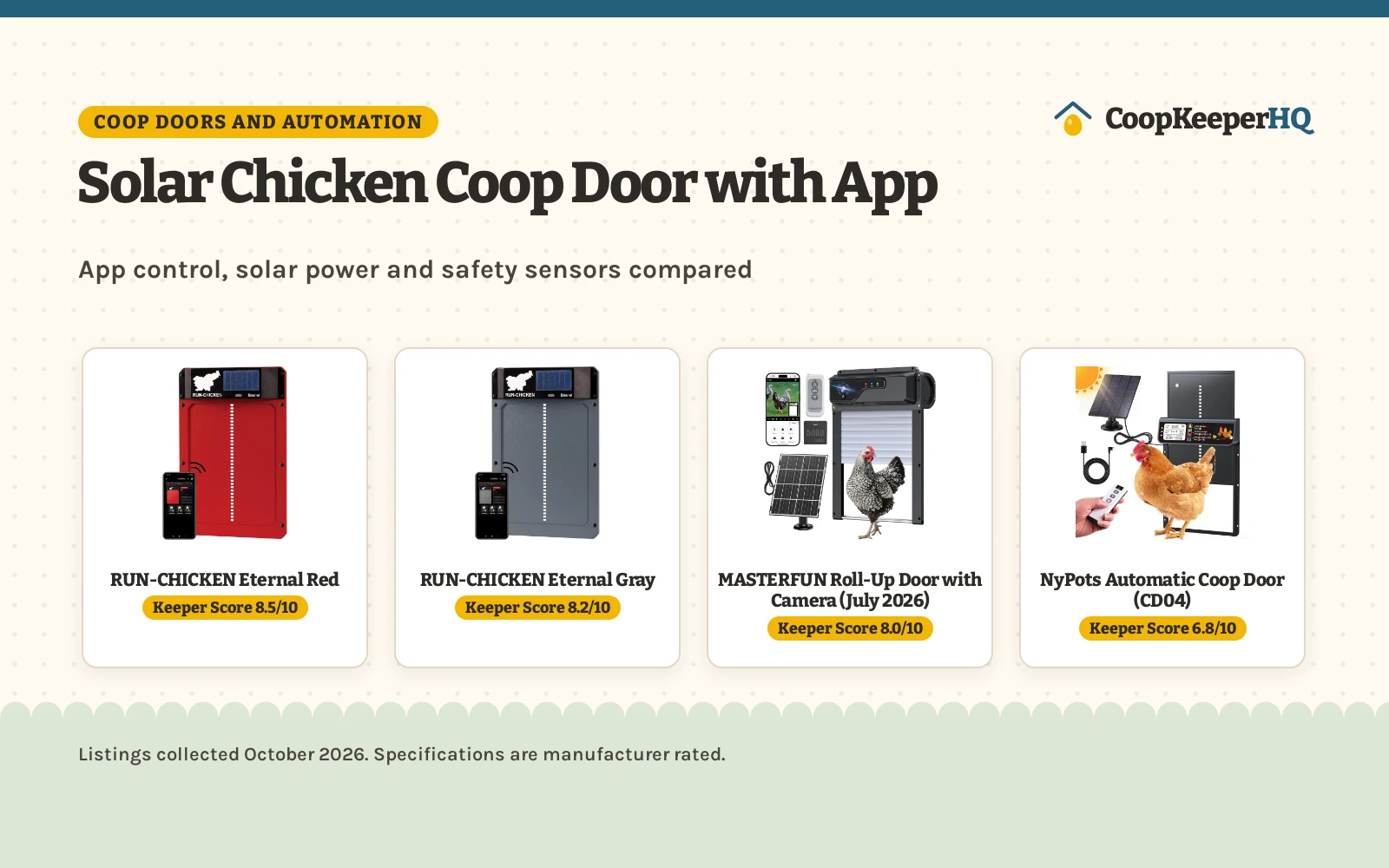
 RUN-CHICKEN Door Eternal9.7/10View on Amazon
- 3
 RUN-CHICKEN Door Eternal9.7/10View on Amazon
- 4
 Chicken Coop DoorView on Amazon
- 5
 AsFrost Automatic Chicken Coop DoorView on Amazon
- 6
 Automatic Chicken Coop Door: 3500mAh Solar PoweredView on Amazon
- 7
 Automatic Chicken Coop Door Solar Powered with TimerView on Amazon
- 8
 Solar Chicken Coop DoorView on Amazon
- 9
 Automatic Chicken Coop Door Solar Timer/Light Sensor PoweredView on Amazon
Heading out to the run at dawn in freezing boots or rushing home before dusk to lock up before raccoons arrive is a chore every chicken keeper knows well. If you are tired of being tied to the coop door morning and night, choosing between a solar vs electric chicken coop door comes down to your yard setup: a solar coop door is the better choice for almost every backyard flock because it runs independently on sunlight without stringing extension cords across the lawn, while a plug-in electric coop door only makes sense if you already have a weather-sealed outlet right at the coop wall. Both systems relieve you of daily lockup duties, but understanding how they gather energy, survive harsh winters, and protect your birds helps you pick the right setup.
Other options for the coop
 Chicken Coop DoorCheck price on Amazon
 AsFrost Automatic Chicken Coop DoorCheck price on Amazon
 Automatic Chicken Coop Door: 3500mAh Solar PoweredCheck price on Amazon
 Automatic Chicken Coop Door Solar Powered with TimerCheck price on Amazon
 Solar Chicken Coop DoorCheck price on Amazon
 Automatic Chicken Coop Door Solar Timer/Light Sensor PoweredCheck price on Amazon
CoopKeeperHQ earns a commission if you buy through our links, at no added cost to you. Affiliate disclosure.
Solar vs electric chicken coop door: how the power sources compare
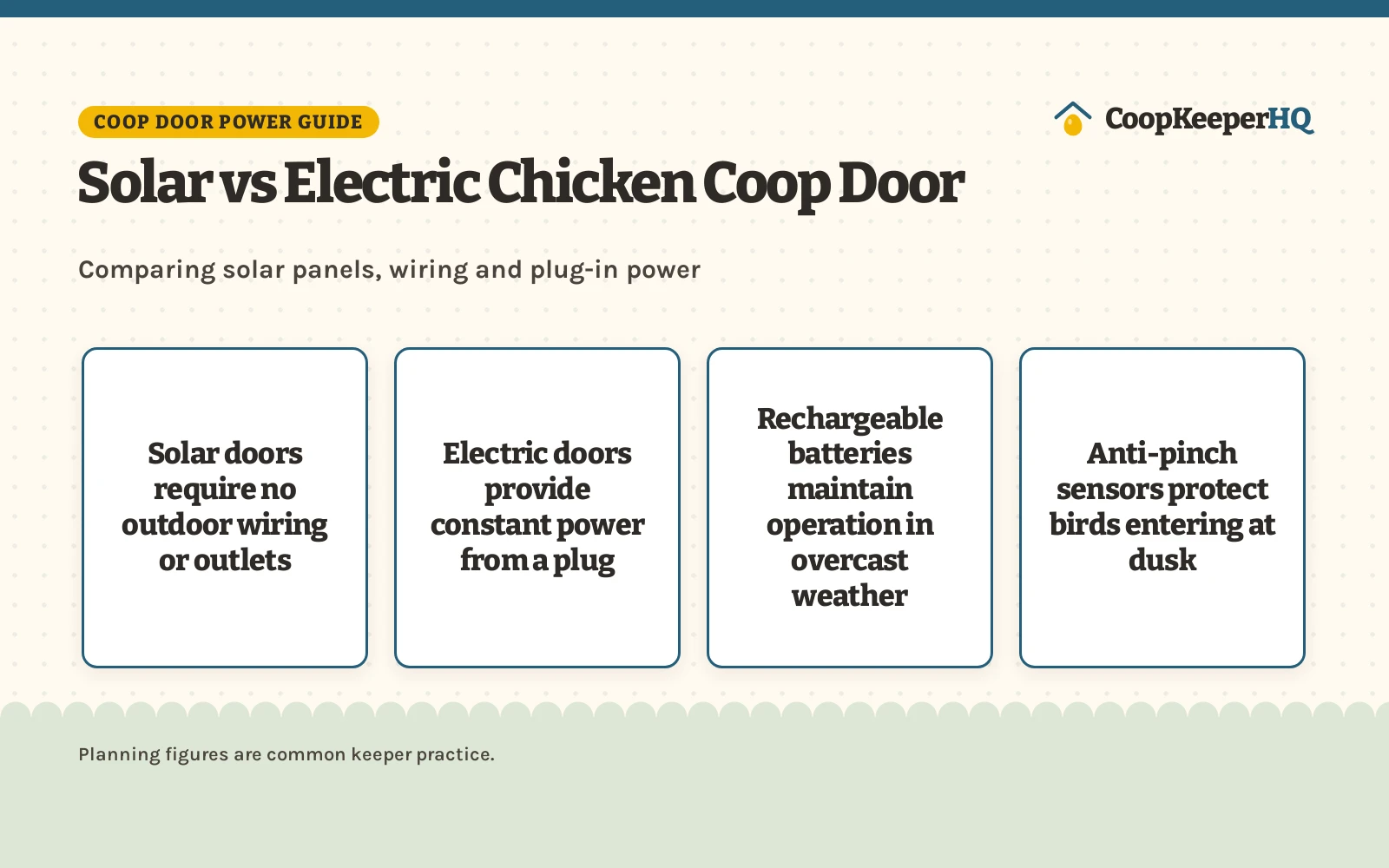
Automating your flock routine requires a motor to move the slider, and that motor must draw dependable energy every day. A solar powered chicken coop door uses a compact photovoltaic panel mounted on the coop roof or sunny siding to capture daylight and charge an internal battery. For example, the AsFrost listing states a 7W solar panel with a built-in 2000mAh battery, while the OKKÖBI listing states an internal battery of 2000mAh. This design operates off the power grid entirely. In contrast, an electric door connects to household alternating current through a power adapter and an outlet cord. That constant connection delivers uninterrupted power without relying on sunny weather, but it anchors your coop to the reach of your home electrical system. Unless your run borders a garage with an exterior plug, adding an electric model demands outdoor wiring chores that an automatic chicken coop door running on solar energy avoids completely.
Power reliability in cloudy weather and cold seasons
Keepers often wonder whether solar technology can survive dark winter months or weeks of rainy weather. Modern solar doors do not run directly on live sunshine; rather, the solar collector trickle-charges the onboard battery. When overcast skies linger, the internal reserve provides ample energy to keep the door cycling at sunrise and dusk. Manufacturers equip these doors with sizable energy banks: the Tephrotrak listing states a 3500mAh battery, and the Chickcozy listing specifies a 3200mAh battery. Freezing temperatures present a challenge for all outdoor gear, as winter chill slows battery chemistry. However, quality doors are engineered for severe winter climates: the Chickcozy listing states an operating range from -22°F to 131°F, the RUN-CHICKEN listing states operation from -15°F to 140°F, and the OKKÖBI listing states an operating range from -14°F to 140°F. If you manage a flock in an area with prolonged blizzards, a cold weather coop door powered by solar panels with USB auxiliary charging provides dependable service without grid dependence.
Installation chores and wiring requirements
The physical setup highlights the biggest practical difference between these power choices. Installing a solar coop door is a straightforward project requiring minimal carpentry. The Chickcozy listing states that setup takes just 6 screws, allowing you to secure the housing over your pop hole opening and position the solar panel where sunlight is unobstructed. Because no high-voltage electrical lines are involved, you do not need an electrician or conduit tools. A plug-in electric door, by comparison, requires a safe path from your household electrical panel to the coop. Running extension cords over the lawn creates serious hazards from mowers, foot traffic, and weathering. For coops placed far out in pastures or back corners of the yard, choosing a solar vs battery chicken coop door eliminates trenching labor entirely and lets you position your flock wherever foraging conditions are best.
Backup power and outage protection
Grid power is convenient until an unexpected outage occurs. Violent storms and winter ice frequently knock out residential utility power. If your coop door relies entirely on a standard wall plug without a battery backup, an outage leaves the mechanism completely paralyzed. If the power failure strikes while the flock is out foraging, the door remains wide open after sunset, inviting raccoons directly into the roosting area. Conversely, if an outage happens overnight, the door will not open at sunrise, trapping birds inside away from their run feeders and drinkers. Solar coop doors avoid this vulnerability because the primary power source is the onboard battery itself. The solar panel continuously replenishes that battery, meaning utility grid failures have no effect on flock safety. Furthermore, listings such as AsFrost and OKKÖBI include a dedicated USB cable, enabling keepers to connect a portable power bank for supplementary charging during unusual seasonal emergencies.
Predator protection and door locking mechanisms
The central purpose of any coop door is securing your birds against hungry nighttime predators. Whether an automatic unit is powered by sunshine or an electrical wall outlet has little bearing on predator resistance; security depends entirely on frame rigidity, door materials, and locking engineering. Raccoons possess dexterous paws capable of gripping loose edges and lifting lightweight sliders. Sturdy automatic doors employ solid aluminum alloy frames rather than brittle plastics. The Tephrotrak listing states a solid aluminum alloy door frame and panel built specifically to resist prying predators. Additionally, quality automated mechanisms utilize geared motor locks that mechanically hold the door down once it reaches the bottom sill so predators cannot wedge claws underneath. When outfitting your shelter with a predator proof chicken coop door, pairing a sturdy metal slider with advice from our how to predator proof a chicken coop guide provides comprehensive protection for roosting hens.
Safety sensors and anti-pinch technology
Chickens do not always move on an orderly schedule. Hens frequently linger on the threshold at sunset, preening feathers or darting across the opening at the final moment. A poorly designed automatic opener risks pinning a bird as the heavy panel descends. Fortunately, quality automatic doors feature integrated anti-pinch protection that detects physical resistance. If a closing door touches a hen, the internal sensor immediately stops downward movement and reverses direction. The Chickcozy listing describes anti-pinch logic combining contact bumpers with electronic sensors that trigger gentle re-closing attempts, while the OKKÖBI listing states anti-pinch technology that reverses if the door detects resistance. The panel lifts back to the fully open position, allowing the hen to step safely onto the coop floor before attempting to seal again. This critical safety mechanism functions identically whether the door draws energy from a solar battery or an electrical wall socket.
Timer controls versus light sensors
Operating an automatic coop door requires selecting how the controller decides when to open and shut. Most units offer several operational modes, including programmable timers and daylight sensing photo-sensors. A light sensor operates on natural daylight cycles, opening at dawn and closing as darkness settles. While convenient because it adjusts as seasonal days lengthen and shorten, light sensors can be tricked by dense tree shade or nearby floodlights. A programmable digital timer opens and shuts at exact clock hours that you select, providing rigid consistency regardless of ambient lighting conditions. High-end models combine these options with manual controls and handheld remotes: the Tephrotrak listing states a remote control range of 656ft, giving keepers the ability to trigger the door from a porch. Reviewing our light sensor vs timer coop door guide will help you determine which control strategy aligns best with your flock daily habits.
Electrical safety, cord management and moisture
Backyard chicken coops represent challenging environments for electrical equipment. Coops accumulate dry wood shavings, feather dust, moisture, and ammonia fumes from droppings. Running standard residential electrical wiring into this setting introduces fire hazards and shock risks. Rodents frequently chew through wire insulation, and chickens naturally peck at hanging cords. If you select a plug-in electric coop door, all outdoor lines must be shielded inside rigid conduit and plugged into an approved ground fault circuit interrupter (GFCI) receptacle with a weatherproof cover. Solar coop doors sidestep these hazards entirely. A solar model operates exclusively on low-voltage direct current contained directly at the door chassis. The Chickcozy listing includes a 6.5ft cable connecting the external solar panel to the door housing, keeping exterior wiring short, manageable, and easy to clip out of beak reach. Keeping high voltage away from dry bedding ensures a safer coop environment for your flock.
Daily coop routine and maintenance habits
Automating your coop entrance removes the pressure of dawn awakenings and frantic evening commutes, but automation never completely replaces good flock husbandry. An automatic door takes care of closing the aperture, yet a diligent keeper still visits the coop around dusk to conduct a head count and verify that all hens found their spots on the roosting bars. Maintenance chores for automatic doors are minimal but necessary for dependability. For a solar setup, wipe dust and pollen off the photovoltaic surface every few weeks using a soft cloth. In snowy regions, gently brush accumulated snow from the solar panel face after winter storms to maintain sunlight absorption. For electric plug-in doors, inspect the cord sheath and GFCI receptacle periodically for moisture or damage. Keep bottom door tracks free of packed pine bedding and ice buildup to prevent false anti-pinch reversals. Checking entrance clearance with our chicken coop door opening size guide ensures your birds enter smoothly without brushing the frame.
A simple power source checklist
- Choose a solar coop door if your flock shelter is located away from household electrical receptacles
- Choose a plug-in electric door only if your run already features a weather-sealed GFCI outlet close at hand
- Ensure any solar collector receives unobstructed southern sky exposure clear of heavy tree branches
- Select a model with an onboard rechargeable battery to maintain operation through cloudy winter weather
- Verify that the door panel is constructed from solid aluminum alloy to resist raccoon tampering
- Confirm the unit includes sensitive anti-pinch sensors to protect lingering hens during dusk closing
- Maintain an evening habit of counting heads on the roost to ensure no bird was locked outside
If you are planning a complete flock housing upgrade, our guide to choosing a chicken coop with auto door covers shelter combinations built for easy flock management.
Birds, breed size, run time and climate in; coop floor, run space, roost length and nesting boxes out.
Wash your hands after handling birds, eggs or equipment, supervise children around the flock, and check local rules on flock size and roosters before you buy. For sick birds, call a poultry veterinarian or your state extension office. See CDC backyard poultry guidance. Read our Safety Disclaimer.
FAQ for the flock
Can a solar chicken coop door work in winter?
Yes, solar coop doors operate reliably through winter when equipped with quality rechargeable batteries. Solar panels continue generating power during overcast days, while internal energy reserves keep the motor opening and closing smoothly even in cold weather.
How long does the battery last on a solar coop door?
Internal rechargeable batteries on modern solar coop doors hold enough stored energy to operate the mechanism continuously through multiple cloudy days without sun. The solar panel tops off the battery whenever daylight appears, providing dependable long-term operation.
Do electric chicken coop doors need a dedicated outlet?
Yes, any plug-in electric coop door requires a weather-protected GFCI exterior outlet. Running extension cords across the yard creates tripping hazards, moisture exposure, and risks of animals chewing through live electrical lines.
What happens to an electric chicken coop door during a power outage?
A plug-in electric door without battery backup stops working immediately when grid power drops out. If the outage happens during the day, the door stays open after sunset; if it happens overnight, birds remain trapped inside until power returns.
Are solar chicken coop doors strong enough to keep predators out?
Yes, predator resistance depends on the strength of the door materials and locking mechanism rather than the electrical source. Heavy-gauge aluminum alloy doors with geared motor locks resist raccoon prying just as effectively as plug-in models.
More coop guides
- Best Automatic Chicken Coop Door: Picks for Every Season
- Best Solar Powered Chicken Coop Door (2026)
- Solar vs Battery Chicken Coop Door: Which One Should You Buy?
- Light Sensor vs Timer Coop Door: Which One Should You Buy?
- Best Predator Proof Chicken Coop Door (2026)
- Best Automatic Coop Door for Cold Winters (2026)
See the coop doors and automation guides and the chicken coops picks.