Cabinet vs Tabletop Egg Incubator: Which One Should You Buy?
Cabinet and tabletop egg incubators compared on capacity, size, power and automation, with stated figures to help you match the machine to your hatch.

On this page
Top picks at a glance
As an Amazon Associate I earn from qualifying purchases.
- 1
 Egg Incubators for Hatching Eggs9.7/10View on Amazon
- 2
 Series III9.7/10View on Amazon
- 3
 GleeGearNex Gen III 24 Egg Automatic Incubator with9.7/10View on Amazon
- 4
 Hatching Time Incubators for Hatching EggsView on Amazon
- 5
 Egg Incubator for Hatching 24 Chicken EggsView on Amazon
- 6
 Cabinet Incubators for Hatching EggsView on Amazon
- 7
 Egg IncubatorView on Amazon
- 8
 KEBONNIXS 12 Egg Incubator with Humidity DisplayView on Amazon
- 9
 Harris Farms Nurture Right Egg Incubator with Auto TurnerView on Amazon
When the egg basket fills faster than the broody hens can cover, an incubator takes over the job. In the cabinet vs tabletop egg incubator choice, the difference is mostly scale: a cabinet is a tall standing unit built for large batches, while a tabletop is a small countertop box for a modest batch. Pick the cabinet when you hatch in volume; pick the tabletop when you hatch a small batch for the backyard flock.
Other options for the coop
 Hatching Time Incubators for Hatching EggsCheck price on Amazon
 Egg Incubator for Hatching 24 Chicken EggsCheck price on Amazon
 Cabinet Incubators for Hatching EggsCheck price on Amazon
 Egg IncubatorCheck price on Amazon
 KEBONNIXS 12 Egg Incubator with Humidity DisplayCheck price on Amazon
 Harris Farms Nurture Right Egg Incubator with Auto TurnerCheck price on Amazon
CoopKeeperHQ earns a commission if you buy through our links, at no added cost to you. Affiliate disclosure.
Cabinet vs tabletop egg incubator: what sets them apart
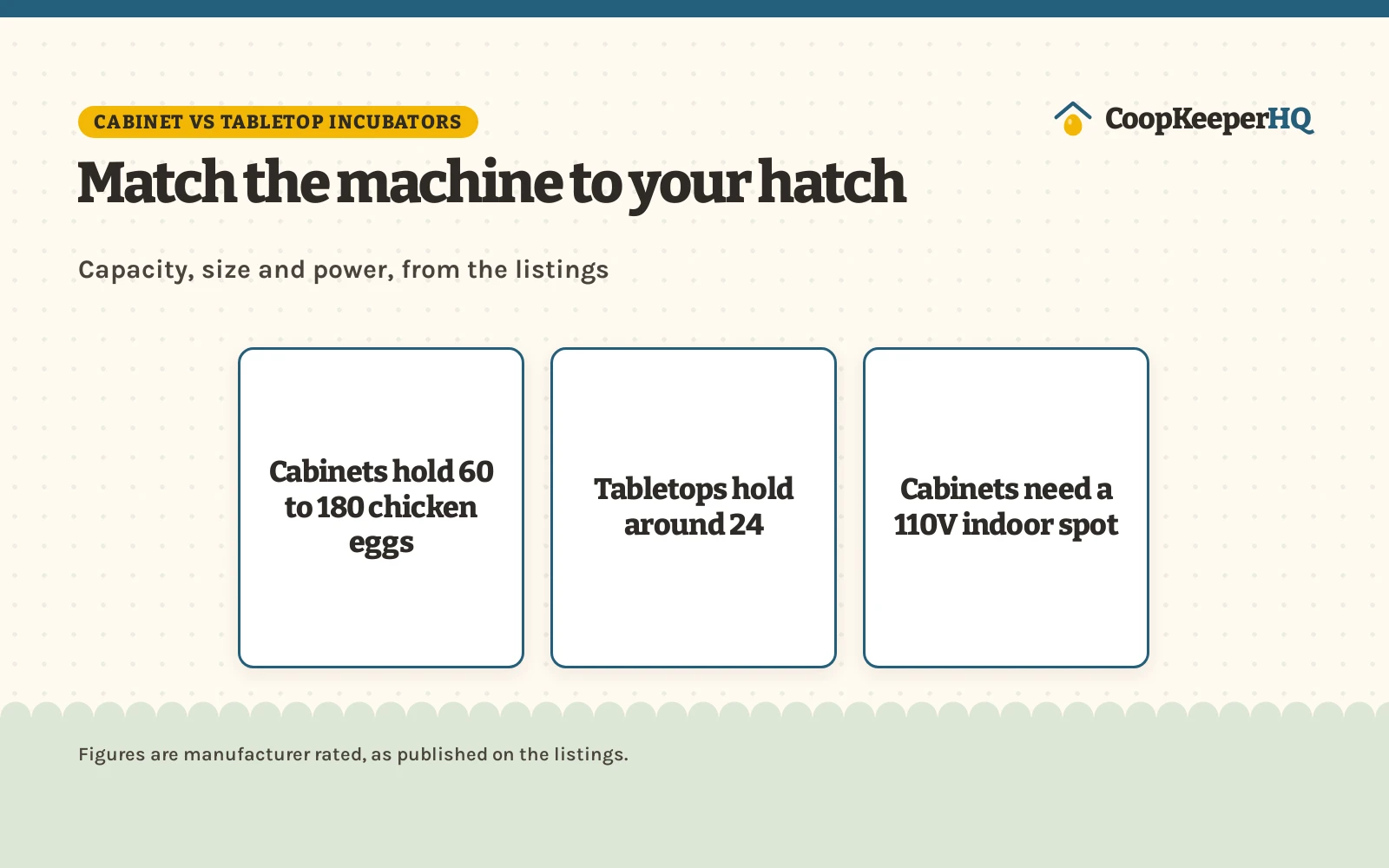
A cabinet incubator stands on the floor like a small fridge. The Hatching Time CT180SH in the listings measures 24.5 x 17 x 42 inches and weighs 49 lb, and it sets and hatches up to 180 chicken eggs in one cabinet. A tabletop sits on a counter: the Proshine unit in the listings measures 14.57 x 9.84 x 11.81 inches, weighs 7.05 lb and holds up to 24 eggs. Same job, very different footprint.
The other split is automation. Cabinets in the listings pair automatic egg turners with humidity control, alarms and ventilation systems, and run on 110V power. Tabletops automate the basics too: the Chalixion turns eggs 360 degrees every 90 minutes, and the SHAWLA turns them every 2 hours. Our forced air vs still air guide explains the airflow side in more detail.
Capacity: the real deciding factor
Count the eggs you plan to set in a season and work backward. The Hatching Time cabinet line covers 60, 120 and 180 chicken eggs across the CT60SH, CT120SH and CT180SH, and the CT180SH also lists 252 partridge, 216 pheasant, 120 turkey or duck, and 72 goose or peacock eggs. Quail capacity on that unit is 324 with the standard setup and reaches 468 with separately sold QT13 racks.
Tabletop units start much smaller. The Chalixion holds 24 chicken eggs or 84 quail eggs, and the Proshine holds up to 24 eggs. Larger units exist in the listings as well: the HKDQ is rated for up to 182 eggs, and the SHAWLA line lists 192/256/500 egg options, all well above the 24-egg tabletops. If you hatch a small batch at a time, a tabletop is plenty; for bigger seasonal hatches, look at cabinets.
Turning, humidity and airflow
Both types turn eggs for you, but the mechanisms differ. The Hatching Time cabinets use automatic Conturn egg turners during the setting stage, then swap to included hatching baskets for the final days. Humisonic humidity control and digital temperature controls run the climate, with high and low alarms for temperature and humidity plus room sensors.
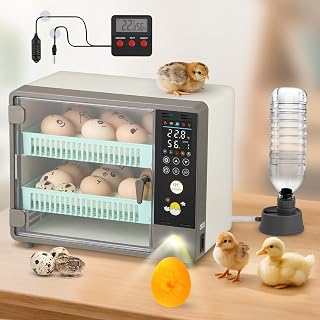
On the tabletop side, the Chalixion’s turner rotates eggs 360 degrees every 90 minutes on a customizable schedule, and its external water filler plus internal atomizing humidifier handle humidity without opening the door. The Proshine offers 4 preset modes for different species with manual override, and 2 built-in fans even out the temperature. The HKDQ uses a double fan system with a transparent lid. Most tabletop units here include a built-in egg candler or interior light for checking development.
Ventilation matters at both scales. The Hatching Time cabinets use IP55-certified AirRoute ventilation with Active Periodic Cooling that adjusts temperature and humidity on a schedule. See our hygrometer picks if you want an independent check on conditions.
Space and power in the real world
A cabinet needs a dedicated indoor spot, preferably a temperature-controlled room per the listings, and a 110V outlet. The CT180SH averages 70W and peaks at 200W; the smaller CT120SH averages 65W with a 190W peak, and the CT60SH averages 50W with a 145W peak. At 49 lb for the big unit, you will want help moving it, and the front and rear doors need clearance on both sides.
A tabletop needs a sturdy counter or table and the same indoor setting. The Proshine weighs 7.05 lb, so it is light enough to carry easily. Either way, keep the incubator away from drafts, direct sun and curious beaks.
Which one fits your hatch
Match the machine to the hatch, not the other way round. A cabinet fits keepers who hatch through the season, run several species, or sell chicks: the multi-species capacities and the setter-to-hatcher workflow in the same cabinet are built for that. A tabletop fits the backyard keeper hatching a batch of the flock’s own eggs, or a classroom demonstration.
Also weigh the extras against the chore list. Automatic turning, humidity control and alarms cut the daily work on either type, so compare what each listing actually automates rather than assuming the bigger box does more. And check the species you keep: adjustable rollers suit mixed egg sizes, while fixed trays suit a single species.
Run the incubator for a day before you set eggs to confirm temperature and humidity, keep it away from direct sun and drafts, and plug it into a protected outlet. Plan the brooder before hatch day. Wash your hands after handling eggs and chicks. See CDC backyard poultry guidance. Read our Safety Disclaimer.
FAQ for the flock
How many eggs does a cabinet incubator hold?
It varies by model. The Hatching Time cabinets in the listings hold 60, 120 or 180 chicken eggs, and the SHAWLA line lists 192/256/500 egg options. Larger eggs mean lower counts: the CT180SH lists 120 turkey or duck eggs and 72 goose or peacock eggs.
Can a tabletop incubator hatch duck or goose eggs?
Some can. The Chalixion’s adjustable rollers suit chickens, ducks, geese, pigeons and quail, and the Proshine lists chicken, duck, quail, goose and pigeon. Check the capacity for the species you keep, since bigger eggs reduce the count.
Do cabinet incubators turn the eggs automatically?
The Hatching Time cabinets use automatic turners during the setting stage, then switch to hatching baskets for the final days. Tabletop units automate turning too: the Chalixion turns eggs every 90 minutes and the SHAWLA every 2 hours.
Where should I put an incubator?
Indoors, in a temperature-controlled room, per the cabinet listings. Give a cabinet clearance for its front and rear doors, and set a tabletop on a sturdy, level surface away from drafts and direct sun.
What is the difference between a setter and a hatcher?
Setting is the main incubation stage, when eggs are turned regularly; hatching is the final stage, when turning stops and chicks emerge. The Hatching Time cabinets handle both in the same cabinet: automatic turners for setting, then the included baskets for hatching.
More coop guides
- Forced Air vs Still Air Incubator: Which Should You Use?
- Best Incubator for Beginners: Easy First-Hatch Picks
- How to Use Egg Incubator: Step-by-Step Guide for Backyard Flocks
- Best Small Incubator for Quail Eggs (2026): 5 Compact Picks
- Chicken Egg Incubation Chart: Day-by-Day Stages and Guide
- Collecting Eggs for Incubation: Step-by-Step Guide for Backyard Flocks
See the beginner incubator picks and the guide to using an egg incubator.