Forced Air vs Still Air Incubator: Which Should You Use?
Forced-air and still-air incubators compared on airflow, temperature stability, egg capacity, ease of use and upkeep, with two still-air examples from the listings we reviewed.

On this page
Top picks at a glance
As an Amazon Associate I earn from qualifying purchases.
- 1
 Little Giant 9300 Digital Still Air Incubator9.5/10View on Amazon
- 2
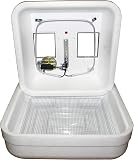 GQF Hova-Bator 1602N Still Air Incubator9.3/10View on Amazon
Forced air vs still air incubator verdict: Choose a forced-air incubator if you want consistent internal temperature, continuous airflow, and simpler monitoring with less thermal layering across the eggs. Choose a still-air incubator if you want a simple unit with no fan motor to maintain and you are comfortable tracking temperature gradients at the top of the eggs.
When you collect fresh hatching eggs from the nesting boxes on a brisk morning, choosing how to incubate them determines your daily hatching routine. Setting up a forced air vs still air incubator changes how heat moves around the eggs and how closely you must watch your gauges. This forced air vs still air incubator comparison examines the differences between fan-driven and thermal-air models, using two still-air examples from the listings we reviewed.
CoopKeeperHQ earns a commission if you buy through our links, at no added cost to you. Affiliate disclosure.
Two examples

Little Giant 9300 Digital Still Air Incubator
A still-air incubator made of warmth-retaining Styrofoam, featuring a digital control board, a built-in hygrometer and capacity for 41 large chicken eggs.
Who it's for: keepers hatching small batches of chicken or quail eggs who want digital readouts without an internal fan.
Who should skip it: anyone wanting built-in automatic egg turning out of the box or forced-air circulation.
The Little Giant 9300 is a still-air incubator measuring 17.75 x 17.75 x 8 inches and weighing 3.1 pounds. The listing states it features a digital control board for self-regulating temperature control, a built-in digital hygrometer, and a body made of warmth-retaining Styrofoam manufactured in the USA. The maker rates its capacity at 41 large chicken eggs or up to 120 bantam or quail eggs when used with an automatic egg turner, which is sold separately.
Pros
- Digital control board with self-regulating temperature control
- Built-in digital hygrometer to monitor incubation humidity
- Holds 41 large chicken eggs or up to 120 quail eggs
- Made of warmth-retaining Styrofoam in the USA
Cons
- Automatic egg turner is sold separately
- Still-air design lacks an internal circulation fan
- No warranty term is stated in the listing
- No safety listing such as UL or ETL stated
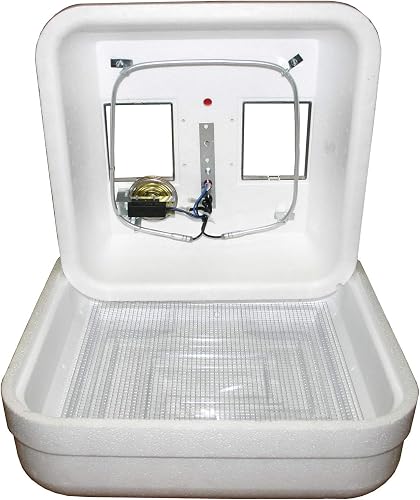
GQF Hova-Bator 1602N Still Air Incubator
A thermal-air flow incubator measuring 19.25 x 19.25 x 5.5 inches, equipped with wafer snap-action temperature control and two top observation windows.
Who it's for: keepers looking for a classic thermal-air incubator with observation windows who are comfortable adjusting a wafer thermostat.
Who should skip it: beginners who prefer digital temperature displays or need a verified egg capacity.
The GQF Hova-Bator 1602N is a thermal-air flow still-air incubator measuring 19.25 x 19.25 x 5.5 inches and weighing 1.2 pounds. The listing states it uses thermal air flow ventilation where heated air flows out top exhaust vents and draws fresh air through the bottom vent. It features a wafer snap-action temperature control, two observation windows on top, and includes a tray, stand, manual, and AC adapter. The listing notes it can be used for chickens, ducks, quail, guinea fowl, and reptiles, though egg holding capacity is not stated. The spec table notes reptile use, while the bullet points describe poultry hatching.
Pros
- Thermal air flow ventilation draws fresh air through exhaust vents
- Includes two observation windows on top to view hatching chicks
- Wafer snap-action temperature control mechanism
- Includes tray, stand and manual in the box
Cons
- Egg holding capacity is not stated in the listing
- Wafer snap-action thermostat lacks digital temperature readouts
- No warranty term is stated in the listing
- No safety listing such as UL or ETL stated
Other options for the coop
 Farm Innovators 2450 Digital Circulated Air Incubator withCheck price on Amazon
 Farm Innovators 2100 Heated Still Air Egg IncubatorCheck price on Amazon
 Little Giant® Digital Circulated Air IncubatorCheck price on Amazon
 Farm Innovators FI-2250 Circulated Air IncubatorCheck price on Amazon
 Farm Innovators 2450 Pro Series Digital Air Egg IncubatorCheck price on Amazon
 Farm Innovators 2450 Heated Digital Circulated Air IncubatorCheck price on Amazon
Forced air vs still air incubator: side by side
| Product | Airflow type | Controls | Egg capacity |
|---|---|---|---|
| Little Giant 9300 Digital Still Air Incubator | Still air | Digital control board | 41 chicken eggs |
| GQF Hova-Bator 1602N Still Air Incubator | Thermal air flow | Wafer snap-action | Not stated |
These are common ranges across the poultry listings we read; capacities and sizes are manufacturer ratings, quoted as the listing words them, collected 9 October 2026.
Air circulation and internal airflow
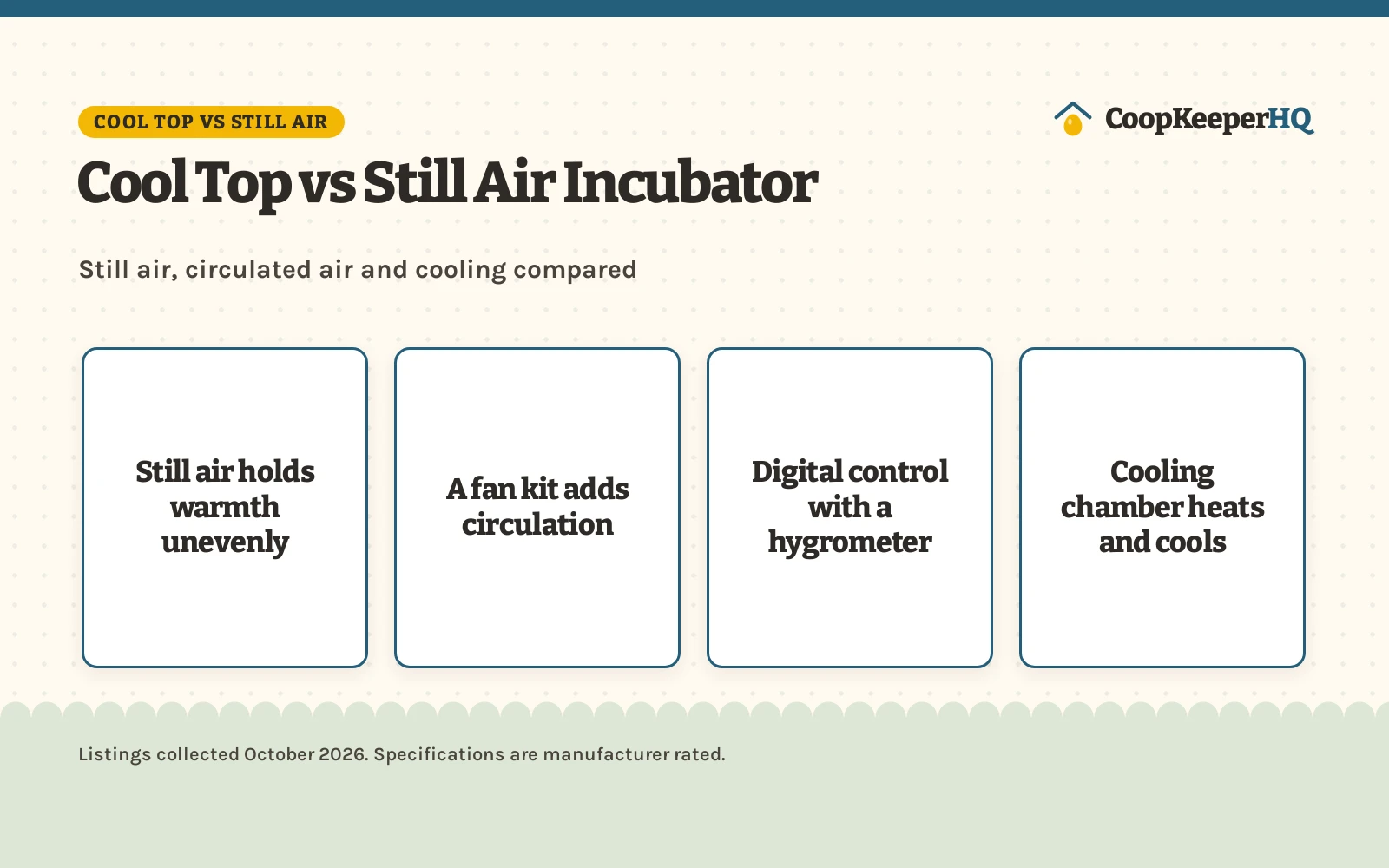
The core difference between these two incubator styles is how air moves across the eggs. A forced-air incubator uses an electric fan to circulate heated air continuously throughout the chamber. This steady airflow prevents air from stagnating and helps minimize hot or cool spots inside the cabinet. In contrast, a still-air incubator has no fan. It relies entirely on natural thermal air flow, where heated air rises toward exhaust vents at the top while cooler, fresh air is drawn inward through bottom vents. The GQF 1602N example uses this thermal air flow approach, venting warm air through its top ports.
Temperature stability and gradients
Because warm air rises, a still-air incubator develops distinct thermal layers. The air near the top of the chamber is noticeably warmer than the air near the floor. To get an accurate reading in a still-air incubator, you must keep the thermometer bulb or sensor sitting level with the top of the eggs, where the embryo develops. In a forced-air incubator, the circulating fan continually mixes the air, helping create a more uniform temperature distribution across the cabinet. Still air incubator temperature management requires close attention to room conditions, because ambient drafts or temperature shifts alter the internal gradient. For any model, follow the specific temperature instructions and sensor placement guidelines in your manufacturer manual.
Humidity and moisture retention
Maintaining proper humidity ensures egg air cells expand at a healthy rate without drying out the membranes before lockdown. In a forced-air incubator, constant air movement increases surface evaporation from water reservoirs, which means you may need to replenish water channels more frequently. In a still-air cabinet, evaporation occurs more slowly through passive air exchange. The Little Giant 9300 includes a built-in digital hygrometer on its control board to help you monitor humidity levels without opening the incubator.
Egg capacity and turning
During early incubation, eggs must be turned multiple times daily so the developing embryo does not adhere to the inner shell membrane. Turning setups vary by specific model rather than airflow design alone. Some incubators include built-in automatic turning racks, while others require manual rotation or an optional turner accessory. For example, the Little Giant 9300 listing states it holds 41 large chicken eggs or up to 120 bantam or quail eggs when paired with an automatic egg turner, which is sold separately. If an incubator does not have an automatic turner installed, keepers must open the lid to turn each egg by hand. If you are exploring different incubator designs and capacities for your flock, our best incubator for chicken eggs guide outlines additional models by batch size.
Operating routine and upkeep
Daily operation looks different depending on which style sits on your hatching bench. A forced-air incubator offers more consistent internal circulation because the fan actively mixes the chamber air, helping reduce temperature pockets when room conditions are properly controlled. However, an internal fan has moving parts that can collect dust and chick down over multiple hatches. A still-air incubator has no fan motor, meaning there are fewer mechanical parts to clean or replace. Both styles require careful monitoring and thorough cleaning between hatches, particularly porous materials like the Styrofoam body on the Little Giant 9300 or the plastic components on the GQF 1602N.
Flock fit
Little Giant 9300 Digital Still Air Incubator
GQF Hova-Bator 1602N Still Air Incubator
Fitting It to Your Flock
- Batch size and egg capacity: The Little Giant 9300 lists capacity for 41 large chicken eggs or up to 120 bantam or quail eggs, making it suitable for moderate backyard hatches, while the GQF 1602N leaves egg capacity unstated.
- Incubator footprint and bench space: The GQF 1602N measures 19.25 x 19.25 x 5.5 inches, while the Little Giant 9300 measures 17.75 x 17.75 x 8 inches, so both need a flat, draft-free surface away from direct sunlight.
- Daily monitoring routine: The Little Giant provides digital temperature and humidity readouts on its control board, whereas the GQF relies on an analog wafer thermostat and two observation windows to check eggs.
- Egg turning requirements: The Little Giant 9300 listing notes its automatic egg turner is sold separately, so if your incubator does not include an automatic turner, plan daily chore time to rotate eggs manually unless you purchase the accessory.
FAQ for the flock
What is the difference between a forced-air and a still-air incubator?
A forced-air incubator uses an internal electric fan to circulate heated air continuously, keeping the temperature uniform across all eggs. A still-air incubator relies solely on natural convection, with warm air rising toward the top exhaust vents and cooler air remaining near the floor.
What is the correct still air incubator temperature?
Because still-air incubators lack a circulation fan, temperatures vary between the upper and lower portions of the chamber. Keepers must place the thermometer level with the top of the eggs and follow the specific temperature instructions in the manufacturer manual.
Is a fan incubator better than a still air incubator?
A fan-driven forced-air incubator circulates air continuously, creating more uniform internal temperatures and reducing thermal stratification across the eggs. A still-air unit operates silently with no fan motor to clean or service, but requires closer attention to thermometer placement to monitor the natural thermal gradient.
Do still-air incubators require manual egg turning?
Not necessarily. Egg turning depends on the specific model and accessories rather than the airflow style alone. While some incubators come equipped with built-in turners, other models like the Little Giant 9300 list the automatic egg turner as a separate accessory, requiring manual turning if the accessory is not installed.
Can you hatch different poultry eggs in a still-air incubator?
Yes, still-air incubators can hatch multiple species if tray spacing and humidity allow. The GQF 1602N listing notes suitability for chickens, ducks, quail, and guinea fowl, while the Little Giant 9300 notes capacity for chicken eggs or bantam and quail eggs.
How the Coop Score came out
Each example is scored out of 10 on performance, build, value, safety and warranty, using only what the listing publishes. Neither listing states a warranty. The weights are on our How We Pick page.
| Product | Keeper Score | Perf. /35 | Build /25 | Value /25 | Safety /10 | Warranty /5 |
|---|---|---|---|---|---|---|
| Little Giant 9300 Digital Still Air Incubator | 9.5 | 29 | 18 | 20 | 3 | 0 |
| GQF Hova-Bator 1602N Still Air Incubator | 9.3 | 26 | 18 | 18 | 3 | 0 |
Keeper Scores run between 9.2 and 9.8. We spread weighted point totals across that window proportionally, so a product with more points always lands higher.
Which should you choose?
Choose a forced-air incubator if you want uniform internal temperature, continuous circulation that reduces temperature layering, and a setup that minimizes hot and cool spots across the eggs.
Choose a still-air incubator if you want a simpler cabinet with no fan motor to maintain or replace, and you are comfortable positioning your temperature sensor precisely at egg level to manage natural thermal gradients.
Pick a species and a set date for candling days, lockdown and hatch day, with a calendar file to save.
Run the incubator for a day before you set eggs to confirm temperature and humidity, keep it away from direct sun and drafts, and plug it into a protected outlet. Plan the brooder before hatch day. Wash your hands after handling eggs and chicks. See CDC backyard poultry guidance. Read our Safety Disclaimer.
More coop guides
- Best Incubator for Chicken Eggs: Hatch Picks by Size
- Best Incubator for Beginners: Easy First-Hatch Picks
- Best Incubator for Quail Eggs: Small Trays, Big Batches
- Best Incubator Under $100: Hatch Picks
- How to Use Egg Incubator: Step-by-Step Guide for Backyard Flocks
- How Long Do Chicken Eggs Take to Hatch? Day-by-Day Timeline
- How to Hatch Quail in an Incubator: Step-by-Step Guide
- Collecting Eggs for Incubation: Step-by-Step Guide for Backyard Flocks
- Automatic Egg Turner for Incubator: 5 Trays Compared (2026)
- Best Egg Incubator with Automatic Turner (2026)
- Chicken Egg Incubator with Humidity Control: 5 Top Picks Compared (2026)
- Best Small Egg Incubator (2026): 5 Compact Picks