Ceramic Heat Lamp vs Light Bulb: Which One Should You Buy?
A ceramic heat lamp gives heat without light, a light bulb gives both. Two ceramic emitter listings scored, with the bulb side described as the category.

On this page
Top picks at a glance
As an Amazon Associate I earn from qualifying purchases.
- 1
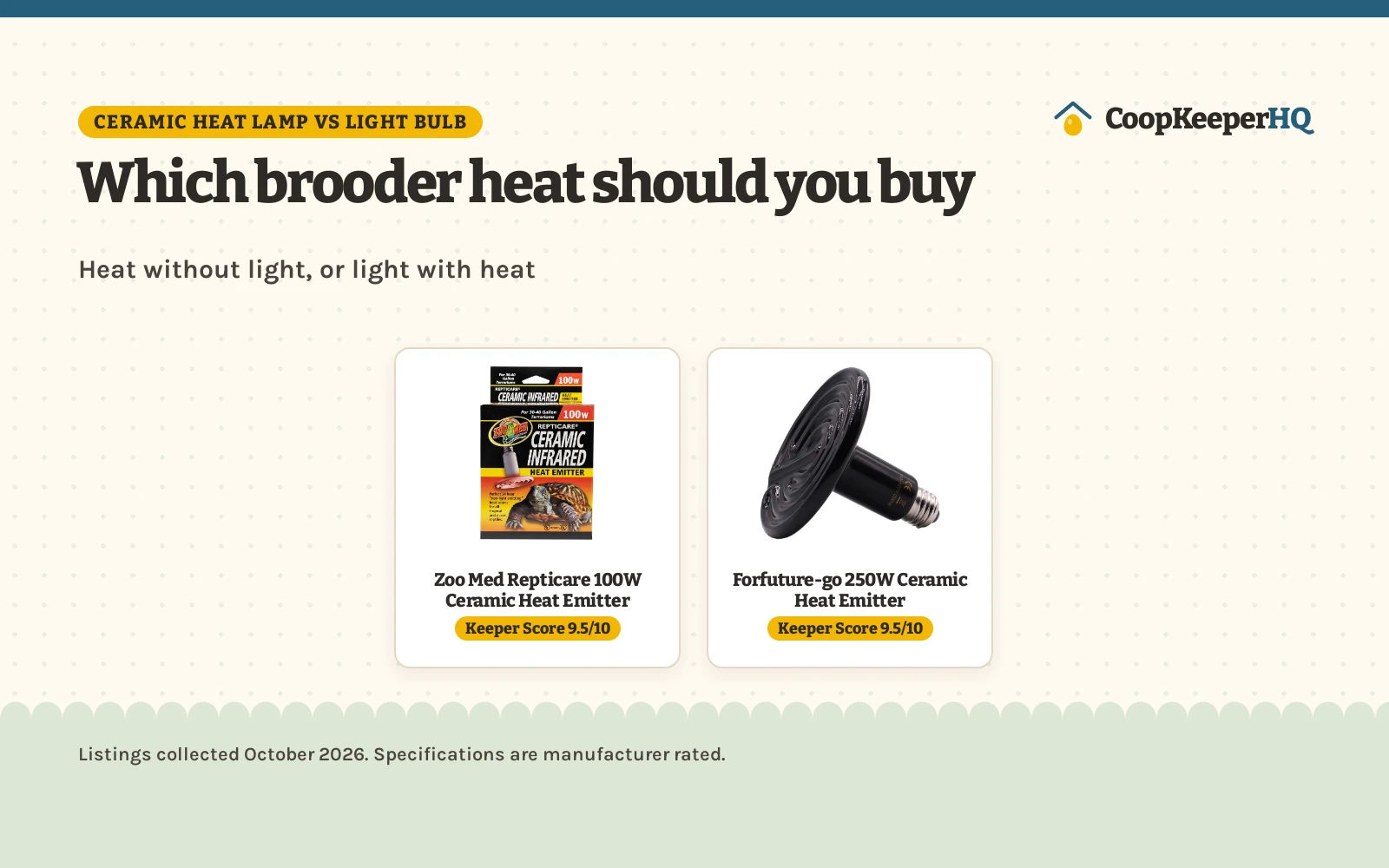
 Zoo Med Repticare 100 Watt Ceramic Infrared Heat9.5/10View on Amazon
- 2
 250W Reptile Heat Lamp Pet Infrared Ceramic Heater9.5/10View on Amazon
Ceramic heat lamp vs light bulb verdict: Pick a ceramic heat lamp when you want heat without light, especially for night use where a glowing bulb would disturb sleep. Pick a light bulb when you want light as well as heat and can live with the glow. Both examples below are ceramic emitters; no light bulb listing was in this set, so the bulb side is described as the category, not a scored product.
The ceramic heat lamp vs light bulb question is really about whether you want light with your heat. A ceramic emitter makes heat and no light; a bulb makes both. For a brooder that runs overnight, that difference decides it for most keepers. This comparison uses two ceramic heat emitter listings as concrete examples, a 100 W Zoo Med and a 250 W Forfuture-go, and measures the light bulb side against them on what the listings actually state.
CoopKeeperHQ earns a commission if you buy through our links, at no added cost to you. Affiliate disclosure.
Two examples
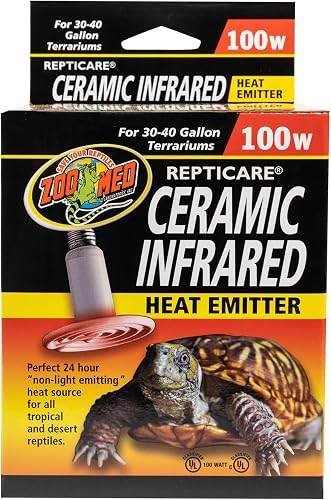
Zoo Med Repticare 100 Watt Ceramic Infrared Heat
A 100 W ceramic infrared heat emitter on an E26 base, porcelain, with a flat face design and a stated 2-year manufacturer warranty.
The Zoo Med Repticare is the lower-wattage ceramic example: a 100 W infrared heat emitter on an E26 base, made of porcelain at 0.27 kg and 4.2 by 3.9 inches. The listing claims a flat face design more efficient than conical designs, suitability for high humidity terrariums, and 10 to 20°F above room temperature. It states a 2-year manufacturer warranty, the only warranty term in this set.
Pros
- Stated 2-year manufacturer warranty, the only one here
- Flat face design the listing calls more efficient than conical
- States 10 to 20°F above room temperature
- Porcelain body, E26 base, 100 to 120 volts
Cons
- 100 W is the lower wattage of the two examples
- No lifespan figure is stated
- No stated chick capacity or brooder sizing
- No safety listing is stated
250W Reptile Heat Lamp Pet Infrared Ceramic Heater
A 250 W ceramic heat emitter on an E26 base with no light emitted, a stated 10,000-hour lifespan and about 4 minutes to rated temperature.
The Forfuture-go is the higher-wattage ceramic example: a 250 W emitter on an E26 base for 110 to 120 volts, with a 125 mm heating surface, 108 mm height and 0.33 kg weight. The listing states no light is emitted, a lifespan of up to 10,000 hours, and about 4 minutes to reach the rated temperature. The safety notes are the clearest here: keep 30 cm from animals, do not check heat by hand, and do not cycle the lamp frequently.
Pros
- 250 W with no light emitted, stated for night use
- Stated lifespan of up to 10,000 hours
- About 4 minutes to rated temperature, per the listing
- Clear safety guidance: 30 cm distance, no frequent cycling
Cons
- No warranty term is stated
- 250 W is the higher draw of the two
- No stated chick capacity or brooder sizing
Other options for the coop
 2-Pack 100W Ceramic Heat Lamps with 1-pcs Digital-ThermometerCheck price on Amazon
 Reptile Heat Lamp FixtureCheck price on Amazon
 LUCKY HERP Reptile Heat LampCheck price on Amazon
 8.5-inch Standard Lamp Dome for Reptile Heating LampsCheck price on Amazon
 REPTITRIP 5.5" Reptile Heat Lamp Fixture with DimmingCheck price on Amazon
 5.5inch Reptile Heat Lamp with Thermostat and 100W Che BulbCheck price on Amazon
Ceramic heat lamp vs light bulb: side by side
| Factor | Ceramic heat lamp | Light bulb | Notes |
|---|---|---|---|
| Light emitted | None, per the Forfuture-go listing | Yes, a bulb glows | The deciding difference |
| Example wattages | 100 W and 250 W stated | Not in these listings | Only sizing figure given |
| Stated lifespan | Up to 10,000 hours (Forfuture-go) | Not in these listings | Cannot compare longevity |
| Warranty stated | 2 years (Zoo Med) | Not in these listings | Only Zoo Med states one |
| Night use | No light to disturb sleep, per the listing | Light all night | From the Forfuture-go listing |
| Warm-up | About 4 minutes to rated temperature (Forfuture-go) | Not in these listings | Stated by Forfuture-go only |
| Humidity claim | Suited to high-humidity setups (both) | Not in these listings | Both claim tolerance; no figures |
Capacities and sizes are manufacturer ratings, quoted as the listing words them, collected 22 October 2026. Both scored examples are ceramic emitters; the light bulb column describes the category since no bulb listing was in this set.
What the two listings state
The Zoo Med Repticare is a 100 W ceramic infrared heat emitter on an E26 base, made of porcelain, weighing 0.27 kg at 4.2 by 3.9 inches. Its bullets state a flat face design it calls more efficient than conical designs, suitability for high humidity terrariums, and a claim it can raise air temperature 10 to 20°F above the surrounding room. The listing states a 2-year manufacturer warranty and 100 to 120 volts at 60 hertz.
The Forfuture-go is a 250 W ceramic heat emitter on an E26 base for 110 to 120 volts, with a 125 mm heating surface diameter, 108 mm height, 0.33 kg weight and 4.92 by 4.25 inch body. It states no light is emitted, only heat, with a stated lifespan of up to 10,000 hours, and it claims about 4 minutes to reach the rated temperature after switching on. The maker describes a thick special ceramic shell it calls stronger and more durable than ordinary heating lamps.
Light, or no light
This is the whole comparison. The Forfuture-go listing states plainly that the bulb generates heat during use and does not emit light, and that at night it will not affect sleep. A standard light bulb cannot make that claim: it glows the whole time it heats. If the brooder sits where light at night is a problem, the ceramic side wins on the listings’ own words. If you want to see the chicks without a separate lamp, the bulb’s glow is the point. Our ceramic heat emitter vs heat lamp guide covers the emitter side in more depth.
Wattage, warm-up and coverage
The listings give 100 W and 250 W, and neither states a chick count or brooder size it covers, so treat wattage as the only sizing figure you get. The Zoo Med claims 10 to 20°F above room temperature; the Forfuture-go claims about 4 minutes to reach its rated temperature. Neither listing states a thermostat or a temperature control, though the Forfuture-go says it can be used with temperature control. For brooder sizing help, see our ceramic heat emitter for brooder picks and the brooder thermometer comparison.
Safety notes, from the listings
The Forfuture-go listing carries the clearest safety guidance: keep more than 30 cm between the lamp and the animals, do not check the temperature with your hand, do not switch the lamp on immediately after switching it off, and do not turn it on and off frequently. Both listings state indoor use. The Zoo Med is porcelain and the Forfuture-go a thick ceramic shell, but neither listing states a guard or a cage, so mount the emitter where chicks and bedding cannot touch it. See our alternatives to heat lamps if an exposed hot element worries you.
Fitting It to Your Flock
- For night brooding, the Forfuture-go states no light emitted and no effect on sleep; a bulb glows all night.
- Neither listing states a chick capacity, so size by wattage and check temperature with a thermometer, not your hand.
- Keep the 30 cm minimum distance the Forfuture-go listing states, and mount either emitter out of reach of bedding.
- Both listings state indoor use; a damp coop needs the humidity-tolerant designs the listings claim, not an open bulb.
FAQ for the flock
Do ceramic heat lamps produce light?
Not per the listings. The Forfuture-go states the emitter generates heat during use and does not emit light, which is why the listing recommends it for night use. The Zoo Med is also a ceramic infrared emitter rather than a bulb.
How long does the Forfuture-go ceramic emitter last?
The listing states up to 10,000 hours. The Zoo Med listing states no lifespan figure, so the two cannot be compared on longevity.
What wattage ceramic heat lamp do I need?
The listings state 100 W and 250 W examples but neither states a chick capacity or brooder size, so there is no stated sizing rule here. The Zoo Med claims 10 to 20°F above room temperature; measure your own brooder with a thermometer.
Can I use a regular light bulb instead of a ceramic heat lamp?
A bulb gives light as well as heat, which suits daytime viewing but glows all night. No light bulb listing was in this set, so nothing here scores a bulb against the two ceramic examples on watts, lifespan or warranty.
Do ceramic emitters suit humid brooders?
Both listings claim humidity tolerance: the Zoo Med states suitability for high humidity terrariums and the Forfuture-go states resistance to humid areas. Neither listing states a water-resistance figure, so keep them dry regardless.
How the Coop Score came out
| Product | Keeper Score | Perf. /35 | Build /25 | Value /25 | Safety /10 | Warranty /5 |
|---|---|---|---|---|---|---|
| Zoo Med Repticare 100W Ceramic Heat Emitter | 9.5 | 26 | 19 | 18 | 5 | 3 |
| Forfuture-go 250W Ceramic Heat Emitter | 9.5 | 28 | 19 | 19 | 4 | 0 |
Keeper Scores run between 9.2 and 9.8. We spread weighted point totals across that window proportionally, so a product with more points always lands higher.
The Keeper Score weighs performance, build, value, safety and warranty on what each listing states. The Zoo Med leads on the stated 2-year warranty; the Forfuture-go leads on stated lifespan and safety guidance. Neither listing states a safety certification, so neither earns points there.
Which should you choose?
Choose a ceramic heat lamp if the brooder runs at night and you want heat without light, you like the stated 10,000-hour lifespan on the Forfuture-go, or you want the 2-year stated warranty on the Zoo Med.
Choose a light bulb if you want light plus heat from one socket and the night glow does not bother the flock. No bulb example was in this set, so compare any bulb against the figures above.
More coop guides
- Ceramic Heat Emitter vs Heat Lamp: Which One Should You Buy?
- Red Heat Lamp vs Clear Heat Lamp: Which One Should You Buy?
- Best Ceramic Heat Emitter for Brooder (2026): 4 Picks Compared
- Heat Plate vs Heat Lamp for Chicks: Which Is Safer?
- Brooder Heater vs Heat Lamp: Which One Should You Buy?
- Alternative to Heat Lamp for Chickens: Which One Should You Buy?
- Digital vs Analog Brooder Thermometer: Which One Should You Buy?
- Incubator vs Brooder: Which One Should You Buy?
See the brooder hub for the full setup.