How Long Do Chicken Eggs Take to Hatch? Day-by-Day Timeline
Chicken eggs take 21 days to hatch under stable incubation conditions, with critical milestones from day 1 setting through day 18 lockdown and hatch day.

On this page
Setting a clutch of fertile eggs in an incubator is one of the most exciting chores on a backyard homestead. If you are watching the calendar and wondering how long do chicken eggs take to hatch, chicken eggs take 21 days to hatch under consistent incubation conditions. While minor temperature swings can nudge emergence by a few hours, day 21 is the reliable timeline for healthy chicks to pip and emerge.
As an Amazon Associate I earn from qualifying purchases. CoopKeeperHQ earns a commission if you buy through our links, at no added cost to you. Affiliate disclosure.
How long do chicken eggs take to hatch: the standard 21-day cycle
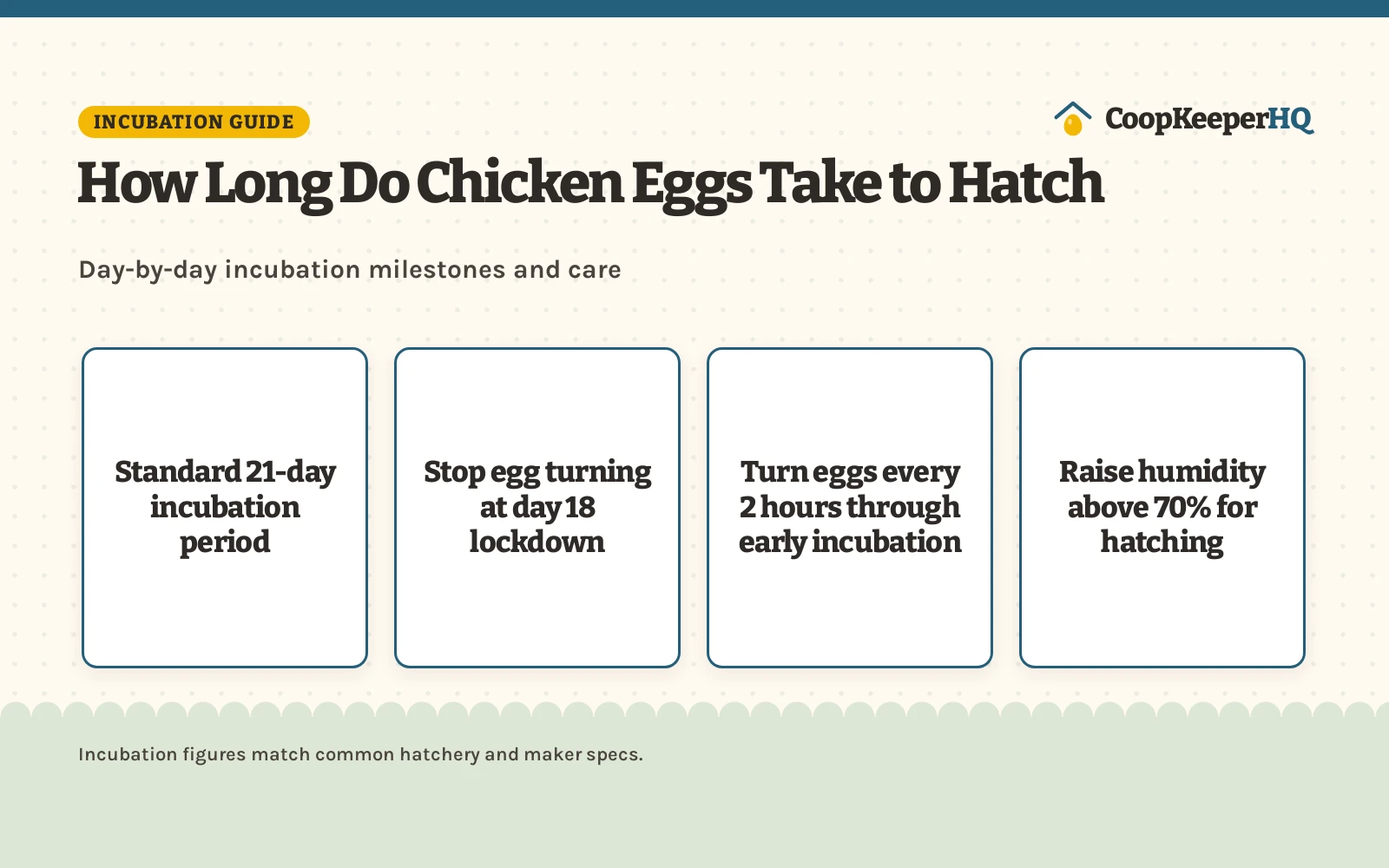
The standard incubation period for chicken eggs is 21 days. During these 3 weeks, an embryo develops from a cluster of cells into a chick with feathers, a beak, and working lungs. The cycle divides into two main phases: early incubation from day 1 until day 18, and lockdown from day 18 through day 21. Each phase requires specific humidity and turning routines so the embryo develops normally and orients properly for hatching.
Hatch day rarely happens all at once. Even when eggs are set together, chicks pip at slightly different times across day 21. Factors such as egg freshness, shell thickness, and minor temperature fluctuations cause some chicks to emerge early on day 21 while others finish hatching later. As Round Lake Farm notes in their hatching instructions, chicken eggs hatch on day 21, but eggs can hatch later if an incubator runs even a degree lower than needed.
Preparing and setting eggs before incubation
A successful hatch starts before you turn the incubator on. Clean, intact eggs collected from healthy breeding stock yield the highest hatch rates. Avoid washing eggs, which removes the protective bloom and allows bacteria through the shell. For advice on selecting eggs prior to incubation, see our guide on collecting eggs for incubation.
If you purchase shipped hatching eggs or gather them from cold nesting boxes, allow them to rest pointy end down for 24 hours at room temperature before setting them. Round Lake Farm emphasizes this 24-hour rest so the internal air cell can stabilize. Freshness also matters: eggs collected within 2 days of laying show higher viability than older eggs. Once rested, review our guide on how to use an egg incubator before loading your trays.
Temperature control and heat circulation
Consistent warmth is the critical factor in egg development. Developing embryos depend on steady heat circulation to maintain cell division at an even rate. Quality incubators use internal circulating fans to distribute warm air evenly across the chamber, avoiding hot spots near heating elements or cold spots near outer walls.
Different incubators provide different thermal controls. For example, GleeGearNex specifies a presettable temperature range of 68 to 104°F with 360-degree circulating airflow. Meanwhile, MEMTIM includes sensors with an automated alarm that alerts keepers if conditions drift beyond a preset ±2°F range. Choosing an incubator with reliable controls keeps your hatch on schedule, and our guide to the incubator for chicken eggs compares top models by flock size.
Egg turning routines and embryo development
In natural brooding, a hen shifts her clutch frequently. Regular turning prevents the developing embryo from settling against the shell membrane, which could cause developmental problems. In an incubator, automatic turners rotate eggs gently to replicate this motion.
Incubator listings document these turning intervals clearly. Sailnovo models flip eggs automatically every 120 minutes, or every 2 hours, using an integrated motor. GleeGearNex also automates egg turning every 2 hours throughout the cycle. MEMTIM provides automatic turning every 2 hours, with an adjustable interval ranging from 60 to 210 minutes. Turning continues through early incubation and stops completely once you enter lockdown on day 18.
Humidity management throughout incubation
Humidity controls how much moisture evaporates through the porous shell during incubation. As moisture evaporates, the internal air cell expands, creating the air pocket the chick pierces when it takes its first breath. If humidity is too high, the air cell remains too small; if humidity is too low, the chick can stick to dry membranes.
Incubation humidity runs in two distinct stages. During early incubation before lockdown, keep moisture moderate. GleeGearNex lists typical early humidity at 55 to 65% RH, while MEMTIM incorporates a 300-millilitre water tank maintaining 55% to 70% humidity. External water ports, featured on Sailnovo and GleeGearNex models, allow keepers to replenish water reservoirs without lifting the lid and losing chamber warmth.
Candling eggs to monitor embryo progress
Candling involves shining a concentrated beam of bright light through the eggshell in a dark room to observe internal development. Most modern incubators, including units from Sailnovo, GleeGearNex, and MEMTIM, include a built-in LED candling light on the unit. If your machine lacks an integrated light, our guide explaining what is an egg candler reviews standalone candling options.
Keepers candle eggs during early incubation to confirm fertility, checking for dark blood vessels radiating from the embryo. Another candling check before day 18 lockdown verifies that the embryo fills most of the shell and the air cell has drawn down properly. Any clear, infertile eggs should be removed promptly to keep the chamber clean.
Lockdown on day 18: preparing for hatch day
Lockdown day 18 marks the turning point in the incubation period for chicken eggs. Exactly 3 days before the scheduled hatch on day 21, the incubator setup changes completely to create safe hatching conditions. Sailnovo incubators stop flipping eggs automatically 3 to 4 days before hatching, and MEMTIM similarly pauses turning for the final phase.
During lockdown, complete three essential steps. First, remove turning racks or disengage the motor so eggs sit flat on the hatching floor. Second, increase internal humidity above 70% RH, as recommended by GleeGearNex and MEMTIM, to soften shell membranes. Third, close the incubator lid and leave it shut. Opening the lid during lockdown releases humid air, causing delicate membranes around pipping chicks to dry out and shrink-wrap around them.
Hatch day: pip, zip, and emergence
On day 21, the chick begins its final effort to emerge. The process begins with an internal pip, where the chick pierces the internal air cell with its egg tooth and begins breathing air. Soon after, the chick creates an external pip: a tiny crack on the outer shell. A chick may rest for several hours after making an external pip, sometimes resting up to 24 hours while its lungs adjust and it absorbs the yolk sac.
Once rested, the chick begins zipping, rotating inside the egg and cutting a circular cap around the blunt end of the shell. Zipping typically takes 1 to 2 hours of active pushing. After the cap breaks free, the chick kicks itself out into the tray. Wet chicks should remain inside the warm incubator until their down is completely dry and fluffy. Avoid assisting a struggling chick, as pulling shell fragments prematurely can tear unabsorbed blood vessels; consult a poultry vet or state extension specialist if you encounter persistent hatching complications.
Incubation periods for other poultry species
While chicken eggs take 21 days to hatch, other common backyard poultry have different developmental schedules. Coturnix quail eggs hatch much faster than chicken eggs, while duck egg incubation days and goose egg timelines are significantly longer than chickens. Because different species require different schedules, avoid incubating different poultry eggs in the same chamber at the same time.
Incubator egg capacities also vary depending on egg size. MEMTIM states an incubator capacity of 24 chicken eggs, 12 duck eggs, 10 goose eggs, or 40 quail eggs in its adjustable tray. GleeGearNex lists a capacity of 12 chicken eggs or 24 quail eggs. If you raise waterfowl or game birds, review our comprehensive guides on incubation for duck eggs and incubation time for quail eggs for species-specific schedules.
Moving newborn chicks to the brooder
Newly hatched chicks can stay inside the incubator for up to 24 hours without food or water because they are nourished by the absorbed yolk sac. Leaving them inside allows down feathers to dry thoroughly without chilling. Opening the incubator lid repeatedly to take out individual chicks releases critical humidity, so wait until multiple chicks are dry before transferring them.
Prepare your brooding area before hatch day arrives. A warm, draft-free enclosure with clean bedding, fresh water, and starter feed provides the ideal environment for delicate chicks. For brooder setup steps and space requirements, see our guide on requirements for a chick brooder. We recommend using a radiant heat plate rather than a traditional heat lamp to eliminate fire hazards.
A simple incubation checklist
- Incubator runs empty for 24 hours to stabilize temperature and humidity
- Fertile hatching eggs rest pointy end down for 24 hours before setting
- Incubation temperature maintained steadily within maker presets
- Automatic turning active every 2 hours from day 1 through early incubation
- Moisture maintained at 55 to 65% humidity during early incubation
- Day 18 lockdown initiated: egg turning stopped and humidity raised above 70%
- Incubator kept closed throughout day 21 while chicks pip, zip, and dry
For more equipment setup advice, review our complete walkthrough on how to use an egg incubator.
Pick a species and a set date for candling days, lockdown and hatch day, with a calendar file to save.
Run the incubator for a day before you set eggs to confirm temperature and humidity, keep it away from direct sun and drafts, and plug it into a protected outlet. Plan the brooder before hatch day. Wash your hands after handling eggs and chicks. See CDC backyard poultry guidance. Read our Safety Disclaimer.
FAQ for the flock
Can chicken eggs hatch earlier than 21 days?
Chicken eggs can occasionally hatch slightly ahead of schedule if the incubator ran warmer than standard. Warmer temperatures accelerate embryo development, though excessive warmth risks developmental harm. Most healthy chicks emerge on day 21.
What causes chicken eggs to hatch late?
Slightly cool incubation temperatures are the most common reason chicken eggs hatch later than day 21. As noted in Round Lake Farm listing details, running a degree lower than needed delays emergence. Eggs stored for longer periods or larger eggs can also take extra time to hatch.
Why is day 18 lockdown important for chicken eggs?
Day 18 lockdown gives chicks a stable, non-moving floor so they can orient their beaks toward the air cell for hatching. Raising humidity above 70% during lockdown keeps the inner membrane soft and pliable so the chick does not become trapped.
How often should chicken eggs be turned during incubation?
Eggs should be turned multiple times daily. Modern incubators from Sailnovo, GleeGearNex, and MEMTIM rotate eggs automatically every 2 hours to keep the embryo centered and prevent it from sticking to the outer shell membrane.
Do duck eggs take the same time to hatch as chicken eggs?
Duck eggs do not hatch in 21 days. Duck egg incubation days are longer than chicken incubation, requiring additional days of incubation before hatching. Because of different timelines and humidity needs, do not incubate duck eggs and chicken eggs together in the same tray.
More coop guides
- Best Incubator for Chicken Eggs: Hatch Picks by Size
- How to Use Egg Incubator: Step-by-Step Guide for Backyard Flocks
- Collecting Eggs for Incubation: Step-by-Step Guide for Backyard Flocks
See the incubator and hatching picks and the egg handling guides.