How to Cut Wire Mesh for Chicken Coops and Runs
Cut wire mesh for chicken coops and runs with the right snips or cutters, straight lines, clean edges and panels that sit flat on the frame.

On this page
Top picks at a glance
As an Amazon Associate I earn from qualifying purchases.
- 1
 10 Inch Aviation Tin Snips9.6/10View on Amazon
- 2
 HURRICANE 10 inch Aviation Tin Snips9.4/10View on Amazon
- 3
 WORKPRO 6 in Wire Cutters9.4/10View on Amazon
A roll of wire mesh fresh from the yard store rarely fits the run frame as it comes. Panels need trimming to length, openings need cutting for doors and feeders, and every cut leaves wire ends that can catch on sleeves and scratch hands at feeding time. Knowing how to cut wire mesh cleanly turns that roll into panels that sit flat, fasten tight and leave no sharp ends sticking out. This guide covers marking the line, making the cut and finishing the edge, with the gear that handles each part of the job.
CoopKeeperHQ earns a commission if you buy through our links, at no added cost to you. Affiliate disclosure.
| # | Product | Keeper Score | Buy |
|---|---|---|---|
| 1 | 10 Inch Aviation Tin Snips | 9.6/10 | Buy on Amazon |
| 2 | HURRICANE 10 inch Aviation Tin Snips | 9.4/10 | Buy on Amazon |
| 3 | WORKPRO 6 in Wire Cutters | 9.4/10 | Buy on Amazon |
10 Inch Aviation Tin Snips
Straight-cut tin snips rated to 18 gauge cold-rolled steel that list chicken wire and hardware cloth among the materials they cut.
Who it's for: keepers cutting rolls of chicken wire or hardware cloth into run panels along straight lines.
Who should skip it: anyone cutting tight curves or working with material thicker than the stated 18 gauge limit.
warmtree lists the wtATS10in at 10.0 x 3.0 x 1.5 inches, with blades forged from chrome vanadium steel and sanded serrated edges rated 58-62 HRC. The listing states it cuts up to 18 gauge (1.2 mm) cold-rolled steel and galvanized sheet and 22 gauge (0.7 mm) stainless steel, and it names chicken wire and hardware cloth among the materials it handles. A locking latch holds the blades shut in storage, and the spring-assisted mechanism opens the blades after each cut.
Pros
- Lists chicken wire and hardware cloth as materials it cuts
- Rated to 18 gauge cold-rolled steel and 22 gauge stainless steel
- Serrated Cr-V blades rated 58-62 HRC for grip and edge life
- Spring-assisted opening and Tyregrip handles for long cutting sessions
Cons
- Straight-cut design suits long runs, not tight curves
- Protective gloves not included
- No warranty term is stated
- One size only is listed
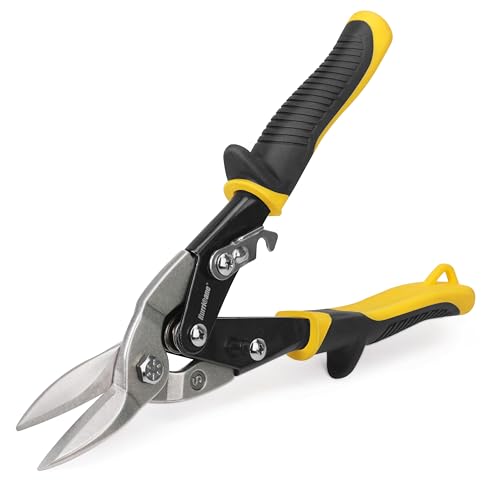
HURRICANE 10 inch Aviation Tin Snips
Straight-cut tin snips for thin sheet metal and gutters, with Cr-V serrated blades and a manual safety latch.
Who it's for: keepers trimming thin sheet metal, gutter sections and flashing to fit around the coop and run.
Who should skip it: anyone whose main job is cutting wire mesh, since the listing states to avoid that use.
HURRICANE lists the 02-024 at 10.0 x 3.0 x 1.5 inches, with forged chrome vanadium steel blades with micro-serrations and a non-slip Tyregrip handle. The listing states it cuts up to 20-gauge cold rolled steel and 22-gauge stainless steel, and it is designed for straight-line cutting and wide, gentle curves in thin sheet metal, gutters and HVAC ducts. The listing also states to avoid using it on wire mesh, hardened steel and metal rods, so it belongs in this guide as the sheet-metal snip for flashing and trim around the coop, not as the mesh cutter.
Pros
- Rated to 20-gauge cold rolled steel and 22-gauge stainless steel
- Cr-V serrated blades grip thin sheet and resist slipping
- Non-slip Tyregrip handle with a hanging hole for storage
- Manual safety latch and self-opening spring for smooth operation
Cons
- Listing states to avoid using it on wire mesh
- Listing states to avoid hardened steel and metal rods
- Straight-cut design is not intended for tight circles or sharp angles
- No warranty term is stated
WORKPRO 6 in Wire Cutters
Compact diagonal cutters in 50CrV steel with hardened cutting edges for snipping single wires at the edge of a mesh panel.
Who it's for: keepers who need to nip single wires, trim ties and clean up cut ends.
Who should skip it: anyone cutting full panels, where long snips cover ground faster.
WORKPRO lists the W031377A as a 6-inch diagonal cutter made of 50CrV steel with a heat treated and blackened surface. The listing states heat treated hardness up to 48 HRC and high-frequency treated hardness up to 65 HRC, with hardened cutting edges and a bi-material handle for anti-slip grip. It is built for cutting wires quickly, which makes it the tool for trimming single strands and tidying the ends after the main cut.
Pros
- 50CrV steel with heat treated, hardened cutting edges
- Hardness stated at 48 HRC, with high-frequency treated edges at 65 HRC
- Bi-material handle shaped for anti-slip comfort grip
- Compact 6-inch size for reaching single wires at panel edges
Cons
- No warranty term is stated
- Short jaws suit single wires, not long straight cuts
- Listing gives no stated cutting capacity in gauge
- No locking latch is stated
Other options for the coop
 Stainless Steel Mesh Screen11 X24 inCheck price on Amazon
 Upgraded 304 Crimped Wire 0.65mmCheck price on Amazon
 Topworths Hardware Cloth 1/8" Chicken Wire Mesh Fencing 36inCheck price on Amazon
 304 Stainless Steel Hardware Cloth 1/4 23 GA 24in x 49ft RollCheck price on Amazon
 304 Stainless Steel Hardware Cloth 1/2 20 GA 40in x 48ft RollCheck price on Amazon
- 304 Stainless Steel Hardware Cloth 1/2 20 GA 48in x 48ft RollCheck price on Amazon
How to cut wire mesh: mark the line first
Start by unrolling the mesh on flat ground and letting it relax before measuring. Lay the panel where it will hang, mark the cut line along a wire with a marker or a strip of tape, and check the line against the frame before cutting. Cutting along a wire keeps the edge straight and leaves even ends to fold flat later.
Hold the mesh flat with a board or a spare length of timber while cutting, and keep hands clear of the cut ends as they spring free. Work from one end of the line to the other in steady cuts, and let the waste fall away rather than pulling it through the cut. For the mesh types used on coops and runs, see the hardware cloth guide before choosing between welded mesh and woven wire.
The gear for cutting wire mesh
The cut itself needs long snips for the straight runs along the marked line, and short diagonal cutters for single wires and tidy ends. The first two cutters below cover those jobs, ranked by how well each listing fits mesh work, and the third is the sheet-metal snip for trim around the coop.
Cutting chicken wire and hardware cloth
Chicken wire cuts easily with straight snips that list it among the materials they cut, worked along one wire at a time, while welded hardware cloth takes more force at each weld. Open the snips wide, seat the wire deep in the jaws and close in a firm motion rather than nibbling at the wire. The how to cut chicken wire guide covers the same steps for lighter woven wire.
- Straight runs. Long tin snips follow the marked wire and keep the panel edge even.
- Single wires. Diagonal cutters nip one wire at a time at corners, around posts and at door openings.
- Thick welds. Seat welded joints deep in the jaws and cut one weld at a time.
- Curves and notches. Cut relief slits toward the curve, then trim the waste away in small pieces.
When the choice is between snips and a larger cutter, the bolt cutters vs wire cutters for fencing comparison sets out which tool suits each fencing job.
Finishing the cut edge
Fresh cut ends are sharp, so fold each one flat against the panel with pliers or bend the edge wire back over the cut. Run a gloved hand along the finished edge before fitting the panel, and trim any end that still catches. Fit the panel to the frame with the folded edge facing out of the run where birds cannot reach it, and fasten along the frame so the mesh cannot pull free. See the chicken runs and fencing guides for framing and fastening.
Birds, breed size, run time and climate in; coop floor, run space, roost length and nesting boxes out.
Wash your hands after handling birds, eggs or equipment, supervise children around the flock, and check local rules on flock size and roosters before you buy. For sick birds, call a poultry veterinarian or your state extension office. See CDC backyard poultry guidance. Read our Safety Disclaimer.
FAQ for the flock
What is the best way to cut wire mesh?
Mark along a wire, then cut with straight tin snips worked along the line in steady cuts. Use diagonal cutters for single wires at corners and openings, and fold the cut ends flat when done.
Can tin snips cut chicken wire?
Yes, where the listing states it. The warmtree snips (on Amazon) in this guide list chicken wire and hardware cloth among the materials they cut, and they are rated to 18 gauge cold-rolled steel. Check the listing of any snips before cutting, since some makers state to avoid wire mesh.
How do I keep cut wire mesh from leaving sharp edges?
Cut along a wire so the ends stay even, then fold each cut end flat against the panel or bend the edge wire back over the cut. Check the finished edge with a gloved hand before fitting the panel to the frame.
Should I cut wire mesh before or after fitting it to the run?
Cut panels to size on flat ground, then fit them to the frame. Cutting in place can leave uneven edges and makes it harder to fold the sharp ends flat.
More coop guides
- How to Cut Chicken Wire for Backyard Coops and Runs
- What Is Hardware Cloth? Wire Mesh Guide for Chicken Coops
- Bolt Cutters vs Wire Cutters for Fencing: Which One Should You Buy?
- Chicken Wire vs Welded Wire: Which One Should You Buy?
- Staples vs Nails for Chicken Wire: Which One Should You Buy?
See the chicken runs and fencing guides for framing, fastening and run layouts.