T Post Fence Calculator: How Many Posts Your Fence Needs
A step-by-step way to count T-posts for a chicken run fence, from measuring the run to matching the driver to the post.

On this page
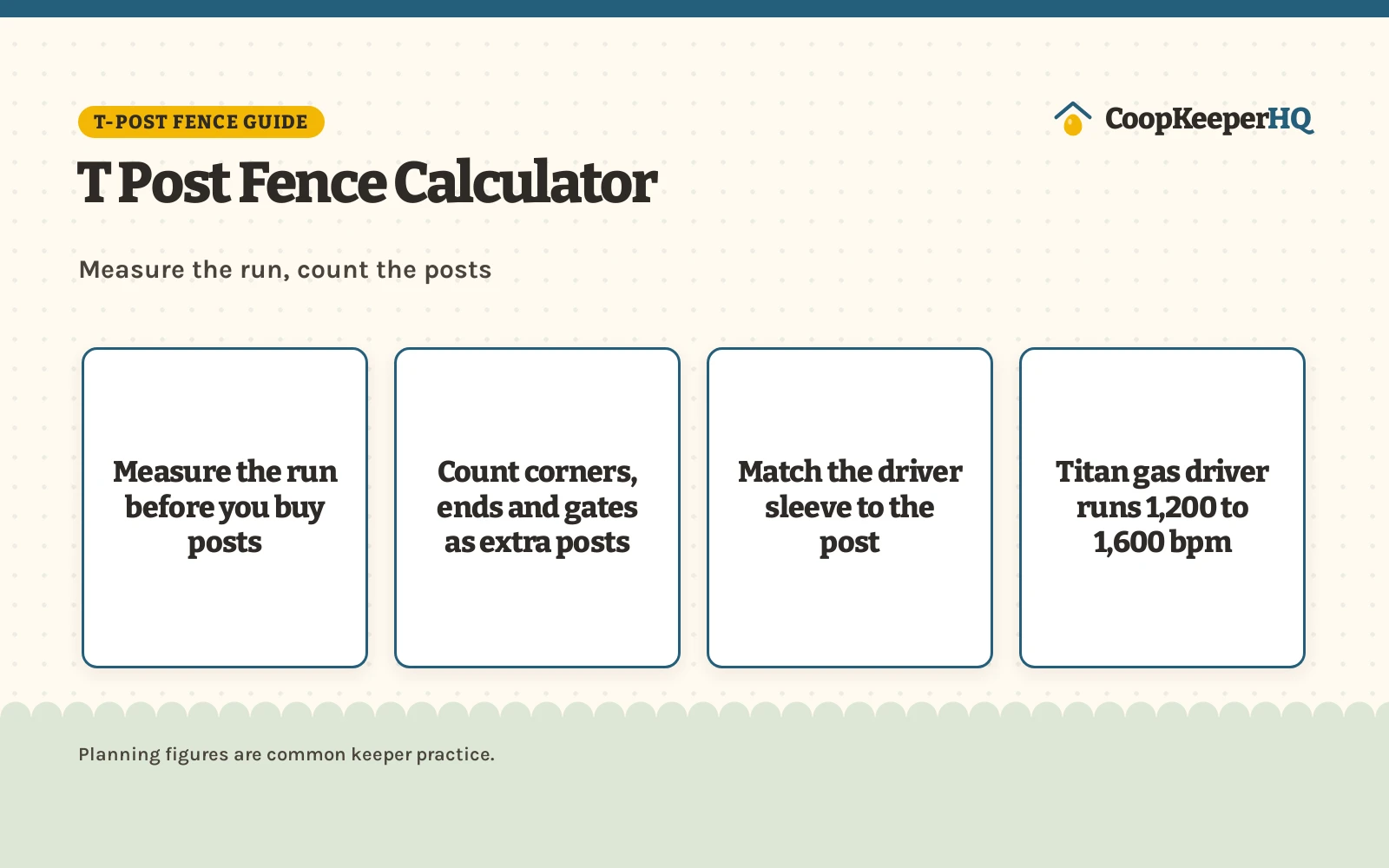
A run fence starts with a tape measure and a count, not a guess, and the t post fence calculator turns that count into a post list. Walk the fence line with the tape, mark every corner and gate, and write down the length of each straight stretch. Then divide each stretch by the spacing you choose, round up, and add one post for each end, corner and gate, counting a post once when it serves two roles, and the calculator does that arithmetic for a straight run, a rectangle or an L-shaped run.
As an Amazon Associate I earn from qualifying purchases. CoopKeeperHQ earns a commission if you buy through our links, at no added cost to you. Affiliate disclosure.
How the t post fence calculator works
A T-post fence calculator takes the length of the fence line and the spacing between posts and returns a post count. You enter the length of each straight stretch, the spacing you want between posts, and the number of corners and gates. The calculator divides each stretch by the spacing, rounds up to a whole post, and adds one post for each end, corner and gate, counting a post once when it serves two roles: a corner where two stretches meet is one post shared by both. The result is the number of T-posts to buy, plus the wire for the run.
Measure the fence line first
Walk the line where the fence will stand and measure each straight stretch with a tape. Write down the length of each stretch, and mark every corner, gate and end on the ground with a stake or a flag. A rectangle has 4 corners and a straight run has none, so the shape decides how many extra posts the count needs. Measure again if the ground slopes or the line bends, and use the longer measure when two measures disagree. The how to set a corner post for a fence guide covers the corner work.
Pick a spacing and count the posts
Spacing is the distance between one post and the next, and it decides how many posts a stretch needs. Closer posts hold the wire tighter and stand up better in wind, while wider spacing uses fewer posts and less driving time. Pick one spacing for the fence and use it for every stretch, so the calculator gives one count for the run. Divide the length of a stretch by the spacing and round up when the division leaves a part post, then add a post for each end of the stretch. Where two stretches meet at a corner, that corner post is the end post for both stretches, so count it once.
Add corners, ends and gates
Corners, ends and gates each need a post, counted once even when one post serves two roles. A corner post takes the pull of wire from two directions, an end post anchors the start and finish of a run, and a gate post carries the gate and its hinges. Walk the line again and count the corners, the ends and the gates, counting a corner where two stretches meet as one post, then add that count to the posts from the spacing. A gate also needs room to swing, so mark the swing on the ground before you set the posts.
Match the driver to the post
A post driver sets the post, and the driver must fit the post. Gas drivers suit long runs: the Titan PGD1032 runs on a 140FA 4-stroke engine and delivers from 1,200 to 1,600 bpm, and it comes with 1, 1.75 and 2.5 in adapter sleeves. The JKCHEN PRO driver (on Amazon) runs at 1900W and 6500 RPM with 55J of impact, a 1.3L fuel tank and 3 sleeves at 49mm, 69mm and 100mm. The HIGOSPRO electric driver (on Amazon) runs at 2200W and 110V with 2100 BPM and 85J of impact, and it comes with 2 sleeves at 55 and 70mm. A hand pounder suits a short run: the iHYTOON steel hand pounder (on Amazon) drops over standard steel T-posts and works by hand. Match the sleeve to the post before you buy, and check the driver weight: the Titan weighs 34.5 lb. The standard T post dimensions chart lists post sizes, and the best post driver for rocky ground guide compares drivers for hard ground.
A simple fence checklist
- Fence line walked and every corner, gate and end marked
- Length of each straight stretch written down
- One spacing picked for the fence
- Posts counted: length divided by spacing, plus ends, corners and gates, each post counted once
- Driver sleeve matched to the post size
- Gate swing marked on the ground before setting posts
For run layouts, see the chicken run ideas guide.
Wash your hands after handling birds, eggs or equipment, supervise children around the flock, and check local rules on flock size and roosters before you buy. For sick birds, call a poultry veterinarian or your state extension office. See CDC backyard poultry guidance. Read our Safety Disclaimer.
FAQ for the flock
How many T-posts do I need for a run?
Measure each straight stretch, divide the length by the spacing you choose, then add one post for each end, corner and gate, counting a post once when it serves two roles. A corner where two stretches meet is one post shared by both. The calculator does that arithmetic for a straight run, a rectangle or an L-shaped run.
What spacing should I use between T-posts?
The calculator lets you pick the spacing, so use the spacing that suits the wire and the ground. Closer posts hold the wire tighter, wider spacing uses fewer posts, and one spacing for the fence keeps the count simple.
Do corners and gates need extra posts?
Yes. A corner post takes the pull of wire from two directions, an end post anchors the start and finish of a run, and a gate post carries the gate. Count the corners, ends and gates, counting each post once even when it serves two roles, and add them to the posts from the spacing.
What size driver sleeve fits a T-post?
Match the sleeve to the post. The Titan driver comes with 1, 1.75 and 2.5 in sleeves, the JKCHEN PRO comes with 3 sleeves at 49mm, 69mm and 100mm, and the HIGOSPRO comes with 2 sleeves at 55 and 70mm.
Can one person drive T-posts?
Yes. The iHYTOON hand pounder is made for one-person operation: drop the driver over the post, lift and drive. Gas and electric drivers suit longer runs, and the Titan weighs 34.5 lb.
More coop guides
- How to Set Corner Post for Fence
- Standard T Post Dimensions Chart
- How to Use T Post Clip Tool
- How Many T Post Clips Per Post
- Should Fence Posts Be Set in Concrete? What to Use Instead
- Chicken Run Set Up: A Step-by-Step Guide
- How Tall Should a Chicken Run Be? A Practical Guide for Backyard Flocks
- Best Post Driver for Rocky Ground (2026)
- What Size Auger for Fence Posts: Choosing the Right Bit
- Types of Wood Fence Posts Compared
See the chicken runs and fencing guides and the predator protection guides.