Best Way to Heat a Chicken Coop
A dry, draft-free coop comes first, then a flat radiant panel or forced-air heater on a thermostat, with four heaters compared for winter.


On this page
Top picks at a glance
As an Amazon Associate I earn from qualifying purchases.
- 1
 TIMEBAL 200W UL Certified Coop Heater9.6/10View on Amazon
- 2
 Smart Chicken Coop Heater, 1500W PTC Ceramic9.6/10View on Amazon
- 3
 1500W Chicken Coop Heater with Remote Control9.6/10View on Amazon
- 4
 Chicken Coop Heater, Heat Lamp for Chickens 600W9.4/10View on Amazon
When the nights turn cold and the water starts freezing, the question is how to add heat safely. The best way to heat a chicken coop is to start with the coop itself: keep it dry, close drafts at roost height and keep the vents high, then add a flat radiant panel or a forced-air heater on a thermostat if the birds still need warmth, and choose a panel over a heat lamp.
CoopKeeperHQ earns a commission if you buy through our links, at no added cost to you. Affiliate disclosure.
TIMEBAL 200W UL Certified Coop Heater
A 200W flat-panel radiant heater with a stated UL certification claim, adjustable from 70 to 191°F, with remote control and memory, for supplemental warming of chicks and adult birds.
Who it's for: keepers who want a low, steady panel with a stated UL certification claim.
Who should skip it: anyone warming a large coop, since no coverage area is stated.
TIMEBAL's PG091_BK is a 200W flat-panel radiant heater with a stated UL certification claim, adjustable from 70 to 191°F, with an LED display and a remote control. It mounts on the wall or sits inside the coop, and its non-glowing design keeps the resting area quiet. It remembers its settings after an outage and works with outlet timers and thermostatic plugs, not included.
Pros
- UL certification claimed, with zero-clearance installation
- Adjustable from 70 to 191°F, remote control
- Memory keeps settings after an outage
- Non-glowing panel, no bulbs to replace
Cons
- No warranty term stated
- No coverage area stated
- No built-in thermostat; needs an external plug
- 200W is the lowest wattage here
Smart Chicken Coop Heater, 1500W PTC Ceramic
A 1500W wall-hanging PTC ceramic heater with 3 modes, a thermostat from 59 to 120°F, 149°F overheat protection and a timer, covering coops up to 285 sq ft.
Who it's for: keepers heating a whole coop with thermostat control and a timer.
Who should skip it: anyone without a wall spot about 3.2 ft above the ground.
SolarCluck's US-JSNFJ5BK is a 1500W wall-hanging PTC ceramic heater with three modes: 1500W high heat, 800W eco heat and a natural breeze mode. The thermostat sets from 59 to 120°F, and a built-in 149°F overheat protection adds a cutoff. It covers coops up to 285 sq ft, and it hangs on the wall off the ground, away from bedding and droppings.
Pros
- 1500W high heat, 800W eco mode
- Thermostat from 59 to 120°F
- Covers coops up to 285 sq ft
- 8H, 12H and 24H timer, remote control
Cons
- No warranty term stated
- No safety listing such as UL or ETL stated
- Wall hanging only; needs two screws or nails
- Must hang about 3.2 ft above the ground
1500W Chicken Coop Heater with Remote Control
A 1500W wall-mounted PTC heater, thermostat from 60 to 90°F, warm air in 5 seconds, a 0 to 12H timer, a 130°F cutoff and coverage up to 220 sq ft.
Who it's for: keepers who want fast warm air and a thermostat in a wall unit.
Who should skip it: anyone who wants a stated safety listing.
QVVCOOP's UPW-S330292 is a 1500W wall-mounted PTC heater that delivers warm air in 5 seconds and covers enclosed coops up to 220 sq ft, with coverage varying by insulation and outdoor temperature. The thermostat sets from 60 to 90°F and cycles heating on and off with the ambient temperature, and a 130°F internal cutoff stops the unit if it overheats. It has two modes, 1500W heat and a natural fan mode, plus a remote and a 12-hour timer.
Pros
- 1500W heat, warm air in 5 seconds
- Thermostat from 60 to 90°F
- Covers coops up to 220 sq ft
- Remote control and a 12-hour timer
Cons
- No warranty term stated
- No safety listing such as UL or ETL stated
- Only 2 modes, heat and fan
- Must mount about 3.2 ft above the floor
Chicken Coop Heater, Heat Lamp for Chickens 600W
A 600W heat lamp, 100W low and 600W high, galvanized steel housing, protective grill, 5.9 ft cord and a second lamp tube included.
Who it's for: keepers who already use a lamp and want a spare tube.
Who should skip it: anyone heating a coop with dry bedding, where a panel is the safer choice.
Zoblise's ZO1505 is a 600W heat lamp with two settings, 100W low and 600W high, that warms up in seconds and spreads directional warmth. It has a galvanized steel housing, a protective grill and a 5.9 ft cord with a toggle switch, plus a hanging chain. Two lamp tubes are included, one installed and one for replacement, and the listing notes a slight burnt smell on first use.
Pros
- Two settings, 100W and 600W
- Warms up in seconds, directional heat
- Second lamp tube included for replacement
- 5.9 ft cord, hanging chain and toggle switch
Cons
- A heat lamp, a fire risk in a coop
- No thermostat or timer stated
- No safety listing such as UL or ETL stated
- No warranty term stated
Other options for the coop
 Fanspex 600W Hanging Heater for Poultry Chicken Coop PetCheck price on Amazon
 400W Chicken Coop Heater with Thermostat & Light & RemoteCheck price on Amazon
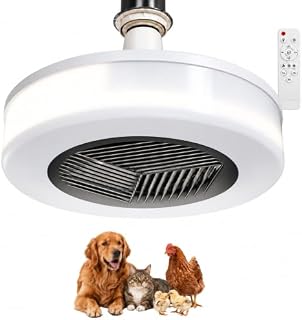 400W Chicken Coop Heater with Adjustable Heat ModesCheck price on Amazon
 Chicken Coop Heater for Winter with Smart APP ControlCheck price on Amazon
 Chicken Coop Heater Inside Coop with Remote ControlCheck price on Amazon
 PETNF Chicken Coop Heater 140 Watts Radiant Heat ChickenCheck price on Amazon
Best way to heat a chicken coop: start with the coop, not the heater
Wind and damp do more harm than cold air alone. Close gaps at roost height, patch holes and repair roof leaks before thinking about a heater. Wet bedding pulls warmth out of a coop, so keep it deep and dry and scoop out wet spots. A heater alone cannot fix a damp coop; without dry bedding and open high vents it only warms damp air. Our guide to winterizing a chicken coop covers the full fall checklist.
Ventilation still matters in the cold
It feels backwards, but a sealed coop is a problem. Chickens breathe out a lot of moisture overnight, and a closed-up coop holds it. Leave vents high on the walls, above the roosts, so damp air leaves without a breeze blowing across the birds.
Pick the heater type: panel, forced air or lamp
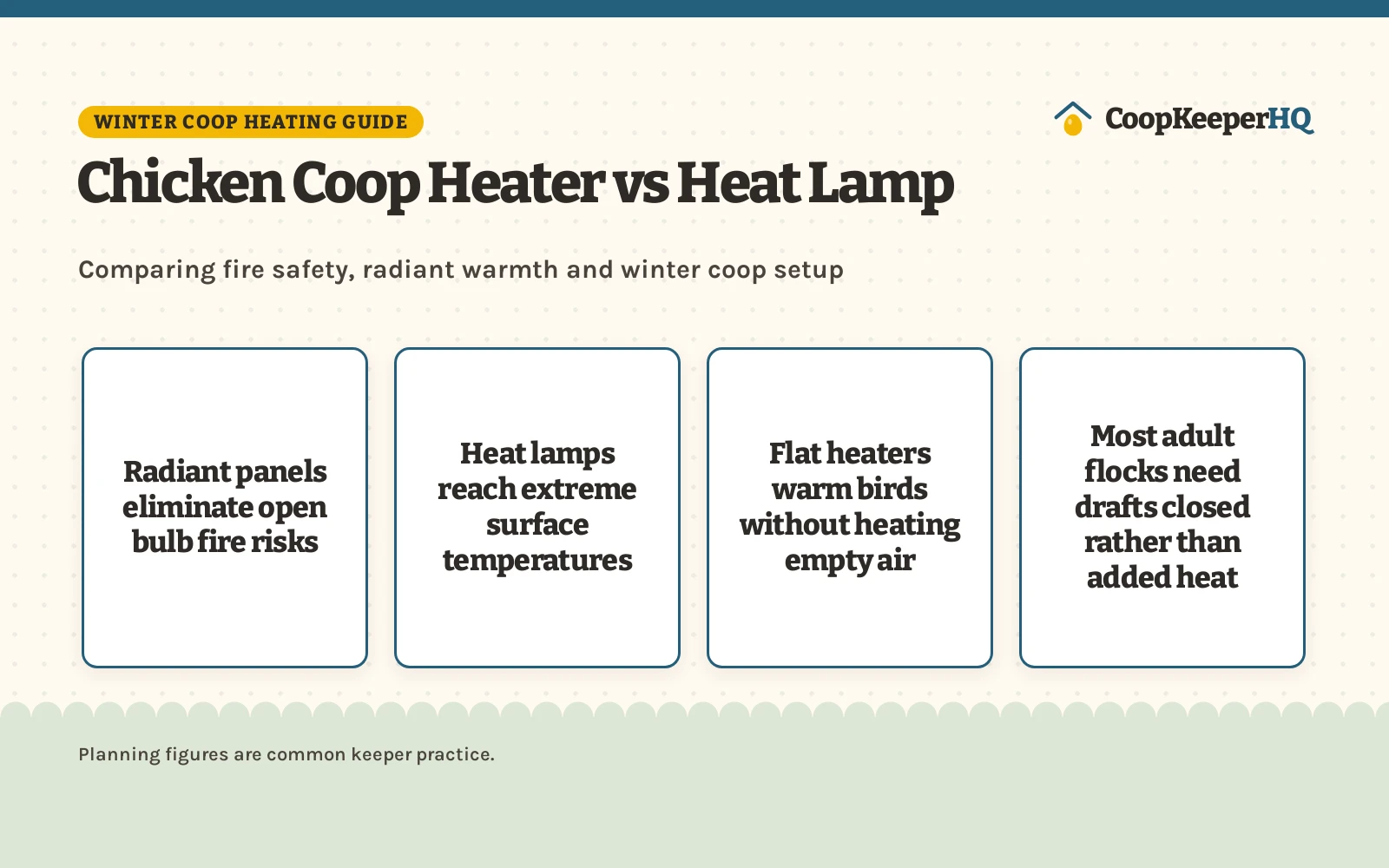
Three types show up in the listings, and they are not equal on safety. A flat radiant panel gives steady, gentle heat with no glowing bulb, and the TIMEBAL panel below carries a stated UL certification claim. A forced-air PTC heater moves warm air through the coop faster and usually brings a thermostat and a timer. A heat lamp is the risky one: a hot bulb over dry bedding is a well-known coop fire risk, so we recommend a panel instead. The chicken coop heater vs heat lamp comparison explains the risk in more detail.
The gear: four heaters that fit the job
Each heater below handles one part of the job: the panel gives low, steady heat, the two forced-air models warm a coop on a thermostat, and the lamp is the directional option with the fire risk that comes with it.
Mind the electrics
Anything plugged in at the coop should run from a GFCI outlet, with cords kept off the ground. Check cords every few weeks in winter, since rain, ice and dust age them fast. A thermostat plug or an outlet timer, like the ones the TIMEBAL listing says it works with, keeps the heater from running all day. See the thermostat vs timer for coop heater comparison before you run a cord to the coop.
A simple cold-weather checklist
- Roost area is free of drafts and the roof does not leak
- Vents high on the wall are open
- Bedding is deep and dry
- Water does not freeze
- Heater is on a thermostat or timer, not running all day
- Outdoor electrical gear is on a GFCI outlet with protected cords
Birds, breed size, run time and climate in; coop floor, run space, roost length and nesting boxes out.
Wash your hands after handling birds, eggs or equipment, supervise children around the flock, and check local rules on flock size and roosters before you buy. For sick birds, call a poultry veterinarian or your state extension office. See CDC backyard poultry guidance. Read our Safety Disclaimer.
FAQ for the flock
Do chickens need a heater in winter?
Most healthy adult chickens do not. A dry, draft-free roost with deep, dry bedding matters more than added heat.
Is a heat lamp safe in a chicken coop?
It is the riskiest option in this guide. A heat lamp is a well-known coop fire risk because the hot bulb can fall into bedding, so a flat radiant panel or heat plate is the safer choice, like the TIMEBAL panel in this guide.
What temperature should a chicken coop heater be set to?
Use each heater’s own range: the SolarCluck sets from 59 to 120°F and the QVVCOOP from 60 to 90°F, and their built-in thermostats cycle the heat on and off as the coop warms and cools. The TIMEBAL adjusts from 70 to 191°F but has no built-in thermostat, so it needs an external thermostatic plug, not included, to cycle the same way.
Can a chicken coop heater run on a timer?
Yes. The TIMEBAL works with outlet timers and thermostat plugs, not included. The SolarCluck has 8H, 12H and 24H timer options, and the QVVCOOP has a timer up to 12 hours.
How big a coop will these heaters warm?
The SolarCluck covers coops up to 285 sq ft and the QVVCOOP covers enclosed coops up to 220 sq ft. The QVVCOOP listing notes its coverage varies with insulation and outdoor temperature.
More coop guides
- Best Chicken Coop Heater: Safer Panels for Winter
- How to Winterize a Chicken Coop: A Fall Checklist
- Chicken Coop Fan vs Heater: Which One Should You Buy?
- Heat Plate vs Heat Lamp for Chicks: Which Is Safer?
- Best Radiant Heater for Chicken Coop (2026): 5 Picks Compared
- Chicken Coop Heater vs Heat Lamp: Which One Should You Buy?
- Thermostat vs Timer for Coop Heater: Which One Should You Buy?
- Best Chicken Coop Thermometer for Winter (2026)
- Do Chickens Need Heat Lamps in the Winter? A Practical Guide
- How to Keep Chickens Cool in Summer: Shade, Water and Airflow
See the chicken coop picks and the coop supply guides.