Do Chickens Need Heat Lamps in the Winter? A Practical Guide
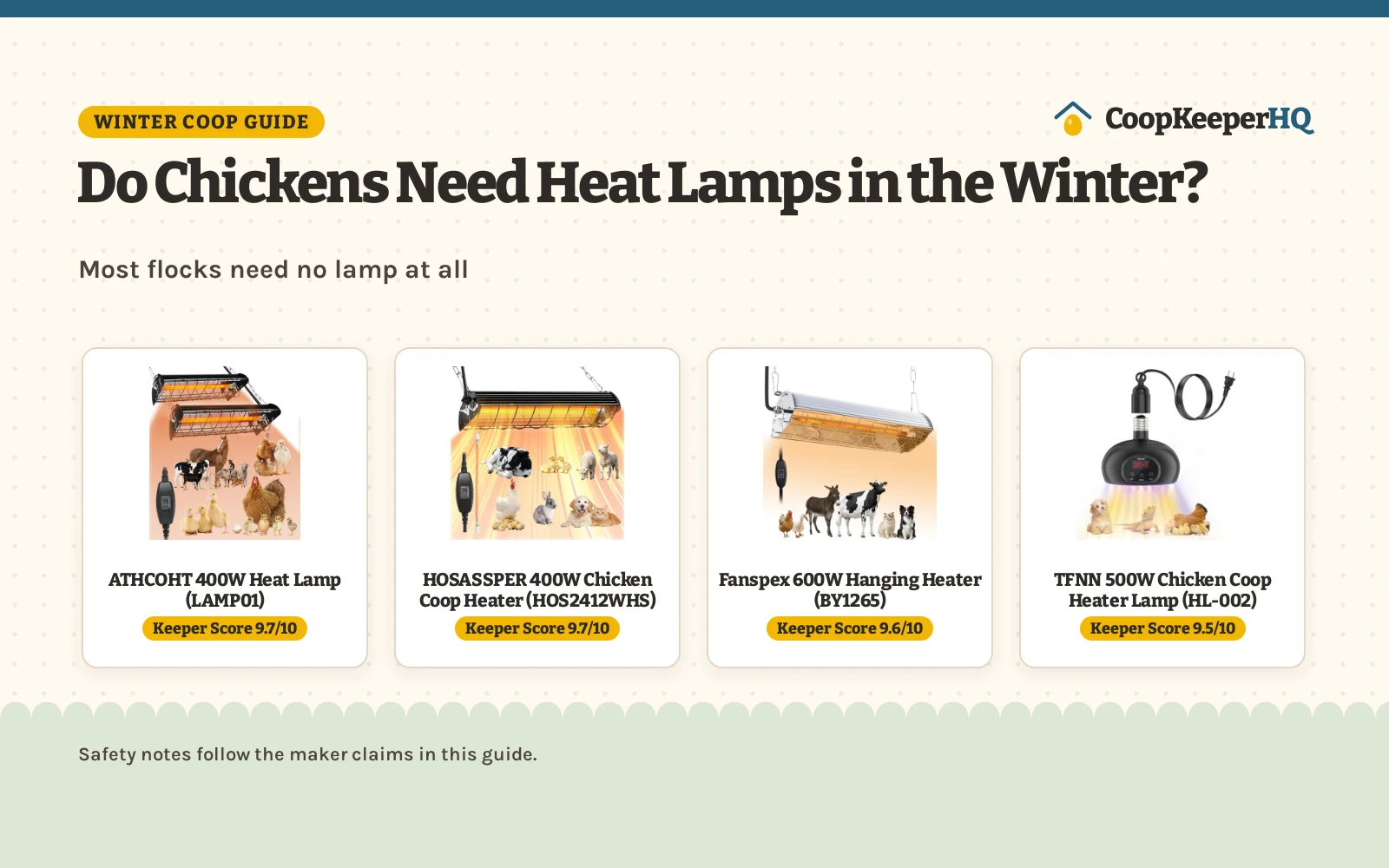
Most healthy adult chickens stay warm without a heat lamp when the coop is dry, draft-free and well ventilated, with safer heat choices for the coldest nights.

On this page
Top picks at a glance
As an Amazon Associate I earn from qualifying purchases.
- 1
 ATHCOHT 400W Heat Lamp for Chickens with Carbon9.7/10View on Amazon
- 2
 HOSASSPER 400W Chicken Coop Heater9.7/10View on Amazon
- 3
 Fanspex 600W Hanging Heater for Poultry Chicken9.6/10View on Amazon
- 4
 TFNN Chicken Coop Heater Lamp, 200W to 500W9.5/10View on Amazon
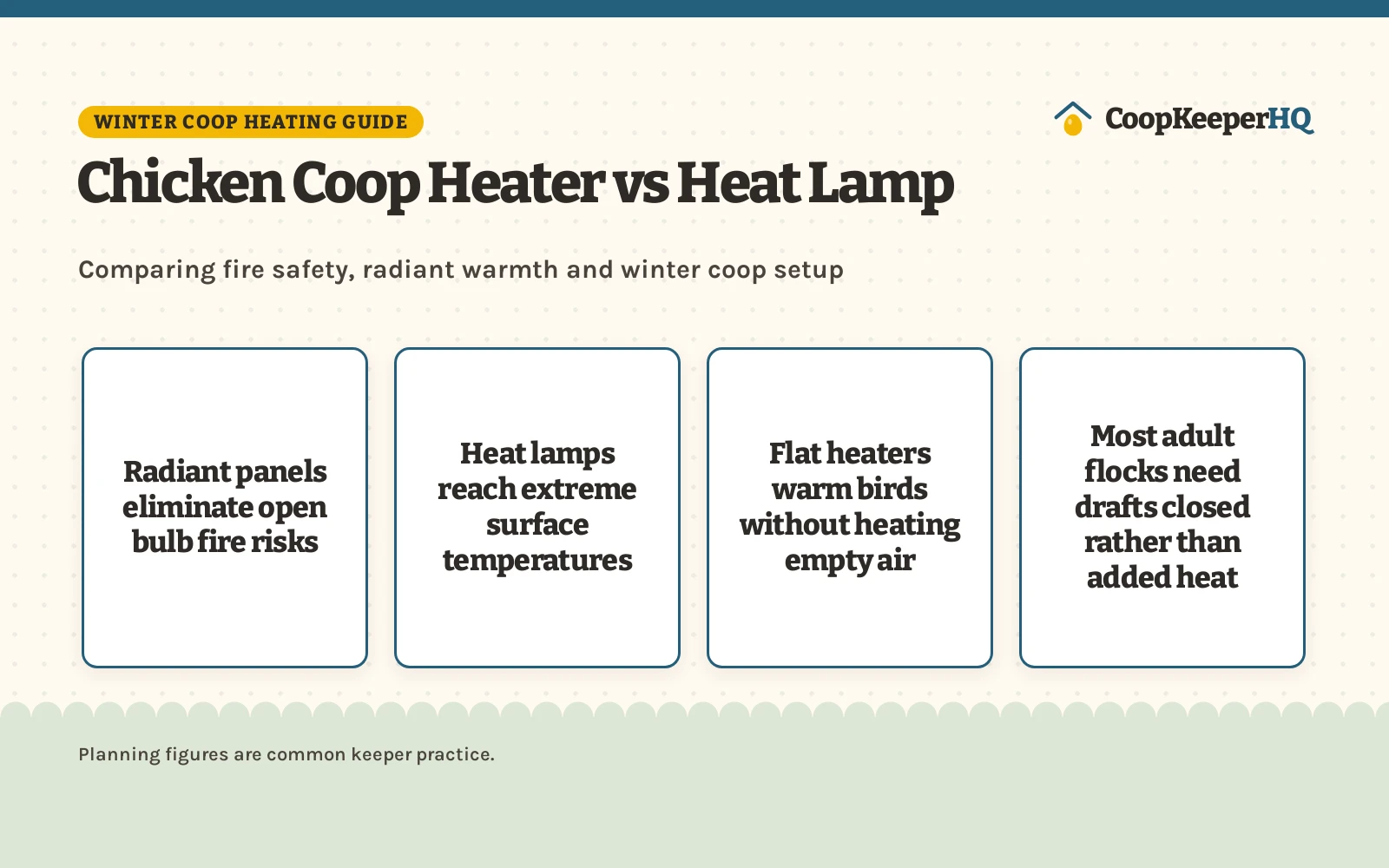
On a cold morning, the keeper opens the pop door to a quiet coop, checks the water, and wonders whether the birds need more warmth. The short answer to do chickens need heat lamps in the winter is no for most healthy adult chickens. A dry coop and still air at roost height do more for the flock than a hot bulb, and a lamp brings a fire risk into a coop full of dust and dry bedding.
CoopKeeperHQ earns a commission if you buy through our links, at no added cost to you. Affiliate disclosure.
ATHCOHT 400W Heat Lamp for Chickens with Carbon
A 2-pack carbon fiber lamp with 200W and 400W settings, a stated 12,000-hour bulb life, a UL power cord and IP67 code for added coop heat.
Who it's for: a keeper who wants added coop heat with a long stated bulb life.
Who should skip it: anyone who wants a timer, or a settled pack count, since the listing says both 1 pc and 2 Pack.
ATHCOHT lists a 400W carbon fiber lamp that heats in 1 to 2 seconds, switches between 200W and 400W, and covers up to 5,000 cm² at 90% heat conversion efficiency. The listing states a bulb life of up to 12,000 hours, about the life of five traditional infrared bulbs, plus a UL power cord the listing calls certified. One line disagrees: the color field says 1 pc while the title says 2 Pack.
Pros
- Two lamps in the pack for a large coop or a spare
- Bulb stated to last 12,000 hours
- 200W and 400W settings
- UL power cord and IP67 code stated
Cons
- Color field says 1 pc while the title says 2 Pack
- No timer is stated
- Hangs from chains, so it needs a hanging point
- Only two power settings
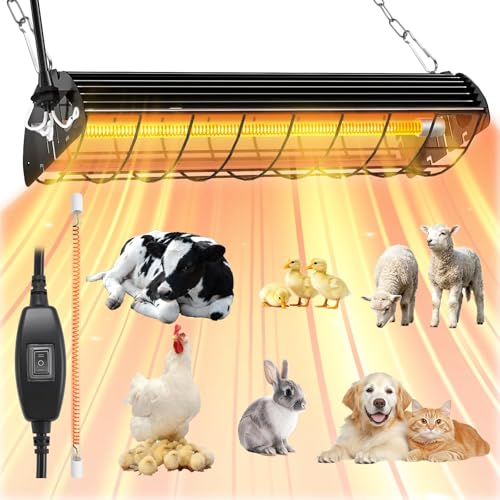
HOSASSPER 400W Chicken Coop Heater
A 400W carbon fiber lamp with 200W and 400W settings, a stated 12,000-hour bulb life, claimed UL certification and 5-layer protection, with a long 8.2 ft cord.
Who it's for: a keeper who wants added coop heat with a long cord and a safety cage.
Who should skip it: anyone who wants a timer, or a UL number behind the claim.
HOSASSPER lists a 400W carbon fiber lamp with two heat settings, low at 200 watts and high at 400 watts, and heat in 1 to 2 seconds. The listing claims 3x faster heating than conventional lamps, a 28% cut in power use, UL certification with 5-layer protection, and a protective safety cage, on an 8.2 ft cord with a toggle switch. Two wordings do not match: the title says UL Passed, the bullets use different words, and no UL number is stated. The lifespan line reads 12,000W hours, which looks like a misprint.
Pros
- Carbon fiber bulb stated to last 12,000 hours
- 200W and 400W settings for different weather
- UL certification, 5-layer protection stated
- 8.2 ft cord with a toggle switch
Cons
- UL claim worded differently, no UL number stated
- Lifespan written as 12,000W hours, reads like a misprint
- No timer is stated
- No coverage area is stated
Fanspex 600W Hanging Heater for Poultry Chicken
A 600W hanging heater with 300W and 600W modes and a stated MTBF of 10,000+ hours.
Who it's for: a keeper who wants the strongest stated wattage here, with a metal cage around the element.
Who should skip it: anyone who wants a stated safety certification or a timer.
Fanspex lists a 600W hanging heater with two modes, 300W and 600W, a carbon fiber element with a stated MTBF of 10,000+ hours, and heat in 3 seconds. The body is metal throughout, with a high reflective aluminum panel and a metal mesh cage around the heater. A 6.5 ft chain is included. The listing names no safety certification or timer.
Pros
- 600W high mode for large spaces
- MTBF of 10,000+ hours stated
- Heats in 3 seconds, per the listing
- Metal mesh cage keeps pets from the heater
Cons
- No UL or ETL listing is stated
- No timer is stated
- One heater in the pack
- Heat area called large, no size stated
TFNN Chicken Coop Heater Lamp, 200W to 500W
A heater lamp with 200W, 350W and 500W settings, a timer, claimed UL certification and a 197°F overheat cutoff for timed coop heat.
Who it's for: a keeper who wants a timer and three power settings, and who hangs it by the ring on top.
Who should skip it: anyone who wants a stated warranty, or matching socket and timer lines.
TFNN lists a heater lamp with three temperature switches at 200W, 350W and 500W, three brightness levels, and a timer with 3H, 6H, 9H and 12H settings plus always on. The listing states UL certification, flame retardant material and overheat protection, with power cut off past 197°F. It also lists 8 full-light bulbs, 12 UVA bulbs and 4 UVB bulbs, much of it light for reptiles. Two lines do not match: the title says E36/E27 sockets while the bullets say E26/E27, and the title timer lists 3, 6 and 12 hours while the bullets add 9H.
Pros
- Three power settings: 200W, 350W, 500W
- Timer with 3H, 6H, 9H, 12H plus always on
- Claimed UL certification, overheat protection, 197°F cutoff
- 365 days after-sales service stated
Cons
- Title says E36/E27, bullets say E26/E27
- Title timer lists 3, 6, 12 hours; bullets add 9H
- No warranty term is stated
- Bulb detail covers UVA and UVB light
Other options for the coop
 600W Heat Lamp for ChickensCheck price on Amazon
 QRQ Chicken Coop HeaterCheck price on Amazon
 Homnebila 250W Chicken Coop Heat Lamp with Guard & AdjustableCheck price on Amazon
 Chicken Coop Heater Inside Coop heat lamp,300 Watt Two-StageCheck price on Amazon
 Chicken Coop Heater for WinterCheck price on Amazon
 REPTI ZOO 2 Pack Infrared Heat LampCheck price on Amazon
Do chickens need heat lamps in the winter? Start with the coop, not the lamp
Chickens carry a thick layer of feathers, huddle on the roost, and warm the coop with their own bodies. What chills them is damp and wind, not cold air alone, so close gaps at roost height and keep rain and snow from blowing in. Leave vents high on the walls, above the roosts, so damp air leaves. That answers the related question, do chicken coops need to be heated, too: most do not.
Heat lamps for the coop
If extra heat is still needed, the lamps below handle that one job, with settings from 200W to 600W.
Keep the coop dry and draft-free
Wind and damp do more harm than cold air alone. Repair roof leaks first, and keep the floor dry with deep bedding, topped up when the surface gets damp. Hardware cloth over openings keeps predators out while the coop is aired, and the hardware cloth guide covers what to buy. The chicken coop bedding picks compare pine, aspen and hemp.
Keep water from freezing
Chickens drink less when the water is frozen. A heated waterer base or heated waterer solves it, and the heated chicken waterer guide compares them. Use a GFCI outlet for any outdoor electrical gear, and check cords for chew marks.
If extra heat is needed, choose the safer kind
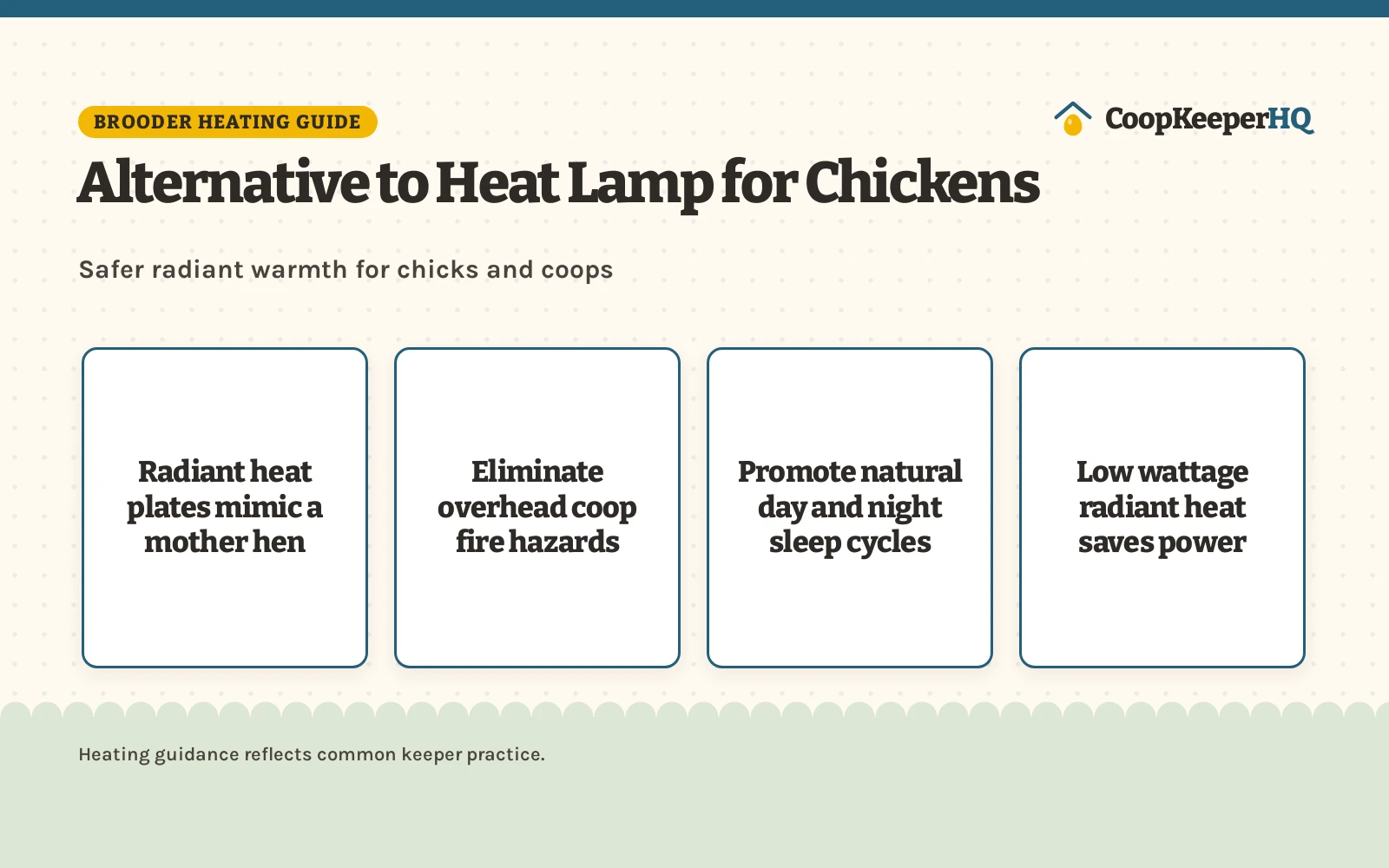
A heat lamp is a choice for particular climates or birds, and it brings a hot bulb and a power cord into a coop full of dust and dry bedding. A flat radiant panel with a stated UL or ETL listing is the safer type, and the best chicken coop heater guide compares panels. For chicks, a heat plate beats a lamp; the heat plate vs heat lamp comparison and the brooder heat plate guide explain why. If unsure, ask a poultry vet or the state extension office.
A simple winter checklist
- Roost area is free of drafts and the roof does not leak
- Vents high on the wall are open
- Bedding is deep and dry
- Water does not freeze
- Outdoor electrical gear is on a GFCI outlet with protected cords
- Any heat lamp hangs clear of bedding, or is swapped for a panel
For the full list of repairs before cold weather, see the guide to winterizing a chicken coop, and the automatic coop door guide covers closing the pop door when the keeper is out late.
Birds, breed size, run time and climate in; coop floor, run space, roost length and nesting boxes out.
Wash your hands after handling birds, eggs or equipment, supervise children around the flock, and check local rules on flock size and roosters before you buy. For sick birds, call a poultry veterinarian or your state extension office. See CDC backyard poultry guidance. Read our Safety Disclaimer.
FAQ for the flock
Do chickens need heat in winter?
Most healthy adult chickens do not: a dry, draft-free roost with deep bedding matters more than added heat.
Is it safe to use a heat lamp in a coop?
Heat lamps are a known coop fire risk because a hot bulb can fall into bedding. A flat radiant panel or heat plate is the safer type.
What wattage should a coop heater be?
The lamps in this guide run from 200W to 600W, with settings from 200W to 400W on two of them. Match the setting to the size of the space and the weather, and hang the lamp where birds cannot touch it.
Should chicks get a heat lamp in winter?
Chicks need warmth until they feather out, and a heat plate is the safer choice for a brooder.
More coop guides
- How to Keep Chickens Warm in Winter Without Overheating the Coop
- Heat Plate vs Heat Lamp for Chicks: Which Is Safer?
- Best Chicken Coop Heater: Safer Panels for Winter
- Best Brooder Heat Plate: Safer Heat for Chicks
- Best Heated Chicken Waterer: Picks That Will Not Freeze
- How to Winterize a Chicken Coop: A Fall Checklist
- Best Chicken Coop Bedding: Shavings, Hemp and Sand
- Chicken Coop Fan vs Heater: Which One Should You Buy?
- Insulated vs Uninsulated Chicken Coop: Which One Should You Buy?
- How to Keep Chickens Cool in Summer: Shade, Water and Airflow
- Chicken Keeping Supplies List: What You Need and What Can Wait
See the chicken coop picks and the coop supply guides.