How Long Does Chain Link Fence Last
How long a chain link fence lasts comes down to its coating, its wire gauge and its posts and gates, and what to check each season to keep the run standing.

On this page
Top picks at a glance
As an Amazon Associate I earn from qualifying purchases.
- 1
 Goldshire 48x72in Adjustable Galvanized Chain Link Fence Gate9.7/10View on Amazon
- 2
 FULUPET Chain Link Fence Gate9.6/10View on Amazon
- 3
 VEVOR Chain Link Fence Gate 32 x 46 in Adjustable Garden9.6/10View on Amazon
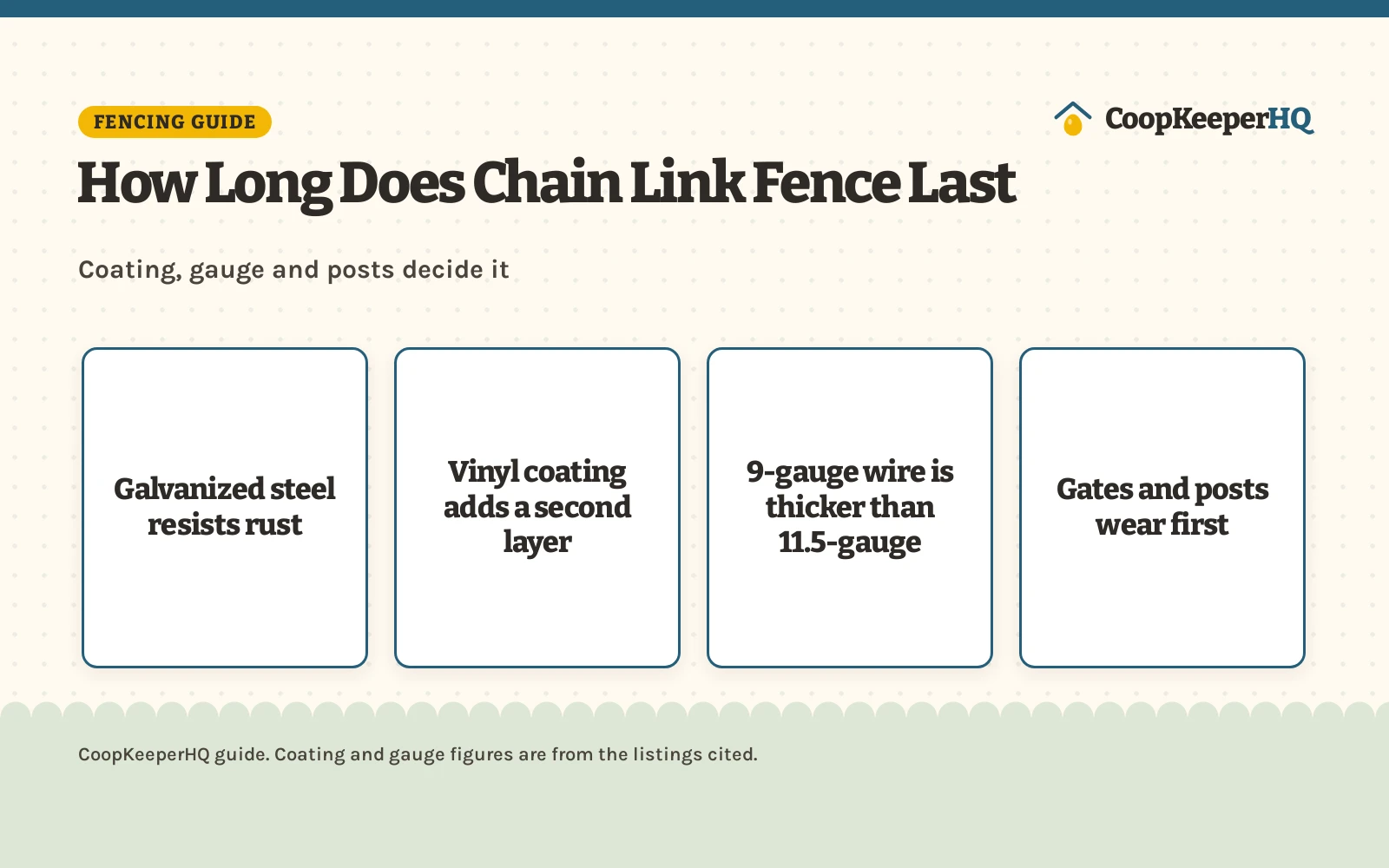
A run fence takes weather, hens scratching at its base and the odd bump from a wheelbarrow, season after season. How long does chain link fence last? There is no honest single figure, but the ranking is clear from what the listings state: thick, vinyl-coated galvanized fabric should last longest, plain galvanized fabric of thinner wire comes next, and in either case the gates, fittings and posts usually give out before the fabric does. Rust starts wherever the coating gets broken, so a sound coating and sound hardware matter more than age alone.
CoopKeeperHQ earns a commission if you buy through our links, at no added cost to you. Affiliate disclosure.
How long does chain link fence last: what decides it
A chain link fence is a set of parts, and each part ages at its own pace. The fabric is galvanized steel, sometimes with a vinyl coat over it. The posts and rails hold the fabric up, and the gate is the part that moves. From the listings, the order from longest-lasting to shortest is: 9-gauge vinyl-coated galvanized fabric, then bare 11.5-gauge galvanized fabric. The listings give no year counts, so we do not either. What usually fails first is not the fabric but the gate, the fittings and the posts, and rust begins where the coating is scraped or nicked. A fence that stays tight and dry at its base lasts longer than one that sags, leans or sits with its coating scraped away.
The coating: galvanized steel, with or without vinyl
Every fabric listing here is galvanized steel, and the listings describe the galvanizing as rust resistant. The 9-gauge CAPHAUS and Fencer Wire rolls add a black vinyl coat over the galvanized steel: the listings call the result 9-gauge black vinyl-coated galvanized steel, and describe it as rust resistant and long lasting. The 11.5-gauge rolls are galvanized steel without the vinyl coat. The vinyl layer covers the steel, so a scratch that reaches the steel matters more than a scuff on the vinyl. One VEVOR gate lists galvanized steel with a plastic coating on the frame; the other VEVOR gates list galvanized steel. The Epcee gate (on Amazon) pairs galvanized steel pipes with 304 stainless steel connectors, which the listing states resist corrosion.
Coating is not the whole story: a galvanized coating resists rust on the wire, but it does not stop a gate from sagging or a post from leaning. Treat the coating as the fence’s rust defence and the frame as its strength, and check both.
Wire gauge and mesh size
Wire gauge runs the other way from what you might expect: the 9-gauge fabric in these listings is thicker than the 11.5-gauge fabric. The CAPHAUS rolls come in both gauges, and the Fencer Wire rolls do too, so the gauge is a choice you make when you buy the roll. Thicker wire stands up better to knocks and the daily push of birds against the mesh, while thinner wire is lighter to handle and easier to cut to length. Our types of wire fence guide compares the wire types for chicken runs.
Mesh size is the diamond in the fabric. The CAPHAUS and Fencer Wire rolls list a diamond mesh size of 2-3/8 inches, and the VEVOR gates list a 2.5 x 2.5-inch mesh. The VEVOR listings state that tightly woven chain links prevent small animals from getting through, and the gate mesh and the fabric mesh should match so there is no weak panel in the run. Note that the listed gate mesh, 2.5 inches, is wider than the listed fabric mesh, 2-3/8 inches, so the gate is the wider opening in the run.
One caution for a chicken run: 2-3/8 inch diamond chain link does not stop weasels, rats or digging predators. Add hardware cloth over the lower part of the fence and an apron along the ground. Our hardware cloth guide covers the rolls for that job.
Best rolls for a run
If you are buying fabric, these are the listings compared here, with the coating and gauge each one states:
- CAPHAUS 9-gauge black vinyl-coated galvanized steel, 48 inch x 50 ft roll: the thicker, vinyl-coated option.
- Fencer Wire 9-gauge black vinyl-coated galvanized steel, 4 ft x 50 ft roll: the same gauge and coating, listed in feet.
- CAPHAUS 11.5-gauge galvanized steel, 48 inch x 50 ft roll: thinner wire, no vinyl coat.
- Fencer Wire 11.5-gauge galvanized steel, 5 ft x 50 ft roll: thinner wire, no vinyl coat, taller roll.
For the longest-lasting fabric, the two vinyl-coated 9-gauge rolls are the pick from these listings.
Posts, gates and hardware wear first
Fittings, gates and posts usually fail before the fabric does. Posts lean when the ground softens, gates sag on their hinges, and latches and tension bands work loose. Two VEVOR gates list a 72 x 48 inch frame and one lists a 70 x 72 inch frame; all three fit openings from 24 to 72 inches, include a latch, hinges and cable ties, and suit 40/42mm posts. The Epcee gate lists a 2.6ft x 5ft frame with chain link tension bands and 304 stainless steel L-connectors, and notes that posts, hinges and latches are not included, so those come separately. See our chain link fence gate sizes guide for gate dimensions, and the chain link fence post size guide for posts and rails.
The frame pipe matters too. The Master Halco listing is 1-3/8 inch by 8 foot galvanized pipe in 18-gauge, sold as 4 pieces, for chain link fence, gates and posts. The SmartSign fence clips (on Amazon) are galvanized steel, with three 3/8 inch holes and three 3/16 inch holes, and the kit includes 2 fence clips, 2 bolts, 2 screws and 4 nylon washers. Small fittings like these are easy to swap, and a loose clip or a missing bolt is often what lets a panel sag. Our guide to setting run posts covers posts that stay straight.
What shortens a fence’s life
Rust starts where the coating is broken, so a nick from a mower or a scrape from a barrow is where trouble begins. Standing water at the base keeps the bottom of the fabric damp, and a gate that drags wears its hinges and latch. Vegetation growing through the mesh holds damp against the wire and pulls the fabric out of shape. Walk the fence line now and then, look for rust spots, loose bands and leaning posts, and fix the small things before they become a leaning panel.
A simple fence checklist
- Gates hang level and latches and hinges are tight
- Posts stand straight and tension bands are tight
- Coating is sound, with no bare wire showing
- Fabric is tight, with no sagging panels
- Mesh matches across gates and fabric
- Vegetation is clear of the wire
For the run around the fence, see our types of fence posts guide and the types of fence gates guide.
Birds, breed size, run time and climate in; coop floor, run space, roost length and nesting boxes out.
Wash your hands after handling birds, eggs or equipment, supervise children around the flock, and check local rules on flock size and roosters before you buy. For sick birds, call a poultry veterinarian or your state extension office. See CDC backyard poultry guidance. Read our Safety Disclaimer.
FAQ for the flock
How long does a chain link fence last?
There is no single figure, but the order is clear. Vinyl-coated 9-gauge galvanized fabric should last longest, bare 11.5-gauge galvanized fabric comes next, and gates, fittings and posts usually fail before either. Judge the fence by its coating, its gauge and its fittings, not by age alone.
Does galvanized chain link fence rust?
Galvanized steel resists rust, and the listings describe the galvanizing as rust resistant. Rust starts where the coating is broken, so a scratch that reaches the steel is the place to watch. The vinyl-coated rolls add a second layer over the galvanized steel.
What gauge chain link fence should I buy for a chicken run?
The listings here offer 9-gauge and 11.5-gauge fabric, and the 9-gauge is thicker. Thicker wire stands up better to knocks and daily wear, while the 11.5-gauge is lighter to handle. Match the gauge to how hard the run is used, and match the mesh across gates and fabric.
What wears out first on a chain link fence?
The moving and fastening parts: gates sag on their hinges, latches and tension bands work loose, and posts lean. The fabric usually lasts longer than these fittings, so check the gate and the posts first when a fence starts to look tired.
Does chain link fence keep predators out of a chicken run?
Not on its own. The 2-3/8 inch diamond mesh does not stop weasels, rats or digging predators, so add hardware cloth and a ground apron to the run.
How can I make a chain link fence last longer?
Keep the coating sound, the fabric tight and the gate hung level. Clear vegetation from the wire, fix loose bands and clips, and repair rust spots where the coating is broken. Check the posts after wet weather, since leaning posts pull the whole fence out of shape.
More coop guides
- Chain Link Fence Gates Sizes: Dimensions Chart
- Chain Link Fence Post Size: Terminal, Line and Rail Sizes
- Types of Fence Posts: Materials Compared
- Types of Fence Gates for Chicken Runs
- Types of Wire Fence for Chicken Runs
- Fence Panels Types for Runs and Enclosures
- How Deep Post for Fence: Setting Run Posts That Stay Straight
- Best Chain Link Fence Locks for Outdoor Gates (2026)
- Best Predator Proof Chicken Coop Fencing Hardware Cloth (2026): 5 Rolls for the Run
- How to Use a Post Driver for Fence Posts
See the chicken runs and fencing picks and the coop supply guides.