Build vs Buy Chicken Coop: Which One Should You Buy?
Comparing prebuilt kits and DIY coop builds across lumber durability, predator protection, labor time and real flock space.

On this page
Top picks at a glance
As an Amazon Associate I earn from qualifying purchases.
- 1
 PetsCosset Chicken Coop with Wheels9.6/10View on Amazon
- 2
 Quictent Large Chicken Run9.6/10View on Amazon
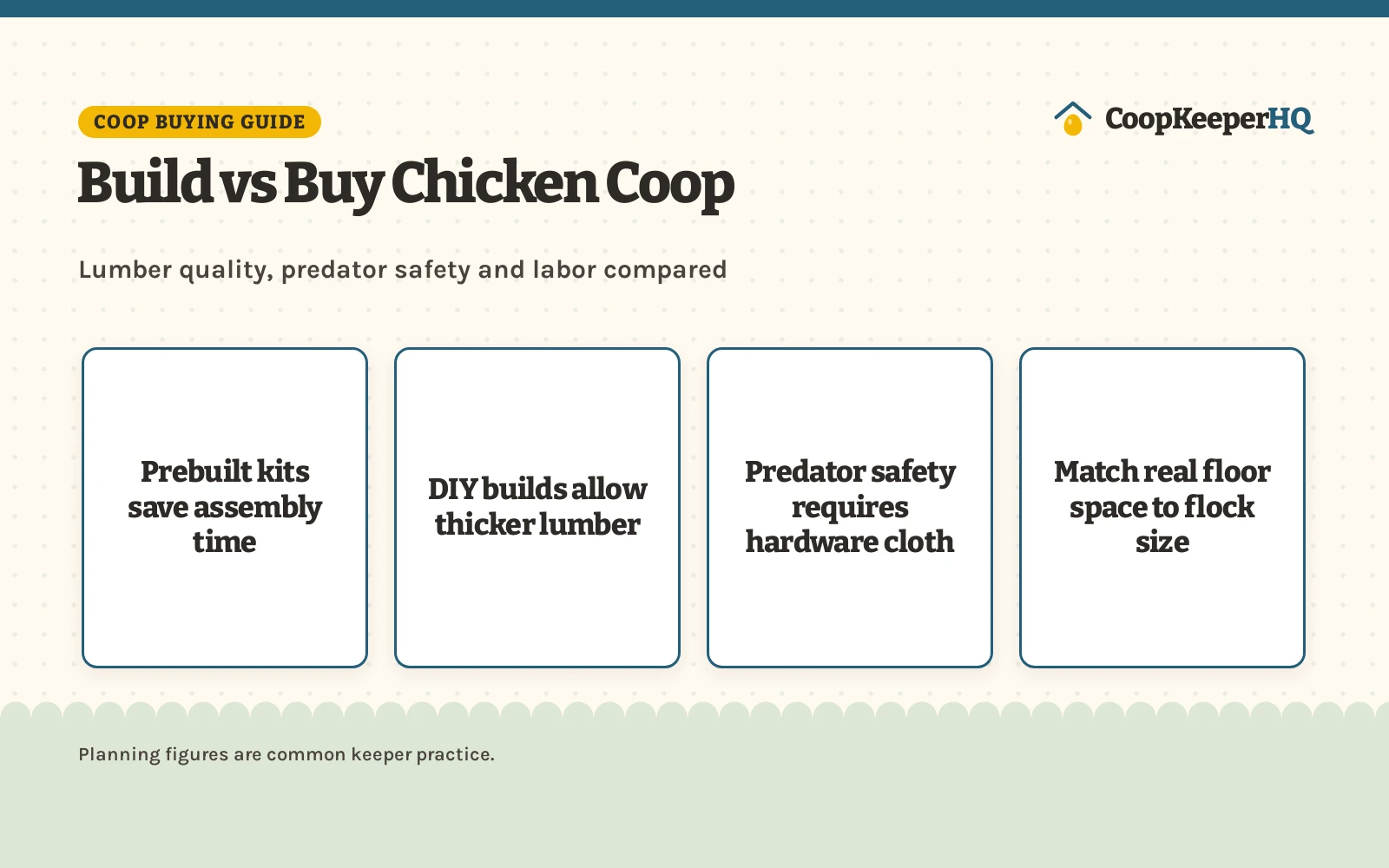
Every morning when you step out to unlatch the pop door and collect fresh eggs, your coop either makes chores simple or turns them into extra work. Deciding between a build vs buy chicken coop comes down to your carpentry skills, available free time and housing goals: buying a prebuilt kit saves time by providing manufactured panels and assembly hardware in one package, while building your own coop delivers custom dimensions, heavier framing materials and a layout tailored to your backyard.
Other options for the coop
 GOJOOASIS 40" Wooden Chicken Run Coop Outdoor Hen HouseCheck price on Amazon
 Sweet PDZ Chicken Coop RefresherCheck price on Amazon
 Automatic Chicken Coop Door Solar Powered with Timer & LightCheck price on Amazon
 Chicken Coop Heater for Winter with Smart APP ControlCheck price on Amazon
 Chicken Coop Heater Inside Coop with Remote ControlCheck price on Amazon
 PETNF Chicken Coop Heater 140 Watts Radiant Heat ChickenCheck price on Amazon
CoopKeeperHQ earns a commission if you buy through our links, at no added cost to you. Affiliate disclosure.
Build vs buy chicken coop: start with your flock size and timeline
Before purchasing lumber or ordering a prebuilt coop, evaluate your timeline and flock plans. If you have growing chicks in a brooder, you face a firm deadline before they outgrow their space and require outdoor housing. Ordering a prebuilt kit delivers ready-to-assemble shelter in flat boxes with pre-drilled panels. If you have weekends to spare and specific dimensions in mind, building your own coop gives you full control over lumber selection, interior height and layout details. Prebuilt options range from compact backyard hutches to large walk-in enclosures, while a custom build lets you fit irregular spaces or match existing outbuildings.
Prebuilt coop kits: speed and convenience
The main appeal of a prebuilt chicken coop is convenience. Instead of drafting cut lists and hauling lumber, you receive labeled components, hardware and instructions. Most kits assemble with a cordless drill and basic hand tools. For small yards, compact kits provide dedicated zones in a tidy footprint. For example, the Petsfit outdoor coop (on Amazon) listing provides an overall footprint of 80.5 x 30 x 41.5 inches with 2 nesting boxes and 2 roost bars, rated for 2 to 4 chickens. For mobile pasturing, the PetsCosset chicken tractor (on Amazon) listing measures 77.41 x 25.6 x 39.4 inches with dual wheels, 5 access points and a 55 pound weight, rated for 2 to 4 chickens or 4 to 6 depending on breed. Larger prebuilt designs also include walk-in metal runs and multi-box wooden hen houses, giving keepers choices across different flock sizes without needing woodworking equipment.
DIY coops: durability and custom layout
Building your own coop allows you to design around your chores and backyard layout. While compact hutch kits require bending down to clean floors, building a custom walk-in coop lets you set ceiling heights and doorway dimensions to your own height, eliminating back strain when shoveling out bedding. You can orient windows to capture summer breezes while shielding roosts from prevailing winter winds, position nesting boxes at waist height for comfortable egg collection, and tailor roost lengths to your flock. Reviewing proven walk-in chicken coop plans provides practical structural layouts designed around keeper ergonomics and flock comfort.
Material strength: thin panels versus solid lumber
Material quality represents an important comparison between commercial kits and custom builds. Many compact wooden coops rely on lightweight fir framing and thin panels to keep package weights practical for parcel delivery. In exposed outdoor settings, lighter wood can weather over several seasons without diligent maintenance. Listings frequently include anchoring hardware to stabilize light structures; for example, the Petsfit listing provides 6 ground stakes to help protect its fir frame against soil shifting and tipping. Some specialized wooden shelters use heavier lumber, such as the FunXplore listing which features solid wood panels measuring 1.38 inches thick.
When building your own coop, you select every board, choosing exterior-grade plywood, dimensional timber framing and corrugated metal or asphalt roofing. If you prefer prebuilt metal construction for outdoor runs, commercial walk-in enclosures provide rigid steel frames. The Quictent walk-in run (on Amazon) listing features 1 inch diameter steel poles reinforced with 8 support bars, 1 x 1 inch 20 gauge welded hardware cloth and 550 zip ties measuring 0.2 inch breadth, with a total weight of 91 pounds. Similarly, the Amopatio walk-in metal run (on Amazon) listing features galvanized steel tubing with a 185 pound weight across a 79 x 119 x 79 inch frame.
Predator proofing: hardware cloth and secure latches
Backyard predators such as raccoons, foxes and rodents constantly search for coop entry points. Wire mesh specifications vary across manufactured enclosures. While some lighter pens use hexagonal wire, understanding what is hardware cloth helps you assess whether an enclosure offers adequate defense against persistent predators. Dependable predator protection requires welded wire mesh, and our hardware cloth guide details wire specifications. For example, the Quictent walk-in run listing includes 1 x 1 inch 20 gauge square welded hardware cloth with PVC coating and an extended ground skirt to prevent digging predators.
Latches also require close inspection. Basic coops sometimes rely on simple sliding barrel bolts that dexterous raccoons can lift, whereas other prebuilt models incorporate reinforced hardware. For instance, the Sannwsg walk-in chicken coop (on Amazon) listing includes 3 reinforced metal locks to keep doors shut. Whether buying a kit or building from plans, inspecting dependable chicken coop latches and adding locking carabiners ensures your doors remain safely fastened.
Real floor space: roosts, vents and nesting boxes
Manufacturer bird ratings frequently calculate capacity by including exterior run space or nesting boxes in total dimensions. For instance, the GUTINNEEN coop listing states an overall footprint of 137 x 63 x 62 inches with 6 nesting boxes, 3 push-pull vents and a 27.75 square foot ground activity space in the run, rated by the maker for 10 to 15 chickens. The enclosed sleeping area floor dimensions are not stated in the listing table. In practice, hens need adequate interior floor space to prevent overcrowding and behavioral friction. Our square foot for chicken coop sizing guide explains standard space recommendations, and our coop space guide outlines healthy sizing. Roost layouts also matter: the GUTINNEEN listing includes 4 perches inside the sleeping area and 3 perches in the run, while building your own coop lets you position roosts at custom heights away from draft lines.
Time investment: assembly versus full construction
Your available schedule often decides the build versus buy choice. Assembling a prebuilt kit generally takes a single afternoon. The FunXplore listing notes assembly can be completed in about 30 minutes with pre-drilled holes, while larger enclosures like the Amopatio metal walk-in run listing note assembly requires 2 people working together. Constructing a DIY coop requires a larger commitment across multiple weekends for cutting, framing, siding and painting. If you enjoy carpentry and own basic tools, building is deeply rewarding. If your free time is limited, a prebuilt kit houses your flock without delay.
Budget considerations without hidden expenses
Comparing expenses requires looking beyond initial purchase price tags. A prebuilt coop kit provides an all-in-one package with hardware, roofing and panels in a combined shipment. Depending on the model, keepers sometimes spend extra upgrading mesh to welded hardware cloth, adding locking carabiners or applying exterior weather sealant. Building your own coop requires purchasing framing timber, siding, roofing, hinges, latches and mesh separately. While custom building is not always cheaper in upfront materials than an entry-level kit, every dollar invested buys dimensional lumber and heavy-duty hardware tailored to your climate. Our chicken coop for beginners guide details starter planning.
Daily chores and long-term maintenance
Daily chore routines reveal the practical strengths of each option. Prebuilt kits often feature slide-out droppings trays: the Petsfit model includes a lower clean-out door, the GUTINNEEN model has a pull-out tray, and the PetsCosset tractor features a slide-out tray with 5 access points. While sliding trays sound convenient, bedding can jam in runner grooves over time, requiring routine clearing. A custom DIY coop lets you design deep-litter floors and wide cleanout doors that fit a wheelbarrow. You can also integrate an automatic chicken coop door to let birds into the run at dawn while locking them at dusk.
A simple build vs buy checklist
Use this quick checklist to match your flock and schedule to the right coop choice:
- Choose a prebuilt coop kit if: you need shelter quickly, lack carpentry equipment, or want an all-in-one package with pre-drilled parts and included hardware.
- Choose a DIY coop build if: you have carpentry tools, want custom dimensions to fit your yard, and prefer selecting heavy dimensional lumber and thick exterior siding.
- Choose a hybrid approach if: you want the structural permanence of a custom wooden roost house paired with the fast assembly of a prebuilt metal walk-in run like a Quictent or Amopatio enclosure.
- Key checklist item for prebuilt coops: check whether the listing includes welded hardware cloth and secure latches, or whether those components need upgrading before flock arrival.
Birds, breed size, run time and climate in; coop floor, run space, roost length and nesting boxes out.
Wash your hands after handling birds, eggs or equipment, supervise children around the flock, and check local rules on flock size and roosters before you buy. For sick birds, call a poultry veterinarian or your state extension office. See CDC backyard poultry guidance. Read our Safety Disclaimer.
FAQ for the flock
Is it cheaper to build or buy a chicken coop?
Building a coop is not always cheaper in upfront materials because dimensional lumber, welded hardware cloth, roofing shingles and heavy latches add up quickly. However, building provides greater control over materials and custom floor dimensions for your total investment, whereas entry-level prebuilt kits prioritize fast assembly and compact shipping.
How long does a prebuilt wooden chicken coop last?
Working lifespan depends on wood thickness, local weather and routine care. While lightweight fir panels benefit from regular application of pet-safe exterior wood sealant and roof maintenance, coops built with solid wood panels or heavy dimensional lumber provide longer service life outdoors.
What should I upgrade on a prebuilt chicken coop?
Examine the wire mesh and door hardware first. If a kit uses light wire or basic barrel slide bolts, upgrading to welded hardware cloth and locking carabiners improves predator defense. Applying exterior weather sealant and anchoring the base against wind also protects the structure.
Can a beginner build a chicken coop?
Yes. Beginners can construct a durable chicken coop by selecting straightforward plans with standard rectangular framing and simple shed roofs. Using pre-cut lumber dimensions and verified cut lists keeps carpentry manageable.
Why do prebuilt coop manufacturer chicken counts seem high?
Makers often calculate flock ratings based on minimum roost contact or include attached run space in the overall total. Experienced keepers evaluate housing strictly by enclosed interior floor space to avoid overcrowding.
More coop guides
- Chicken Coop for Beginners: Sizing, Setup, and Daily Care
- Square Foot for Chicken Coop: Complete Sizing Guide (2026)
- Walk in Chicken Coop Plans: Complete Backyard Guide
- Best Chicken Coop for 6 Chickens: Picks Checked for Real Floor Space
See the chicken coop picks and the chicken run guides.