Stainless vs Galvanized Hardware Cloth: Which One Should You Buy?
Stainless resists rust through the alloy itself while galvanized relies on a zinc coating; three 304 stainless rolls ranked for coop and run work.

On this page
Top picks at a glance
As an Amazon Associate I earn from qualifying purchases.
- 1
 GMOTLSE 304 Stainless Steel Hardware Cloth9.6/10View on Amazon
- 2
 PAULEEN Black Hardware Cloth 16 in x 10 ft9.5/10View on Amazon
- 3
 Stainless Steel 304 Welded Wire Mesh-15.7 inches x 10 feetView on Amazon
- 4
 SS304 Stainless Steel 1/4 Hardware Cloth,Stainless Steel WireView on Amazon
- 5
 304 Stainless Steel Hardware Cloth 1/2 Inch 20 Gauge ChickenView on Amazon
- 6
 304 Stainless Steel Hardware Cloth 1/4 23 GA 24in x 49ft RollView on Amazon
- 7
 304 Stainless Steel Hardware Cloth 1/2 20 GA 40in x 48ft RollView on Amazon
- 8304 Stainless Steel Hardware Cloth 1/2 20 GA 48in x 48ft RollView on Amazon
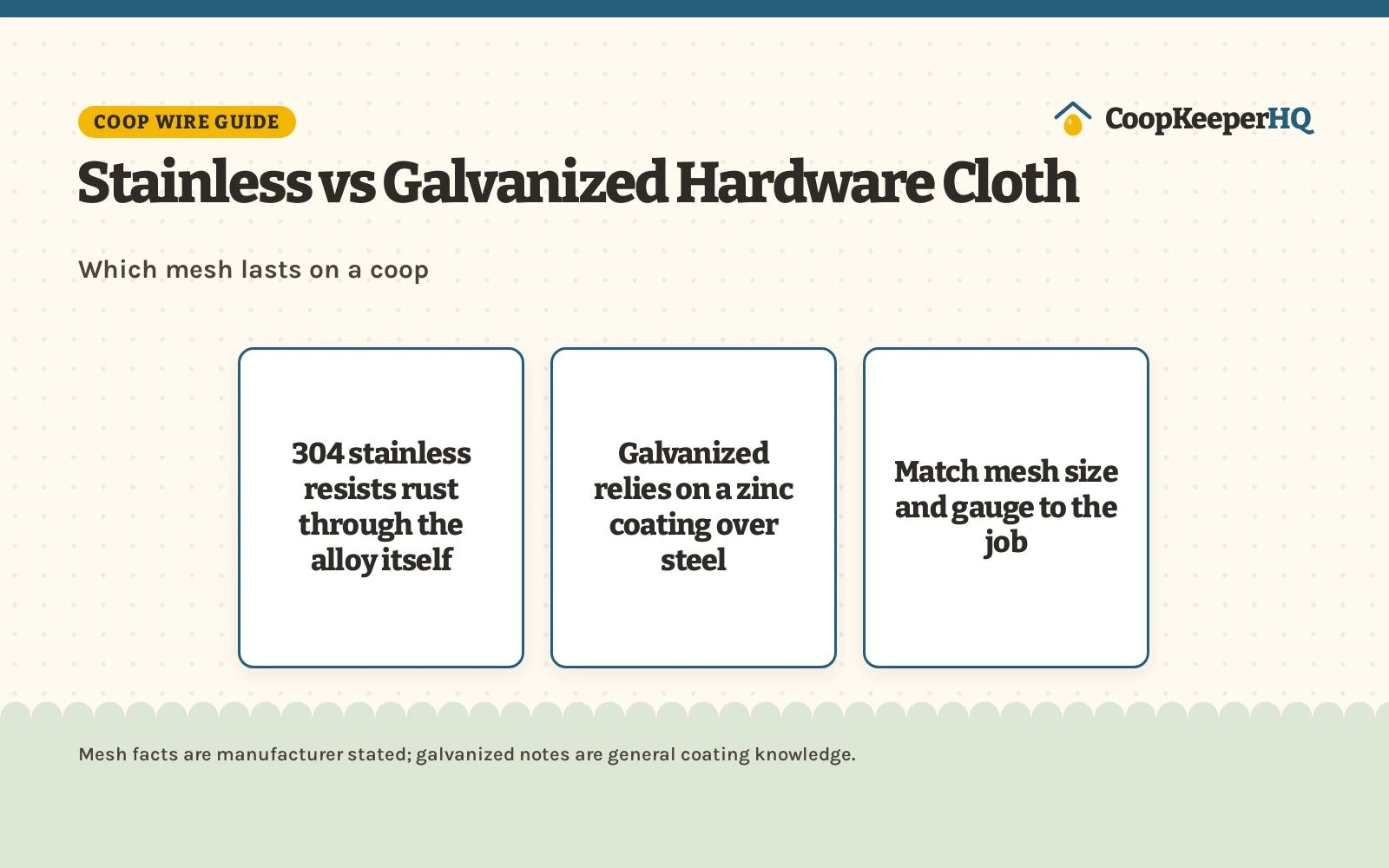
You are patching the run before the weather turns, mesh in one hand and tin snips in the other, and the listings keep talking about stainless vs galvanized hardware cloth like you are supposed to know which one lasts. Here is the short answer: stainless steel hardware cloth is the same alloy all the way through, so it resists rust through the metal itself; galvanized cloth is plain steel wire with a zinc coating, and its protection lasts only as long as that coating stays intact. For a coop that sits outside in rain and mud, stainless is the longer-lasting choice; galvanized suits dry, sheltered spots where its coating is not scratched or cut through.
Other options for the coop
 Stainless Steel 304 Welded Wire Mesh-15.7 inches x 10 feetCheck price on Amazon
 SS304 Stainless Steel 1/4 Hardware Cloth,Stainless Steel WireCheck price on Amazon
 304 Stainless Steel Hardware Cloth 1/2 Inch 20 Gauge ChickenCheck price on Amazon
 304 Stainless Steel Hardware Cloth 1/4 23 GA 24in x 49ft RollCheck price on Amazon
 304 Stainless Steel Hardware Cloth 1/2 20 GA 40in x 48ft RollCheck price on Amazon
- 304 Stainless Steel Hardware Cloth 1/2 20 GA 48in x 48ft RollCheck price on Amazon
CoopKeeperHQ earns a commission if you buy through our links, at no added cost to you. Affiliate disclosure.
Stainless vs galvanized hardware cloth: what actually differs
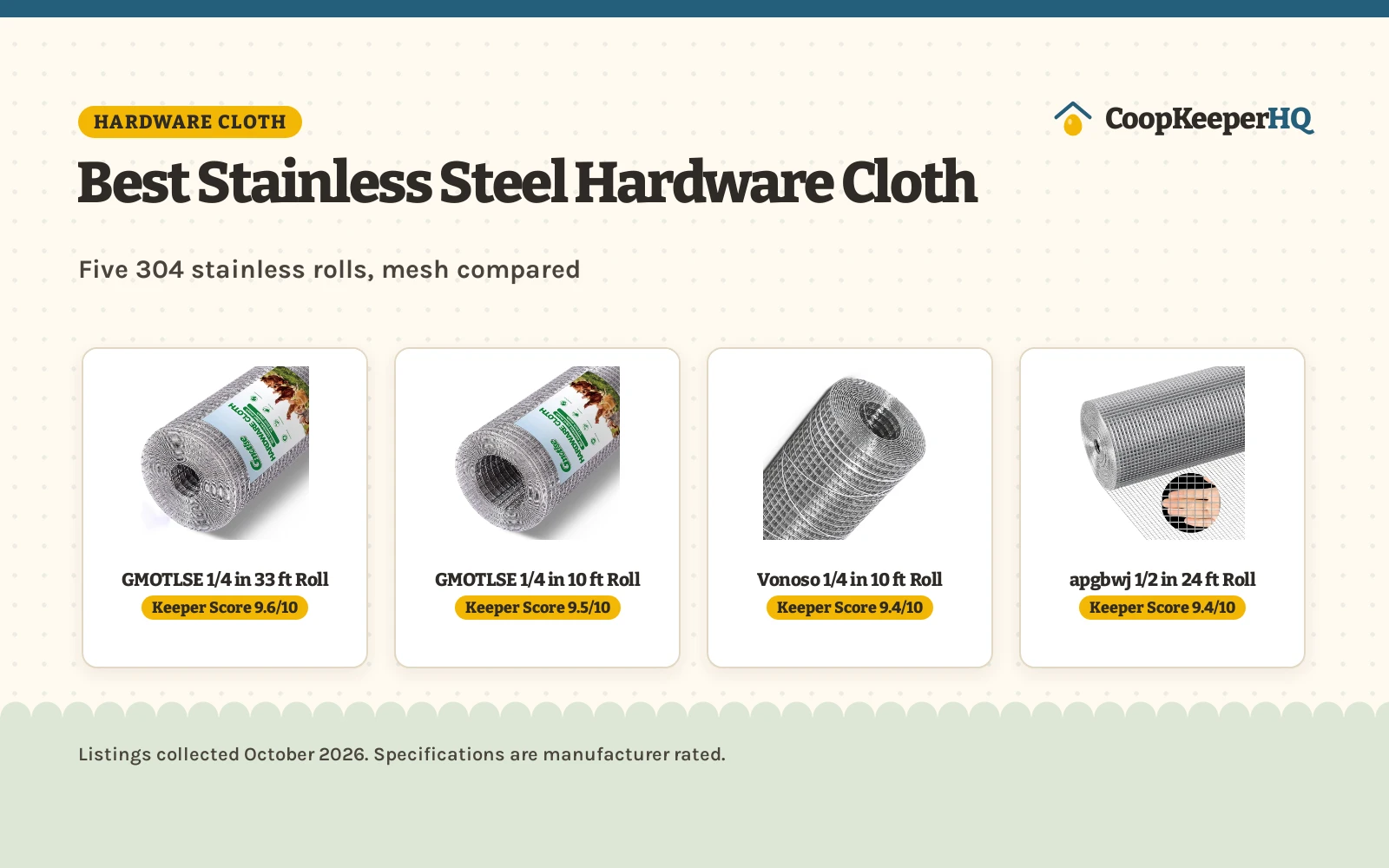
All three rolls in the gear section below are 304 stainless steel, and the listings lean on the same claims: the GMOTLSE states it stays rust resistant and reliable for years even with moisture and outdoor exposure, the apgbwj states excellent corrosion resistance, and the Vonoso states the mesh is rust free and lead free. Those are the maker’s claims, but they describe a real difference. Stainless is an alloy: chromium in the mix is what resists rust, and it is in the metal through and through, so a cut edge is the same material as the face of the wire.
Galvanized cloth works the other way around. The wire is steel, and a zinc coating is what stands between the steel and the weather. While the coating holds, galvanized cloth does its job; where the coating wears, gets scratched by a predator or a shovel, or is cut through when you trim a roll, plain steel sits underneath and rust can start there. That is why galvanized is a fair pick for vents and eaves under a roof, and a weaker pick for ground-level run panels that stay damp. If you want the background on the material itself, see what hardware cloth is.
How to read a hardware cloth listing
Mesh size comes first. A 1/2 in opening, like the apgbwj, covers run panels and coop windows; a 1/4 in opening, like the GMOTLSE and the Vonoso, suits vents, eaves gaps and small openings where you want finer coverage. The GMOTLSE lists uses from blocking gaps under eaves to lining fireplace surrounds and sealing gaps around pipes and vents; the apgbwj lists garden fencing, chicken coops, rabbit enclosures and tree guards. Match the opening to the job: fine mesh for small gaps, standard mesh for walls.
Gauge is the wire thickness, and it runs downward: the lower the number, the thicker the wire. The apgbwj states 19 gauge and the GMOTLSE states 23 gauge, so the apgbwj is the heavier wire of the two; the Vonoso states no gauge, which is a gap in its listing. Thicker wire resists bending and chewing better, so for a run panel that takes daily wear, gauge matters as much as mesh size.
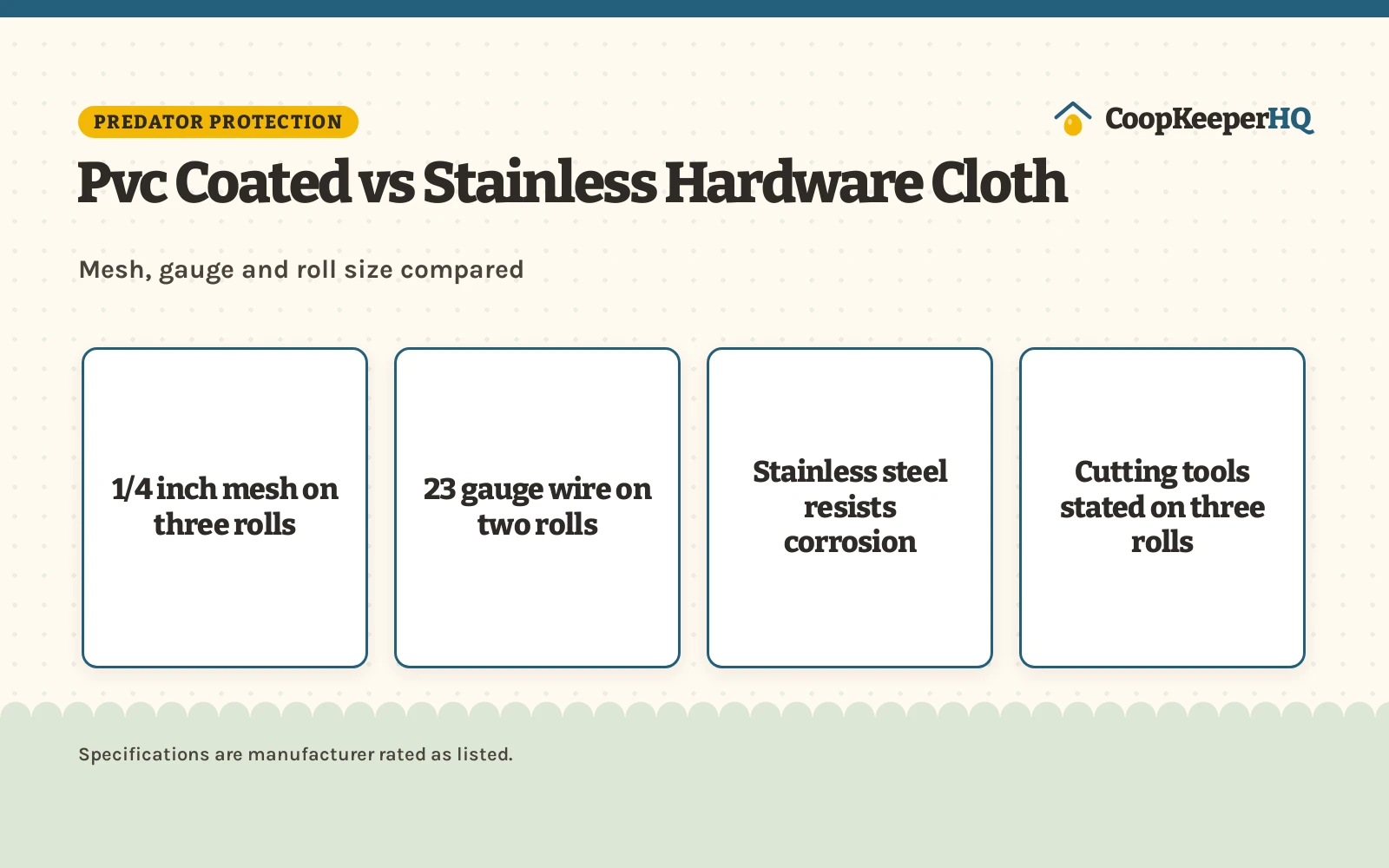
Roll dimensions tell you how far one roll goes: the GMOTLSE is 20 in by 33 ft, the apgbwj is 15.7 in by 24 ft, and the Vonoso is 15.7 in by 10 ft. A taller roll means fewer horizontal seams when you screen a long vent or wall; a narrow roll suits patching and vents. The listings give weights too: 5.89 pounds for the GMOTLSE, 4 pounds for the apgbwj and 1.5 pounds for the Vonoso. Our hardware cloth vs chicken wire comparison explains why welded mesh beats twisted wire for coop work.
The gear: three 304 stainless rolls, ranked
Every roll here is 304 stainless, so the ranking comes down to stated gauge, mesh size and roll dimensions. None of the listings states a warranty term or a safety certification, and none gives a number for the galvanized side of the comparison, so the scores rest on what is stated.
1. apgbwj 304 stainless, 1/2 in mesh, 19 gauge
The apgbwj brings the heaviest stated wire of the three: 19 gauge at 1/2 in mesh, in a 15.7 in by 24 ft roll weighing 4 pounds. The listing states chicken coops among its uses, along with garden fencing, rabbit enclosures and tree guards, and it claims corrosion resistance with a note to clean and maintain the mesh in coastal or high salt environments. That coastal note is worth reading as honesty: even stainless appreciates a rinse where salt air sits. For run panels and coop windows, this is the strongest stated pick.
2. GMOTLSE 304 stainless, 1/4 in mesh, 23 gauge
The GMOTLSE trades wire thickness for coverage: 23 gauge wire at 1/4 in mesh, but a 20 in by 33 ft roll, the longest here, at 5.89 pounds. The listing states rust resistance for years under moisture and outdoor exposure, and says the mesh cuts with household scissors or standard tin snips, which matters when you are fitting odd angles around vents and eaves. It also carries a plain safety reminder: the edges are cut flat but can be sharp, so wear gloves when unpacking, cutting and setting up. Best of the three for fine-mesh work and long runs of vent screening.
3. Vonoso 304 stainless, 1/4 in mesh
The Vonoso is the smallest roll: 15.7 in by 10 ft at 1.5 pounds, 1/4 in mesh in 304 stainless. The listing claims the mesh is rust free and lead free, and says it can be used for food, cage making, garden protection and DIY crafts. Those are the maker’s claims, not ours, and the listing states no gauge, which keeps it third: you are buying on mesh size and the 304 label alone. Fine for small patches, pot drainage and craft cages; buy a bigger roll for a whole run.
Which one for a chicken coop
For the run walls, pick the heaviest gauge with the mesh your flock needs. The apgbwj at 19 gauge and 1/2 in mesh is the natural fit for panels and windows, and it is the only one of the three whose listing names chicken coops directly. For vents, eaves and gaps, the GMOTLSE at 1/4 in mesh covers finer openings and its 33 ft roll goes a long way along a wall. Keep the Vonoso for patches and small jobs.
Cutting and fitting are part of the work. The GMOTLSE states household scissors or standard tin snips handle its 23 gauge wire; heavier wire wants real cutters, and our chicken wire cutters guide compares them. Wear gloves, as the GMOTLSE listing reminds: freshly cut mesh edges are sharp. Plan the roll so seams land on framing, and fold or cap cut edges where birds brush past them. For the whole picture on securing a coop, see how to predator proof a chicken coop and run.
Use a charger rated for the length of netting you run, ground it as the manual describes and post warning signs where neighbors or children can reach the fence. Keep grass and weeds off the bottom strands, and never leave netting unpowered, because birds and wildlife can tangle in it. Read our Safety Disclaimer.
FAQ for the flock
Is stainless steel hardware cloth better than galvanized?
For outdoor coop work it lasts longer. Stainless resists rust through the metal itself, while galvanized relies on a zinc coating that can wear or be cut through. Galvanized still works for dry, sheltered spots where the coating stays intact.
What mesh size should I use for a chicken coop?
The listings here offer 1/2 in and 1/4 in. A 1/2 in opening suits run panels and coop windows, and the apgbwj listing names chicken coops as a use. A 1/4 in opening suits vents, eaves gaps and small openings that need finer coverage.
What does 19 gauge vs 23 gauge mean?
Gauge runs downward: the lower the number, the thicker the wire. The apgbwj states 19 gauge and the GMOTLSE states 23 gauge, so the apgbwj is the heavier wire. Thicker wire resists bending and chewing better on run panels.
Does hardware cloth rust?
Stainless listings claim rust resistance for years, and the Vonoso claims its mesh is rust free. Galvanized cloth can rust where its zinc coating wears through or is scratched. No listing here gives a rust timeline, so treat the claims as the maker’s word.
Can I cut hardware cloth with household scissors?
The GMOTLSE listing states its 23 gauge mesh cuts with household scissors or standard tin snips. Heavier gauges want proper cutters, and gloves are a must either way because cut edges are sharp.
Is stainless hardware cloth safe for garden use?
The Vonoso listing claims its mesh is lead free and can be used for food, garden protection and small animal cages. That is the maker’s claim; the other two listings make no food safety claim.
More coop guides
- What Is Hardware Cloth? Wire Mesh Guide for Chicken Coops
- Hardware Cloth vs Chicken Wire: Which Keeps Predators Out?
- Best Hardware Cloth for Coop Ventilation (2026): 5 Compared
- Hardware Cloth vs Welded Wire: Which One Should You Buy?
- Electric Netting vs Hardware Cloth: Which One Should You Buy?
- Cheap Hardware Cloth Alternative: Which One Should You Buy?
See the predator protection guides and the chicken run and fencing picks.