Best Solar Fence Charger: 5 Energizers for Pastures and Runs
Five solar electric fence chargers compared by range, pulse output voltage, energy rating, battery backup run time and weather resistance.

On this page
Top picks at a glance
As an Amazon Associate I earn from qualifying purchases.
- 1
 Best OverallEpoify LD02 45-Mile 1.2J Solar Charger9.5/10View on Amazon
- 2
 Best with AlarmGorhope 20-Mile 0.32J Solar Charger9.5/10View on Amazon
- 3
 Best Weather Resistancehovikoki 10-Mile 0.18J Solar Energizer9.4/10View on Amazon
- 4
 Best for Strip GrazingEpoify LD01 10-Mile 0.18J Solar Charger9.4/10View on Amazon
- 5
 Best Metal HousingZareba ESP5M-Z 5-Mile Solar Energizer9.3/10View on Amazon
The best solar fence charger delivers reliable high-voltage pulses around pastures and poultry runs without requiring access to an electrical outlet. Combining an energizer, rechargeable battery and solar panel into one portable unit keeps electric netting hot through cloudy weather. We compared five solar electric fence energizers by mileage range, output joules, pulse voltage, battery reserve time and weather protection.
CoopKeeperHQ earns a commission if you buy through our links, at no added cost to you. Affiliate disclosure.
Quick picks
- Best Overall Epoify LD02 45-Mile 1.2J Solar Charger: 1.2 J stored energy and 45-mile coverage with an 8 W solar panel Check price on Amazon
- Best with Alarm Gorhope 20-Mile 0.32J Solar Charger: 0.32 J output, 20-mile range, buzzer alarm and lithium-ion battery Check price on Amazon
- Best Weather Resistance hovikoki 10-Mile 0.18J Solar Energizer: IPX4 housing, tempered glass panel and 12 V 5 Ah sealed GEL battery Check price on Amazon
- Best for Strip Grazing Epoify LD01 10-Mile 0.18J Solar Charger: 0.18 J pulse, 10-mile reach and includes both AC and solar charging Check price on Amazon
- Best Metal Housing Zareba ESP5M-Z 5-Mile Solar Energizer: Steel and aluminum enclosure with a 360-degree rotating post bracket Check price on Amazon
Picks for the flock
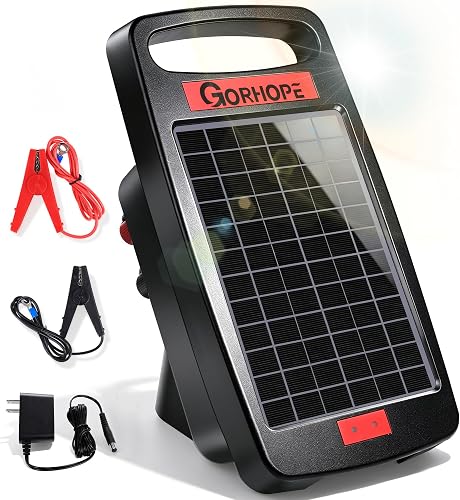
Gorhope 20 Miles Solar Electric Fence Charger
A 0.32 J solar energizer rated for up to 20 miles with a built-in short-circuit buzzer alarm, tempered glass panel and lithium-ion battery.
Who it's for: keepers managing pastures or perimeter runs up to 20 miles who want audible fault alarms and solar charging convenience.
Who should skip it: anyone wanting an included AC plug adapter for pre-charging before mounting.
Gorhope lists a rectangular solar energizer rated for up to 20 miles of fencing with 0.32 joules of output energy and a built-in lithium-ion battery. The maker states it runs for up to 14 days without sunlight once charged, and charges via its tempered glass solar surface or USB Type A port. A built-in buzzer provides immediate alerts for short circuits and ground connection errors. There is a listing contradiction: the bullet text states pulse output ranges from 5700 to 10200 volts, while the spec table lists 10020 volts. It weighs 1.44 kg with an intelligent battery management system.
Pros
- Delivers 0.32 J output energy for fences up to 20 miles
- Built-in buzzer alerts to short circuits and ground errors
- Operates up to 14 days without sunlight on internal lithium-ion battery
- Intelligent battery management system for maintenance-free operation
Cons
- EU spare parts availability listed at only 14 days
- Weighs 1.44 kg, heavier than small portable units
- No AC wall charger included in listed components
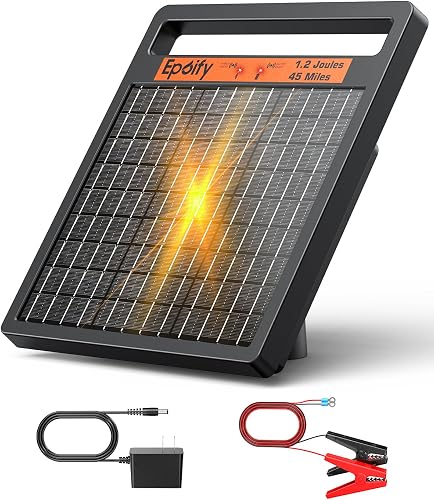
Epoify LD02 Solar Electric Fence Charger, 1.2 J
A high-power 1.2 J stored energy energizer with an 8 W solar panel, 10000 mAh battery, short-circuit alarm and coverage rated up to 45 miles.
Who it's for: keepers with large pastures, multi-strand perimeter fencing, or heavy weed contact needing 1.2 J of pulse energy.
Who should skip it: small backyard coop owners who only need a low-joule charger for a short run.
Epoify's LD02 delivers 1.2 joules of stored energy with a 7 to 11 kV pulse output, designed to energize up to 45 miles of fencing. The unit integrates an 8 W solar panel, a 10000 mAh internal battery with solar and AC backup capability, and a sealed magnetic switch. Dimensions are 6.6 x 4.3 x 8.2 inches and it weighs 5.5 pounds in an ABS housing. The listing includes red and black connection cables and a user manual. No warranty term or days of cloudy-day reserve is stated in the listing.
Pros
- High 1.2 J stored energy rating for long fence lines
- Rated for up to 45 miles of fence coverage
- Large 8 W solar panel with 10000 mAh battery capacity
- Includes short-circuit alarm and sealed magnetic switch
Cons
- No warranty term is stated
- Heaviest charger here at 5.5 pounds
- Output of 1.2 J is higher than needed for small coops
- Listing does not state days of operation without sunlight

hovikoki 10 Mile Solar Fence Charger, 0.18 J
A compact 0.18 J energizer with a 5 W monocrystalline solar panel, 12 V 5 Ah sealed GEL battery rated for up to 25 days without sun, and IPX4 housing.
Who it's for: keepers wanting long reserve battery life for cloudy climates and rotational T-post setups.
Who should skip it: buyers who want consistent listing specifications and a stated manufacturer warranty.
hovikoki offers an all-in-one solar fence charger pairing a 5 W monocrystalline solar panel with a 12 V 5 Ah sealed GEL battery. The listing states it delivers 0.18 joules of pulse energy for fences up to 10 miles, charges in about 6 days of sunlight, and operates for up to 25 days without sun. The housing is ABS with tempered glass and an IPX4 waterproof rating, measuring 8.66 x 11.02 x 6.69 inches. The listing contains two clear contradictions: the bullets state a weight of 5.94 lb while the spec table claims 1.5 pounds, and the bullets claim pulses up to 9300 V while the spec table lists 8100 volts. The battery ships disconnected for transit safety, and no warranty term is stated.
Pros
- Runs up to 25 days without sunlight on a full charge
- Stated IPX4 waterproof rating with tempered glass solar panel
- Includes 12 V 5 Ah sealed GEL battery and AC charger
- Mounts on a standard T-post without tools
Cons
- No warranty term is stated
- Takes about 6 days of sunlight to reach full battery charge

Epoify LD01 24-Hour Solar Electric Fence Charger
A 0.18 J all-in-one energizer for up to 10 miles of pasture fencing, offering 5700 to 10200 V pulses and dual solar or AC adapter charging.
Who it's for: keepers needing an affordable, portable charger for garden protection or small poultry fences with AC pre-charging convenience.
Who should skip it: those in prolonged overcast areas who need a stated multi-week cloudy reserve.
Epoify's LD01 is an all-in-one ABS energizer delivering 0.18 joules of pulse energy for fences up to 10 miles, with output pulses rated from 5700 to 10200 volts. It measures 6.6 x 4.3 x 8.2 inches and weighs 1.44 kg. The maker specifies an initial battery charge of 24 hours via the included AC adapter or 3 full days of direct sunlight before first operation. It provides specific grounding guidelines, recommending three ground rods linked with 20 kV insulated wire at 10-foot and 20-foot spacings, located at least 50 feet from utility grounds. The listing states it is waterproof but does not specify an IP code, battery capacity, or warranty term.
Pros
- Delivers 0.18 J pulse output for pastures up to 10 miles
- Includes AC wall adapter for 24-hour pre-charging
- Pulse voltage ranges from 5700 to 10200 V
- Compact 6.6 x 4.3 x 8.2 in dimensions weighing 1.44 kg
Cons
- No warranty term is stated
- Requires 3 full days of direct sunlight for initial solar charge
- Listing does not state internal battery amp-hour capacity
- Listing does not state continuous days of cloudy weather reserve

Zareba ESP5M-Z Solar Electric Fence Charger
A low-impedance 0.15 J steel and aluminum energizer for up to 5 miles, featuring a 360-degree rotating post bracket and 2-week cloudy operation.
Who it's for: keepers needing a rugged metal-housed charger for small paddocks or perimeter runs up to 5 miles where post mounting is required.
Who should skip it: anyone requiring higher joule output for predator defense or long multi-acre fences.
Zareba's ESP5M-Z energizes up to 5 miles of electric fencing with 0.15 output joules at a 5-watt rating, designed to resist power loss from vegetation along the fence line. It features a steel and aluminum enclosure with an integrated mounting bracket that rotates 360 degrees on T-posts, Y-posts, or round wood posts for sun alignment. The maker states it operates continuously for up to 2 weeks without sunlight and includes lightning damage protection. There is an evident listing discrepancy: the spec table lists output voltage as 8.98 volts, which is an error for an electric fence energizer where thousands of volts are required for pulse delivery. The listing notes it is non-returnable and instructs buyers to contact the manufacturer directly for warranty issues, stating no concrete warranty term.
Pros
- Steel and aluminum enclosure resists harsh outdoor weathering
- Built-in bracket rotates 360 degrees for post mounting
- Operates continuously for up to 2 weeks without sunlight
- Built-in protection against lightning damage
Cons
- No warranty term is stated
- Lowest output here at 0.15 J and 5 miles of range
- Spec table lists output voltage as only 8.98 volts
- Listing notes item is non-returnable
Other options for the coop
 12KV Electric Fence Charger with LED IndicatorCheck price on Amazon
 Solar Fence ChargerCheck price on Amazon
 MINI160 2 Miles Solar Fence ChargerCheck price on Amazon
 Andmon MINI250 Solar Electric Fence Charger with Day or NightCheck price on Amazon
 Solar Electric Fence ChargerCheck price on Amazon
Specs at a glance
| Model | Keeper Score | Range | Joules | Pulse voltage | No-sun run time | Housing | Warranty |
|---|---|---|---|---|---|---|---|
| Epoify LD02 45-Mile 1.2J | 9.5/10 | 45 miles | 1.2 J | 7-11 kV | Not stated | ABS | Not stated |
| Gorhope 20-Mile 0.32J | 9.5/10 | 20 miles | 0.32 J | 5700-10200 V | Up to 14 days | ABS | 1 year |
| hovikoki 10-Mile 0.18J | 9.4/10 | 10 miles | 0.18 J | Up to 9300 V | Up to 25 days | ABS, tempered glass | Not stated |
| Epoify LD01 10-Mile 0.18J | 9.4/10 | 10 miles | 0.18 J | 5700-10200 V | Not stated | ABS | Not stated |
| Zareba ESP5M-Z 5-Mile | 9.3/10 | 5 miles | 0.15 J | 8.98 V listed | Up to 2 weeks | Steel, aluminum | Not stated |
Specs reflect what the manufacturer lists, not measurements in a backyard flock (gathered 9 October 2026). Pulse delivery and battery reserves depend on direct sunlight, fence line vegetation load, and ground rod contact.
Flock fit
Epoify LD02 45-Mile 1.2J Solar Charger
Gorhope 20-Mile 0.32J Solar Charger
hovikoki 10-Mile 0.18J Solar Energizer
Epoify LD01 10-Mile 0.18J Solar Charger
Zareba ESP5M-Z 5-Mile Solar Energizer
Buying guide: choosing the best solar fence charger
Output energy and fence mileage
An electric fence energizer is rated in joules of energy and miles of fence line. Energy measured in joules determines the shock strength felt when an animal touches the wire, especially when tall grass or weeds touch the bottom strand. For small poultry perimeters and garden setups, 0.15 J to 0.18 J units such as the Zareba ESP5M-Z, Epoify LD01, or hovikoki provide sufficient deterrent pulses across 5 to 10 miles. For extensive pastures, perimeter boundaries, or multi-strand setups facing persistent wildlife pressure, higher-output models like the 0.32 J Gorhope or the 1.2 J Epoify LD02 deliver stronger pulses across 20 to 45 miles.
Battery storage and reserve run time
Solar fence chargers pair a photovoltaic solar panel with an internal rechargeable battery to keep the fence active overnight and through prolonged storms. Solar charging performance varies significantly between models:
| Charger | Output energy | Solar panel | No-sun run time |
|---|---|---|---|
| Epoify LD02 | 1.2 J | 8 W | Not stated |
| Gorhope 20-Mile | 0.32 J | Tempered glass | Up to 14 days |
| hovikoki 10-Mile | 0.18 J | 5 W | Up to 25 days |
| Epoify LD01 | 0.18 J | Built-in panel | Not stated |
| Zareba ESP5M-Z | 0.15 J | 5 W | Up to 2 weeks |
Models offering 14 to 25 days of reserve operation prevent fence dropouts during cloudy weeks. Units featuring dual charging inputs, such as the Epoify LD01 with its included AC adapter or the Gorhope with its USB port, allow you to charge the internal battery fully before setting the energizer out on the fence line.
Ground rod installation and connections
An electric fence cannot function without an adequate ground system. When an animal touches the energized wire, electrical current passes through its body into the earth and back to the energizer ground terminal. Inadequate grounding is the leading cause of low fence voltage. The Epoify LD01 listing details a standard grounding guideline: link three ground rods using 20 kV insulated wire, placing rod 1 within 20 ft of the energizer, rod 2 spaced 10 ft away, and rod 3 spaced another 10 ft away. Secure each connection with a dedicated clamp, and maintain at least 50 ft of separation from house, barn, or utility ground rods.
Predator deterrence and livestock containment
Electric fencing creates a psychological barrier that deters predators such as foxes, raccoons, and stray dogs while keeping chickens, goats, and cattle securely inside. Deterring thick-furred predators requires high pulse voltage to penetrate heavy coats. Output ratings between 5700 V and 10200 V on the Epoify LD01 and Gorhope, or up to 11 kV on the Epoify LD02, ensure that contact delivers an unmistakable deterrent pulse. For poultry, pair your energizer with an electric netting fence, as detailed in our poultry netting and charger guide.
Mounting and sun exposure
To keep the internal battery charged year-round, mount your solar energizer where trees or buildings will not cast shadows on the panel. The Zareba ESP5M-Z includes an integrated mounting bracket that rotates 360 degrees to face south on T-posts, Y-posts, or round wood posts. The hovikoki also mounts directly onto a standard T-post without requiring tools. Wipe the solar panel face periodically to remove dust, bird droppings, and snow.
Birds, breed size, run time and climate in; coop floor, run space, roost length and nesting boxes out.
Use a charger rated for the length of netting you run, ground it as the manual describes and post warning signs where neighbors or children can reach the fence. Keep grass and weeds off the bottom strands, and never leave netting unpowered, because birds and wildlife can tangle in it. Read our Safety Disclaimer.
FAQ for the flock
What is the best solar fence charger?
The Epoify LD02 45-Mile 1.2J Solar Charger scores highest in our comparison because it delivers 1.2 joules of stored energy across up to 45 miles of fencing, backed by an 8 W solar panel, a 10000 mAh battery, and a built-in short-circuit alarm.
How long do solar fence chargers last?
Solar fence energizers operate continuously on battery reserves for 14 to 25 days without sunlight depending on battery capacity. The hovikoki lists up to 25 days of operation on its 12 V 5 Ah sealed GEL battery, the Gorhope lists up to 14 days on its lithium-ion pack, and the Zareba states up to 2 weeks.
What size solar fence charger do I need?
For small backyard poultry runs, portable netting, or garden borders up to 10 miles, an energizer delivering 0.15 J to 0.18 J provides adequate voltage. For multi-acre pastures or perimeter fencing up to 45 miles, choose a 0.32 J to 1.2 J model like the Gorhope or Epoify LD02.
What is the best solar electric fence charger for predators?
The Epoify LD02 and Gorhope are well suited for predator deterrence because they deliver high pulse outputs up to 10200 V and 11 kV, backed by 0.32 J to 1.2 J of stored energy to deter foxes, raccoons, and large predators.
How to set up a solar fence charger?
Mount the charger on a post facing south for full sun exposure, connect the positive terminal to your fence line using insulated wire, and connect the ground terminal to metal ground rods placed at least 50 ft away from utility grounds. Pre-charge the internal battery before turning the unit on.
How the Coop Score came out
The Keeper Score evaluates performance (stated fence mileage, output energy in joules, peak voltage, and reserve days without sunlight), build quality, value, safety alerting features, and manufacturer warranty terms. Products with stated short-circuit alerts, ground connection error detection, or defined weather seals score points in safety. Warranty scoring strictly requires a stated concrete term in the listing, which only the Gorhope provides, with a stated one-year warranty covering manufacturer faults.
| Product | Keeper Score | Perf. /35 | Build /25 | Value /25 | Safety /10 | Warranty /5 |
|---|---|---|---|---|---|---|
| Gorhope 20-Mile 0.32J Solar Charger | 9.5 | 27 | 19 | 19 | 7 | 2 |
| Epoify LD02 45-Mile 1.2J Solar Charger | 9.5 | 33 | 18 | 18 | 6 | 0 |
| hovikoki 10-Mile 0.18J Solar Energizer | 9.4 | 24 | 20 | 19 | 5 | 0 |
| Epoify LD01 10-Mile 0.18J Solar Charger | 9.4 | 23 | 16 | 20 | 5 | 0 |
| Zareba ESP5M-Z 5-Mile Solar Energizer | 9.3 | 20 | 20 | 16 | 5 | 0 |
We convert points onto the range from 9.2 up to 9.8 without reshuffling anything: more points, higher number.
More coop guides
- Best Welded Wire Fence Under 100 (2026): 5 Rolls for the Run
- Battery vs Ac Electric Fence Charger: Which One Should You Buy?
- Best Battery Staple Gun Under $80 (2026): 5 Picks Compared
- What Is a Fence Stretcher? Tool Guide
- Types of Post Hole Diggers for Fencing
- How Much Are Wooden Fence Posts: Cost Per Post Compared
- How to Tie T Post Clips for a Sturdy Chicken Run
- Cost of Steel Fence Posts: Prices Per Post Compared
- T Post Fence Calculator: How Many Posts Your Fence Needs
- Concrete Fence Post Types: Sizes and Uses
- How to Secure Fence Post Without Concrete
- Landscape Staples vs Fence Staples: Which One Should You Buy?
- How Much Is Wire Mesh: What a Roll Costs for a Chicken Run
- How to Use a Post Hole Auger for Fence Posts
- How Much Does a Chain Link Fence Gate Cost: Price Guide
- How Much Is Chain Link Fence by the Foot
- Fence Stretcher vs Come Along: Which One Should You Buy?
- How to Lock Chain Link Fence Gate (2026 Guide)
- Chain Link Fence Post Cost (2026): Posts, Bands, Brackets and Caps
- Post Hole Auger vs Post Hole Digger: Which One Should You Buy?
- Best Battery Staple Gun (2026): 5 Picks for the Run
- Cable Ties vs Chicken Wire Ties: Which One Should You Buy?
- How to Use Staple Gun on Poultry Netting
- Copper vs Galvanized Ground Rod: Which One Should You Buy?
- How to Set Corner Post for Fence
- How to Keep a Chicken Run Clean
- Chicken Run Size for 20 Chickens: Space Guide
- Chicken Coop Fencing Ideas: Netting and Panels
- How to Use T Post Clip Tool
- How to Hang a Gate With Hinges
- Does Cattle Panel Rust? What the Zinc Coating Does for a Chicken Run
- Staple Gun Manual: Fasten Wire and Fabric by Hand
- What Size Auger for Fence Posts: Choosing the Right Bit
- Cheap Chicken Pen Ideas and Affordable Fencing
- Chicken Run Ideas: Layouts, Netting and Fencing
- Cattle Panel Fence Ideas for Chicken Runs
- Post Hole Digger vs Post Driver: Which One Should You Buy?
- Chicken Wire Fence Cost: What to Expect
- How Long Do Fence Posts Need to Set in Concrete
- Types of Wood Fence Posts Compared
- Gate Sizes for Fences: Standard Dimensions
- How Many T Post Clips Per Post
- Gate Hinge Types Compared
- Should Fence Posts Be Set in Concrete? What to Use Instead
- Chain Link Fence Gate Latch Types Compared
- How Tall Should a Chicken Run Be? A Practical Guide for Backyard Flocks
- Chicken Run Set Up: A Step-by-Step Guide
- Chicken Wire Uses for Coops and Runs
- What Gauge Is Cattle Panel: What Thickness to Choose
- Chain Link Fence Gauge Chart: What the Numbers Mean for a Chicken Run
- Best Way to Cut Chain Link Fence Safely
- Standard T Post Dimensions Chart
- Standard Fence Post Size Chart
- How to Use Chain Link Fence Ties
- What Size T Post for 5 Ft Fence
- Cost of Hog Panels: What to Expect Per Panel
- How to Cut Wire Mesh for Chicken Coops and Runs
- How Long Are Cattle Panels: Lengths and Sizes Chart
- How to Cut Cattle Panel for Chicken Runs
- Best Corner Post Insulators Under $40 (2026)
- Best Screw-in Electric Fence Insulator Under $30 (2026)
- Best Cable Ties for Chicken Run Under $20 (2026): 5 Picks Compared
- Best Fence Brace Kit (2026)
- Best Post Hole Digger for Hard Ground (2026)
- Best Post Driver for Rocky Ground (2026)
- How Many Fence Post Do I Need for the Run
- What Size T Post for 4 Foot Fence
- Wire Mesh Gauge Chart for Coops and Runs
- How Long Does Chain Link Fence Last
- Chain Link Fence Size Chart for Runs and Yards
- Types of Chicken Wire: Which One to Buy
- How to Use a T-Post Puller
- How to Use a Post Driver for Fence Posts
- Types of Staple Guns: Which One Fits Wire Fencing
- Fence Panels Types for Runs and Enclosures
- Types of Wire Mesh for Coops and Runs
- Chain Link Fence Gates Sizes: Dimensions Chart
- Types of Fence Posts: Materials Compared
- Types of Fence Gates for Chicken Runs
- Welded Wire Mesh Sizes: Gauge and Opening Chart
- How to Use Fencing Pliers
- Manual T Post Puller: How to Choose One for Your Run Fence
- Staple Gun Staple Size: Leg Length and Crown Width for the Run
- How Deep Post for Fence: Setting Run Posts That Stay Straight
- Types of Wire Fence for Chicken Runs
- Chain Link Fence Post Size: Terminal, Line and Rail Sizes
- Gate Latch Types: How to Choose the Right One
- Manual Fence Post Driver: How to Choose the Right One
- Manual T Post Driver: How to Choose and Use One
- Best Cable Ties for Chicken Run (2026)
- 36 vs 48 Inch Chicken Wire: Which One Should You Buy?
- Best Metal Gate Wheels for Metal Tube Gate (2026): 5 Picks Compared
- Best Ground Anchors Heavy Duty for High Winds (2026): 5 Picks for Coops and Runs
- Best Chain Link Fence Locks for Outdoor Gates (2026)
- Best Gas Post Hole Digger with Stand (2026)
- Best Corner Post Insulators (2026)
- Best Chicken Wire 4 Ft X 150 Ft (2026)
- Best Chicken Wire 3 Ft by 150 Ft (2026)
- Best Electric Post Hole Digger for Rocky Soil (2026): 5 Picks for Fence Posts
- Best Fox Proof Walk in Chicken Run (2026)
- Best Fence to Keep Chickens Out of Garden (2026): 5 Picks for Beds and Borders
- Best Screw-in Electric Fence Insulator (2026): 4 Ring Picks for Wood Posts
- Best Welded Wire Fence 5 Ft X 100 Ft (2026): 5 Rolls for Runs
- Best Field Fence Gate Hardware (2026)
- Best Steel T Post Driver (2026): 5 Picks for Fence Lines
- Best Field Fence Post Caps (2026): 5 Picks for Wood, Vinyl and Chain Link
- Best Chicken Wire Wood Fence (2026)
- Best Landscape Staples for Chicken Wire Under $20 (2026)
- 4×4 vs 6×6 Chicken Run: Which One Should You Buy?
- 4×6 vs 8×8 Chicken Run: Which One Should You Buy?
- Staples vs Nails for Chicken Wire: Which One Should You Buy?
- Best T Fence Posts for Poultry Netting (2026): 4 Compared
- Best Field Fence Stretcher Bar (2026)
- Best Heavy Duty Field Fence (2026): 4 Rolls Compared
- Best Metal Fence for Animal Farm (2026): 5 Picks Compared
- 8×8 vs 8×12 Chicken Run: Which One Should You Buy?
- Shade Cloth vs Bird Netting for Chicken Run: Which One Should You Buy?
- Best Woven Wire Fence (2026): 4 Rolls Compared
- Best Ground Post Anchors (2026)
- Best Step in Electric Fence Posts Under $120 (2026)
- Best Solar Fence Charger for Cloudy Weather (2026): 5 Picks Compared
- Field Fence vs Poultry Netting: Which One Should You Buy?
- Poultry Netting vs Portable Fence: Which One Should You Buy?
- 4×8 vs 4×12 Chicken Run: Which One Should You Buy?
- 6×8 vs 6×12 Chicken Run: Which One Should You Buy?
- Polywire vs Electric Fence Wire: Which One Should You Buy?
- Best Chicken Run for Cold Climates (2026)
- Best Chicken Run Cover for Owls (2026)
- Best Landscape Staples for Chicken Wire (2026)
- Best Chicken Run Under $100 (2026): 4 Runs Compared
- Best Electric Fence Charger for Hobby Farm (2026)
- Polywire vs Polyrope Electric Fence: Which One Should You Buy?
- Low vs High Impedance Electric Fence Charger: Which One Should You Buy?
- Best Hog Rings for Poultry Netting (2026): 5 Packs Compared
- Spiral vs Straight Ground Anchors: Which One Should You Buy?
- Best Vinyl Coated Chicken Wire Under $50 (2026)
- 4×4 vs 4×8 Chicken Run: Which One Should You Buy?
- Galvanized vs Stainless Fence Staples: Which One Should You Buy?
- Best Chicken Run Odor Eliminator Under $25 (2026)
- Best Staples for Hardware Cloth (2026): 5 Picks for the Run
- Best Poultry Netting and Charger: Electric Fence Kits Compared
- Best Hardware Cloth for Chicken Coop Runs and Aprons
- Best Automatic Chicken Coop Door: Picks for Every Season
- Best Chicken Tractor: Mobile Coops Compared by Real Space
- How to Keep Chickens Warm in Winter Without Overheating the Coop
Explore our complete chicken runs and fencing section, read our poultry netting and charger guide, check our hardware cloth guide for coop aprons, or inspect our predator protection resources to secure your flock.